




Prepared by the Editorial Board of Dimasheq
Any post-war system must preserve the regime of transit passage, allow ships to safely resume using the original route established by the International Maritime Organization (IMO), and reject any attempts to impose mandatory fees, grant Iran veto power, or establish other arrangements aimed at entrenching its permanent control over one of the world’s most vital energy corridors.
Since the outbreak of the war with Iran, the Strait of Hormuz has become Tehran’s most important strategic bargaining chip. By creating uncertainty over the presence of mines in the traditional central route of the strait, attacking or threatening vessels using the U.S.-protected route through Omani waters, and forcing commercial shipping to pass through its territorial waters, Iranian authorities have effectively imposed a new maritime regime.
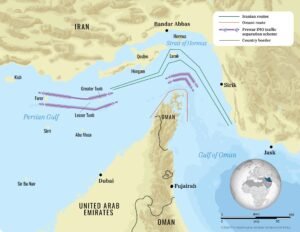
The internationally recognized Traffic Separation Scheme (TSS), adopted in 1968 under the auspices of the IMO, has become practically unnavigable for many operators. Iran has also intimidated mariners into complying with instructions from the Islamic Revolutionary Guard Corps (IRGC) and has demonstrated its willingness to strike vessels that refuse to comply with its conditions, as documented by the Washington Institute’s Maritime Attacks Tracker.
Tehran now seeks to turn this wartime reality into a permanent gain. Rather than merely participating in arrangements initiated by others, Iran wants to assume a dominant, or at least leading, role in any future administration of the strait. This ambition was reflected in its recent rejection of the Omani proposal for regional management, which, according to reports, was supported by other Gulf states.
The proposal appears to have been broadly inspired by the cooperation mechanism established in the Strait of Malacca, which focuses on navigational safety, environmental protection, and voluntary contributions in exchange for navigational assistance services, in line with Article 43 of the United Nations Convention on the Law of the Sea (UNCLOS).
Iran, by contrast, insists that management of the Strait of Hormuz should be limited to the two littoral states, Iran and Oman, while Tehran retains the final say over which vessels are allowed to enter and leave the Persian Gulf.
Recent maritime shipping data underscore Iran’s intentions. Following the collapse of the memorandum of understanding with the United States and the resumption of violence in early July, tanker traffic through the Omani route declined sharply. The total number of transits had risen to nearly 45 vessels per day on average following the June memorandum, but fell sharply to around 13 vessels per day after its collapse.
Likewise, data from Lloyd’s List Intelligence show a significant decline in overall commercial transits after July 7, when Iran attacked three loaded tankers—two carrying crude oil and one carrying liquefied natural gas—while they were using the Omani route.
As of this writing, it appears that more vessels are using the Iranian routes south of Larak Island than the Omani route, while the number of “dark” transits—meaning vessels not transmitting Automatic Identification System (AIS) data—has continued to rise. At various times, Iran has also directed vessels through a more northerly route between Larak and Qeshm Islands.
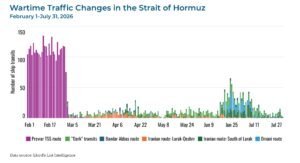
Of particular note was the transit of the LNG carrier Al Areesh (IMO No. 9325697) on July 29. The vessel, associated with QatarEnergy, exited the area through an Iranian-controlled route. It was the first Qatar-linked LNG carrier to transit the Strait of Hormuz since July 7, when the vessel Al Rukayyat (IMO No. 9397339) was attacked off the coast of Limah, Oman, while attempting to navigate the Omani route.
These developments have demonstrated that Doha and other major energy exporters are practically vulnerable to Tehran’s coercive tactics, even as they push for arrangements that are more robust from a legal standpoint.
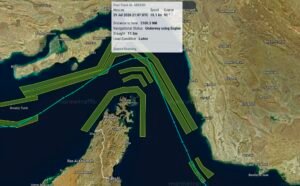
Meanwhile, at least four other vessels have been attacked since July 31, while hundreds of additional vessels and thousands of mariners remain stranded in the Gulf following the suspension of the evacuation plan established by the IMO on June 25.
These trends demonstrate Iran’s determination to direct maritime traffic through routes over which it can exert influence, while portraying the U.S.-provided southern route as unsafe.
Historical and Legal Context
Since 1968, maritime traffic through the Strait of Hormuz has been governed by a Traffic Separation Scheme adopted by the IMO. It consists of two inbound and outbound lanes, each two nautical miles wide, separated by a two-nautical-mile separation zone.
The entire system lies within Omani territorial waters and reflects the 1968 continental shelf agreement between Iran and Oman, which established a median line placing the navigable deep-water channels largely on the Omani side. A 1979 amendment added a coastal navigation zone closer to the Omani coast along the Musandam Peninsula.
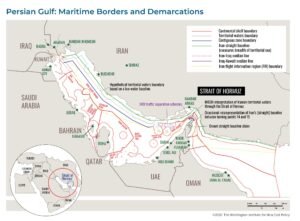
This map was originally published in the Washington Institute’s April 2020 study, “Iran’s Evolving Approach to Asymmetric Naval Warfare: Strategy and Capabilities in the Persian Gulf.”
Under UNCLOS, the Strait of Hormuz is an international strait used for “continuous and expeditious” transit under Articles 37–44. Accordingly, the legal regime governing it is transit passage, which is legally characterized as non-suspendable, non-discriminatory, and free from any requirement for authorization by the coastal state or charges merely for the act of transit.
Coastal states may adopt traffic separation schemes and safety regulations only in consultation with the IMO and only where such measures do not impair the right of transit passage, pursuant to Articles 41–42.
Iran, of course, is not a party to UNCLOS and has long rejected the transit-passage regime in favor of an expansive interpretation of “innocent passage,” based on its 1993 maritime law.
Under this view, the strait is subject to the full sovereignty of the coastal state, including the theoretical right to suspend passage and require prior authorization.
Oman, by contrast, is a party to UNCLOS and is bound by the obligations of non-discriminatory transit passage, which most countries regard as customary international maritime law. Muscat therefore remains reluctant to accept any arrangement that would alter the routes, impose mandatory fees for passage itself, or grant any state veto power.
Iran’s Objectives and Red Lines
Tehran’s strategic objective is to control access to the Gulf, either by institutionalizing the “Persian Gulf Strait Authority” that it established in May or through a subsequent mechanism requiring vessels to obtain Iranian permission to transit, pay fees presented as “service charges,” and accept imposed routing and inspection protocols.
Throughout the war, Iranian government officials and IRGC officers have repeatedly stated that transit through the Strait of Hormuz is permitted only with Tehran’s authorization.
These claims serve both operational and negotiating purposes: they demonstrate Iran’s remaining coercive capabilities and raise the perceived cost of any arrangement that excludes Iranian control.
In the short term, military operations and wartime risks—such as suspected mines and unexploded ordnance—provide Tehran with a temporary justification for altering traffic-management measures, particularly amid continuing delays in mine-clearance operations.
As noted above, Tehran’s preferred end state is a bilateral framework between Iran and Oman that excludes international oversight and treats the two coastal states as the sole decision-makers.
Since June, Foreign Minister Abbas Araghchi has described discussions with Muscat as an exercise of their “natural right” to coordinate safe-passage arrangements and retain ultimate authority for Iran and Oman alone.
By portraying its strategy as pragmatic bilateral cooperation, Tehran seeks to justify what could effectively amount to a unilateral seizure of authority.
Moreover, an unnamed Iranian official quoted recently by Fars News Agency, affiliated with the IRGC, indicated that regardless of any agreement with Oman, Tehran intends to keep the strait closed until the United States lifts its naval blockade, removes sanctions on oil and petrochemicals, and releases the regime’s frozen assets.
These red lines appear firm.
After rejecting Oman’s proposed concept of a “regional consortium,” Iran put forward a counterproposal under which the entire inner route and parts of the outer route would fall within its territorial waters, effectively giving it physical control over both principal transit lanes.
For reasons discussed below, however, granting Iran control over an entire passage should be considered unacceptable to the United States, even if limited to parts of the route.
Policy Recommendations
Washington and its partners’ immediate priority should be to activate a focused, time-limited plan to escort the hundreds of commercial vessels that remain stranded in the Persian Gulf.
To resume limited two-way traffic in the short term and ease pressure on energy markets, the most practical approach is to establish a carefully structured coordination mechanism with Iran and Oman, operating according to the principles outlined below and supported by U.S.-led naval forces.
Long-term governance discussions can proceed in parallel with the implementation of these initial priorities.
Throughout the transition, the Trump administration should mobilize regional states and the broader international community to:
Reject any Iranian attempt to transform wartime coercion into dominant control over the waterway.
Continue supporting arrangements that preserve the continuity of the Omani route until a permanent solution is reached and implemented.
Prioritize the resumption of tanker traffic in both directions through the strait.
Ensure that any long-term arrangements are based on three fundamental principles: preserving freedom of navigation in accordance with the transit-passage regime established under UNCLOS; rejecting any unilateral Iranian right to license or veto commercial shipping; and adopting practical safety and traffic-management measures consistent with the mandates of UNCLOS and the IMO.
Insist that no bilateral Iran-Oman mechanism be accepted unless it is developed in close consultation with other Gulf littoral states, remains permanently open to appropriate contributions from major user states and the IMO, and explicitly affirms the transit-passage regime without provisions allowing suspension, discrimination, or mandatory prior authorization.
The United States should engage constructively in any framework that meets these conditions, while continuing any necessary military operations to restore freedom of navigation and reinforce the legal order.
The Traffic Separation Scheme that existed before the war and was established under IMO authority should be maintained as the operational baseline in Omani territorial waters.
Any modification of the inner route toward the north should be considered only as part of a comprehensive package under which Iran accepts IMO oversight of the amended scheme and formally recognizes that transit passage reflects customary international law.
Changing the routes without these commitments could risk transforming temporary operational patterns into permanent Iranian leverage.
Furthermore, the United States should reject Iranian demands to move the entire inbound route into Iranian territorial waters.
Such a move would place transiting vessels—including U.S. Navy vessels—within an area potentially vulnerable to capture or attack by the IRGC and surrounded by the Iranian coastline on three sides. For this reason alone, this option should be ruled out.
The southernmost inner route—located partly within a narrow strip of international waters separating Omani and Iranian territorial waters and partly within Iranian territorial waters—would be a more acceptable alternative.
Any fees should be limited to voluntary payments for actual services provided, such as pilotage, traffic assistance, hydrographic support, environmental protection, or search and rescue. No fees should be imposed merely for exercising the right of transit.
However, certain voluntary fees may be justified given that hundreds of vessels still stranded in the Gulf will require security guarantees before leaving the area, even if a U.S.-Iran agreement brings the war to an end. These vessels will also likely require escorts and/or guidance to ensure safe navigation.
Ultimately, models combining the cooperative safety practices used in the Strait of Malacca with the open transit character of the Strait of Gibraltar provide the most appropriate reference for permanent arrangements in the Strait of Hormuz that are consistent with UNCLOS.
Given Iran’s coercive tactics and clearly stated intentions, only arrangements that uphold the right of transit passage, reject unilateral control or mandatory fees, and preserve the existing IMO Traffic Separation Scheme as the baseline framework can restore reliable navigation through the strait—a fundamental requirement for protecting global commercial interests and international law.