

Source: Al-Araby Al-Jadeed
In his speech at the opening ceremony of the first Damascus International Festival of Arabic Poetry, Syrian Minister of Culture Mohammed Yassin Saleh thanked his colleague, Finance Minister Mohammed Yusr Bernie, who was among the prominent attendees, for approving the festival’s budget. Without that support, Saleh explained, the event could not have been organized.
This reference may reveal that the festival enjoys the backing and support of the Syrian state as a whole, rather than belonging exclusively to the Ministry of Culture, even though several departments within the ministry mobilized to organize it and provide its logistical and operational requirements. Guests, visitors and attendees broadly agreed that the festival was successful on several levels, particularly in terms of the large public turnout for its events, poetry evenings and parallel activities. This was partly due to the considerable media attention it received across various platforms. The ministry also appeared to recognize the importance of social media, with a team of young employees working to make all the events—including poetry evenings, seminars, discussions, exhibitions and musical nights—attractive and accessible through two platforms.
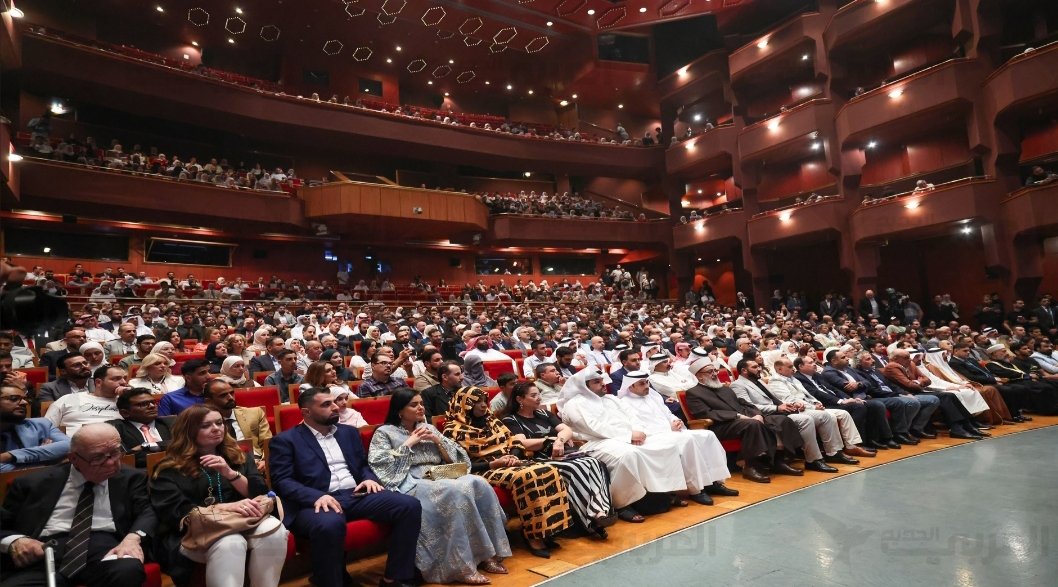
The festival was therefore followed outside Syria as well. Many people who were drawn to its activities through computer and mobile phone screens noticed the packed audience at Damascus Opera House, with not a single empty seat, as people came to listen to poetry. This stands in contrast to poetry evenings and events that receive substantial funding and require significant organizational efforts, yet can sometimes inspire pity because of the scarcity of attendees, visitors and listeners.
The question, then, is whether the popularity of poetry at the Damascus festival stems from the fact that it predominantly featured classical, traditional, metered Arabic poetry—poetry familiar to the ear and pleasing to listeners—or whether it is connected to the broader Syrian context, in which large segments of society are in considerable need of celebration and joy, particularly as the country moves toward restoring its normal rhythms. This is something a visitor to Damascus can sense, roughly a year and a half after the overthrow of the Assad regime, which had forcibly gathered Syrians in the Opera House and elsewhere for celebratory festivals glorifying the president and the Baath Party, which itself had little real power in the face of the security apparatus.
No sooner had the poetry festival ended than the Summer of Syria Festival began. It had been preceded by a Syrian theater event. This reflects a degree of vitality in the diversity of artistic and cultural activities, including seminars, specialized book exhibitions, theatrical and cinematic evenings, and other events in Damascus and other cities.
During its six days, the International Festival of Arabic Poetry, which concluded on August 7, hosted around 55 poets, including one participant from Nigeria. Most were Syrian, but Arab geographical representation was broad, with participants from 15 countries. However, this diversity did not translate into diversity in poetic sensibilities and experiences. The festival appeared almost entirely devoted to celebrating traditional metered poetry, as only two poets—Syrians Mohammed Haj Bakri and Omar Idlibi—were heard reciting non-metered poems.
The audience expected Lebanese poet Shawqi Bziye to read poems that departed from this course. His more than twenty collections contain only one metered poem, “Mount Barouk.” Yet at the opening ceremony, he read passages from this 1977 poem. The well-known poet’s choice was political rather than an expression of alignment with the prevailing mood of the festival. He wanted to read the poem as a reference to the Assad regimes, which killed Lebanese leader Kamal Jumblatt in March 1977. The metered poem was written in mourning for him. Bziye also expressed his delight at the Syrian authorities’ arrest of the person directly responsible for the crime. It was notable that Lebanese leader Walid Jumblatt, during a ceremony in Beirut launching his memoir A Destiny in This Levant the previous Tuesday, greeted Bziye, who was present, for reading the poem “in Damascus.”
Had the renowned poet read at his scheduled evening on the penultimate day of the festival, he would have broken the “monotony” that dominated the event—a monotony that Bziye himself had warned against in his opening speech. Instead, he chose to leave on the morning of the same day.
Guests, visitors and attendees broadly agreed that the festival was successful on several levels.
Although there is merit in festival director and poet Anas Al-Dughaym’s statement during a podcast discussion held as part of the festival’s activities—which also included a tribute seminar for poet Suad Al-Sabah—that “the reader has the right to choose the most beautiful poetry, because a great poem transcends its occasion when it possesses artistic and human beauty,” those who listened to the poems presented by the festival’s male and female guests—many of whom have little notable poetic record and are largely unknown—also have the right to regard some of them as traditional verse lacking the aesthetics of high poetry. This does not overlook talented poets whose work deservedly earned admiration, such as Iraqi poet Walid Al-Sarraaf and others.
The same issue can be compared with other Arab poetry festivals, where another form of “monotony” prevails when free verse and prose poetry dominate, sometimes accompanied by major metrical irregularities. This supports the familiar argument about a current “crisis” in the Arab poetry scene, although there is an obvious risk in making such a sweeping statement. At the same time, however, one can speak of a profound estrangement between the general public and poetry, particularly given the limited sales of poetry books. This was once again demonstrated by the sales figures of six Syrian and Jordanian publishing houses that had small stands at a limited exhibition in the foyer of the Opera House, held as a parallel activity to the festival.
The festival thus raises numerous questions about whether classical Arabic metered poetry alone is capable of establishing communication and connection with audiences at gatherings and festivals, in the post-Mahmoud Darwish and Nizar Qabbani era—both of whom were repeatedly mentioned in speeches delivered at the festival, which celebrated the event, Damascus, a victorious Syria, and so on.
One of the festival’s ironies was that its opening day coincided with the broadcast by Al Jazeera of the second part of Ali Al-Dhafiri’s interview program The Interview with Syrian President Ahmad Al-Sharaa. In it, he spoke about his love of the poetry of Antarah ibn Shaddad, Amr ibn Kulthum and Zuhayr ibn Abi Sulma, saying that he preferred pre-Islamic poetry to other forms and that he read poetry from the early Islamic and Umayyad periods.
The following day, a lecture by Syrian novelist and writer Ibrahim Al-Jabin, as part of the festival’s program, contained an implicit and explicit, as well as critical and polemical, position toward the theorizing of modernism in the poetry of the 1960s. He said that the theorists of the Beirut-based Shi’r magazine, rather than examining the achievements of Syrian poets, went toward “fabricating a distant reference that sought to erase what the people of the Levant had accomplished and to create an arc that would leap over them.”
They attempted to portray poetry of “vision and revelation” as though it were seeing the light for the first time, deliberately overlooking the very early Arab prose heritage that was closer in spirit to prose poetry than anything else, while importing concepts and models from European and American literature, from Rimbaud to Lautréamont. This occurred within the broader and controversial project of Arab modernism, which sought to make modernity revolutionary rather than a gradual product developing according to the natural evolution of Arabic poetry.
Al-Jabin added: “It was also falsely claimed that traditional Arabic poetry had reached a state of decline at the time, even though that era was home to Badawi al-Jabal, al-Jawahiri, Abu Risha, Nizar and others.” The lecture appeared to refer to what he regarded as a cultural—and political—context in which metered poetry was under attack, while the “revolutionary” movement against it coincided with military coups in the region. Al-Jabin noted the “revival of metered poetry after liberation” in Syria recently.
Several free-verse poets invited by the festival’s administration did not participate.
Several free-verse poets whom the festival administration had invited to Damascus and its first international poetry festival did not attend. Their presence could have introduced greater diversity and broken the apparent “monotony.” Nevertheless, the festival’s conclusion with a refined musical and singing performance by artist Bashar Zarkan helped “break” this monotonous rhythm. He performed poems that soared into mystical and romantic atmospheres, markedly different from many of the poems heard during the festival.
The absence of those invited poets did not deprive the festival of its vitality, nor did it eliminate the whirlwind of questions surrounding Syria’s current cultural and political moment. Nor did it diminish the importance added, in part, by the presence of Syrian critic Khaldoun Al-Shamaa, 85, who has lived in London for more than 50 years and who signed copies for the audience of his book Tammuzism and the Counter-Epic: Literary and Critical Modernism among the Arabs, recently published by the Arab Institute for Studies and Publishing.
The festival also benefited from the Arab guests’ great appreciation of the warm reception they received and their presence in Damascus, which they showered with praise—a city that de
serves all love, now, before and always.