

Nouri al-Jarrah
Closeness can sometimes obscure one’s vision, and my words fall short of expressing the deep affection and unbreakable bond that have defined my relationship with Muwafaq Qatt since the 1970s. He has been my friend, fellow artist, and companion in thought and in life’s journey. Ours is a friendship rooted in a time that deserves, at least in the eyes of those of us who grew up together, to be remembered as an age of ultimate innocence and youthful dreams of changing the world.
What brought us together, along with others of our generation, before art, literature, leftist thought, and modernist culture united us, was that stubborn mountain known as Mount Qasioun, which witnessed our births and our rebellious upbringing in Damascus. Today, as I reflect on Muwafaq, who now lives beyond the Sea of Darkness, I find myself wondering: could any of us have imagined the tragic destinies that would turn our Syrian nation into a profoundly tragic one, and its writers and artists into inhabitants of exile?
The childhood and adolescent memories that shaped our upbringing in the al-Muhajireen neighbourhood, just a few steps from the palace of the bloodthirsty dictator who ruled Syria with an iron fist, deserve more than a passing mention in a tribute to an artist.
My early departure from Syria to live abroad cost me dearly, among other things, the loss of contact with friends in Damascus, including Muwafaq, a separation that lasted for decades. Yet the historic earthquake represented by the Syrian uprising brought us together again in an extraordinary way. Our first reunion after more than three decades was astonishing. I felt as though I had said goodbye to him the day before and met him again the following day. I attribute this to his spontaneous nature and endearing sense of humour, which can dissolve even the harshest moments and revive the spirit and memory.
During the difficult years endured by Syrians in their devastated and burning cities, and along the roads of exile where their suffering had grown immense, Muwafaq Qatt became a window of hope in my arduous daily life. He gave meaning to my coffee and brought sunlight to my mornings amid the darkness of exile. Time and again, that brush, with all its strokes upon the wall of Syrian tragedy, shielded me from the gloom of passing days and the prospect of despair.
Today, revisiting the series of caricatures created by Muwafaq Qatt throughout the years of Syrian suffering reveals him as one of the most prominent artists to have expressed the Syrian people’s collective consciousness through caricature. His artistic legacy can be read as a daily chronicle of a people’s struggle.
Through that daily rectangular window in the London newspaper, and later through other platforms, Syrians caught a glimpse of themselves. In the artist’s works, they recognised their own images, experiences, and circumstances, which accompanied their bloody ordeal. They were able to revisit the meanings and implications of momentous events, extraordinary heroism, and blind tyranny. The artist masterfully shed light on a range of pressing issues, choosing to focus on the human essence and the capacity for sacrifice in pursuit of freedom and dignity.
Within that daily satirical space, his brush portrayed people at the height of their collective dream and their smaller personal aspirations, in their everyday lives and ordinary belongings, in their ability to overcome pain, and in the dignity of their pride even during their most devastating moments.
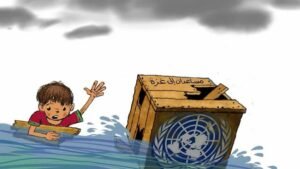
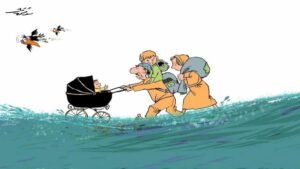
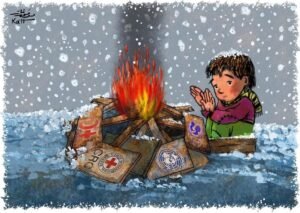
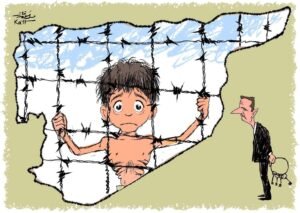
Childhood has rarely become an everyday hero in caricature art, whether Arab or otherwise, as it has in the works of Muwafaq Qatt. In his piercing scenes and tragic depictions of its fate, childhood appears besieged by hunger and mass displacement. It became an inexhaustible source from which the artist drew inspiration, transforming each caricature into damning testimony to the unchecked brutality of tyranny and the death of conscience.
He unleashed every possibility within the art of caricature to condemn a world that had turned its face away from the suffering of a people whose children were subjected to the most horrific forms of oppression, deprivation, killing, and abuse, culminating in the catastrophe of chemical genocide, which exposed, among other things, the hypocrisy of the international community. Art critics studying the caricatures that accompanied the Arab Spring will undoubtedly recognise this distinctive feature of Muwafaq Qatt’s work.
In highlighting this defining characteristic, I do not mean to confine Muwafaq Qatt’s art to it alone. His work encompasses a wide range of subjects and issues. His caricatures have continually devised intelligent forms of expression through which to comment on the political events, developments, and turning points that accompanied his people’s revolution and the painful paths they embarked upon with bloodied feet, as well as the stories of heroism, treachery, and abandonment that emerged from them.
The artist created remarkable images that exposed the many glaring contradictions surrounding political figures who played catastrophic roles against their own people. While these figures dominated the destructive political landscape, the artist responded by inventing satirical images that laid bare their ugliness and brutality. His portrayals subjected them to fierce ridicule, not merely as a form of revenge for their sinister deeds, but to reveal their true nature and preserve their shameful image for posterity.
Satirical art, by its very nature, serves to unmask, expose falsehood, and undermine the logic of evil, class arrogance, and tyranny, along with their transcontinental alliances. One of caricature’s essential roles is to dismantle dominant images and expose the ridiculous underside of authoritarian sanctity.
Another distinctive feature worth highlighting in Muwafaq Qatt’s work, not only in caricature but also in his visual art and animation films, is its universal dimension. He is a pioneer of animation in Syria and the first artist to create animated films in the country. This universal outlook is rooted in an intellectual vision that transcends the national sphere and embraces humanity as a whole, a quality that can be traced back to his intellectual formation and early upbringing.
This is reflected in his choice of subjects, which primarily revolve around ordinary people and those suffering from social, class-based, and political marginalisation. His art therefore transcends narrow identities and exposes the limited horizons of those confined by them, as well as the evils that may arise from such confinement. Through his subjects and artistic expressions, he addresses humanity’s concerns and its simple dreams amid the complexities of the modern age, under the dominance of power-centred geographies over those marginalised by wars of global domination.
For him, art is neither a merely personal pursuit nor an aesthetic luxury. Nor are artistic forms an attempt to rise above people’s ability to appreciate artistic beauty, its expressions, and its subjects.
Art has always been associated, in Muwafaq Qatt’s work, with two functions: social and civilisational. It is through the interplay of these two dimensions that the aesthetic adventure begins and the human element shines through his art.
I do not intend, in this tribute, to assume the role of an art critic. Nor am I capable of offering an objective reading of this satirical artist, whose profound love for simple things allows him to give them depth through his artistic expressions. He is a man shaped by both the richness of the Levant and the complexities of Russian academic training, perhaps also influenced by the cheerful temperament traditionally associated with his fellow Damascenes of Circassian descent.
He gives free rein to his remarkable ability to carve out irony and paradox. And I am certainly unable to portray Muwafaq Qatt independently of a friendship that began half a century ago.
One night, we stayed up together guarding his first art exhibition. Even before travelling to Moscow to study animation, he had already distinguished himself among our circle of friends as a visual artist of remarkable talent, painting oil canvases whose artistic language blended realism and symbolism.
I remember helping him carry his paintings so that he could hang them on the walls of his first exhibition in 1974. The exhibition was held in an apartment in the al-Shaalan area to mark the fiftieth anniversary of the founding of the Syrian Communist Party. We were young men then, and our peers recognised us as the Marxists of Damascus’s al-Muhajireen neighbourhood.
Muwafaq Qatt’s personality took shape early on, characterised by a cheerful, critical temperament, evident in his witty and perceptive remarks, distinguished by their clever and inventive linguistic constructions. These qualities also defined his critical stance towards things and phenomena. He was a calm yet daring person, a striking combination that had been apparent since his early adolescence.
“If intelligence agents catch us, our families will have to buy us new shoes in a larger size! Although, on second thought, we probably won’t need shoes anymore!”
Muwafaq joked as we tore down pictures of Nixon and the tyrant Assad that had been plastered on lampposts throughout the streets of al-Muhajireen, in preparation for the arrival of the American president. It was the summer of 1974.
At the time, Muwafaq had not yet turned to caricature. He was painting oil canvases and preparing to travel to Moscow to study animation at the Higher Institute of Cinematography. He would eventually leave for Moscow, and I would later receive a single letter from him, accompanied by a caricature of himself wearing the famous Russian hat.
In 1988, I heard in London that the intelligence services had detained Muwafaq for several days, holding him hostage in an attempt to force his elder brother, Dib, to surrender himself to Palestine Branch. The same thing later happened to his brother’s wife.
“Anyone who was not a leftist in his youth has no heart, and anyone who remains a leftist after the age of thirty has no mind.”
This was the phrase we used to console ourselves after receiving shocks from every direction, including from some of the very intellectual figures whose ideas we had passionately embraced in our youth. Muwafaq Qatt often repeated it. He had chosen art early on as his sole means of expression, into which he poured his experiences, thoughts, dreams, and aspirations. This choice ultimately freed him from the ideological inclinations that had imprisoned so many of his generation.
As we celebrate him today as a caricaturist, Muwafaq Qatt stands as an artistic experience that has left a distinctive mark on Arab caricature art.
Nouri al-Jarrah
London, 17 February 2026
This tribute was written specifically on the occasion of Muwafaq Qatt receiving the Mahmoud Kahil Award in Beirut.