



Dimasheq
The Hebrew newspaper Maariv published a report on Friday discussing what it described as the decline in U.S. support for Israel, warning of a profound shift in American public opinion. The report notably targeted Qatar and Arab intellectual Azmi Bishara, accusing them of leading what it described as an organized campaign to undermine Israel’s standing.
The report went so far as to describe Bishara as posing a greater threat to Israel than Turkey and Iran combined, alleging that he has influenced American public opinion and contributed to the growing perception that Israel is a burden on the United States rather than a strategic asset. The report also places part of the blame on Israel itself, citing what it calls “excessive complacency” and a failure to recognize anti-Israel trends that had been developing beneath the surface for years. It warns that the decline in American support has become an existential threat requiring a broad media and political campaign to rebuild U.S. backing.
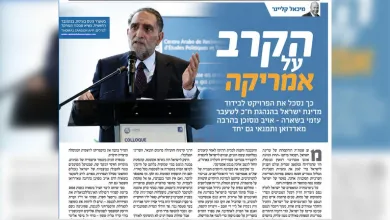
Accompanied by a photograph of Bishara, the article—written by Michael Kleiner, a lawyer, former Knesset member, and President of the Likud Court since July 2013—appeared under the headline: “The Battle for America: How We Will Defeat Former Knesset Member Azmi Bishara’s Campaign to Isolate the State of Israel – An Enemy More Dangerous Than Erdoğan and Khamenei Combined.”
The author argues that since Israel’s establishment, the support of American Jews has been regarded as a first-rate strategic asset. He claims that the so-called “oil weapon”—referring to Gulf states’ attempts to influence Washington—posed a long-term threat to Israeli interests, while the Jewish vote in the United States served as a counterweight by creating an unquestionable political consensus. According to him, any politician who challenged that consensus ultimately paid a political price.
Reviewing different stages of U.S.-Israeli relations under successive American presidents, the author claims that Republican administrations consolidated a strategic partnership based on the view that Israel serves U.S. interests and is a strategic asset for the West. He argues that reservations toward Israel have gradually become more visible, and that the once-solid foundations of support have begun to erode. According to the article, Israel is no longer an unquestioned cause among Democrats or even among younger Republicans.
The writer further contends that Israel has shown inexcusable complacency over the years, arguing that warning signs should have been recognized much earlier. Nevertheless, he believes that influential pro-Israel forces remain strong enough to gradually repair the damage if Israel “awakens and organizes.”
“Empire of Evil”
The article uses the subheading “Empire of Evil” to intensify its criticism of Azmi Bishara, portraying him as responsible for the deterioration in U.S.-Israeli relations.
The author argues that understanding the problem requires recognizing that the decline is not accidental but the result of a highly organized and determined adversary. He writes that this adversary “has a face and a name” and identifies it as Qatar, claiming that the mastermind behind its efforts is Azmi Bishara, whom he describes as a former Knesset member and former candidate for the Israeli premiership.
The article alleges that Bishara has established a vast network of research institutes, think tanks, and academic journals that allegedly function as an operations center aimed at weakening Israel’s position in the Western world, particularly in the United States. It further claims that Bishara is “far more dangerous than Erdoğan and Khamenei combined,” alleging that his intellectual influence and what the author describes as “unlimited Qatari funding” have enabled him to build extensive influence over American and European public opinion.
The author cites Bishara’s political career as evidence of his influence, referring to the 2002 decision by then-chairman of Israel’s Central Elections Committee, Justice Mishael Cheshin, to reject a request submitted by then-State Attorney Talia Sasson seeking to bar Bishara from running for the Knesset.
The article concludes that diagnosing the problem is the first step toward addressing it, arguing that the erosion of American support for Israel is neither inevitable nor natural. It attributes Israel’s predicament to dangerous complacency and compares it to historical failures to heed warning signs, including the Roman suppression of Jewish revolts, Adolf Hitler’s threats, Egypt’s preparations before the 1973 war, and Hamas’ publicly declared invasion plans before October 7.
The author ultimately calls for what he describes as an uncompromising battle over public opinion, urging the mobilization of Jewish organizations, evangelical allies, and social media experts in what he portrays as an existential struggle.
“Serious Incitement”
Commenting on the Israeli report, Amtanes Shehadeh, Director of the Israel Studies Program at the Mada al-Carmel Center, told The New Arab that Israel has been surprised by the decline in its standing within the United States and among the American public.
According to Shehadeh, rather than reassessing its own policies and recognizing that it cannot indefinitely maintain occupation, colonial practices, apartheid, and mass violence without consequences, Israel is seeking external explanations for the decline in its international standing.
He argues that while the Israeli narrative has long dominated knowledge production in the United States, Arab academic and intellectual institutions are now presenting an alternative narrative that challenges what he describes as Zionist-American hegemony. Although he believes the influence attributed to Bishara in the article is exaggerated, he says Israel is searching for convenient explanations for the decline in its image following the war in Gaza instead of engaging in self-criticism.
Shehadeh further argues that targeting Azmi Bishara and the academic institutions he has helped establish is politically convenient within Israeli society, particularly among the political right. He also suggests that criticism of Qatar resonates with the Israeli public and may pave the way for future campaigns against Arab political parties and national institutions ahead of upcoming elections.
He believes Israel is likely to encourage further academic and policy research criticizing Qatar, the Arab Center for Research and Policy Studies, the Doha Institute, and other institutions associated with Bishara’s intellectual work. He describes the article as “serious and dangerous incitement” that should be taken seriously because, in his view, Israeli media often prepares the ground for practical political measures.
Shehadeh concludes by saying that, nearly twenty years after Azmi Bishara’s departure from Israel, he continues to concern Israeli decision-makers because of his contribution to producing alternative knowledge that challenges Zionist and American dominance and criticizes apartheid and the war in Gaza.