
Dimasheq News Editorial Team
After more than a decade on the run, a US court has brought one of the most prominent cybercrime cases linked to the former Syrian regime to a close, sentencing Syrian national Ahmad Omar Agha to 42 months in prison. His name was associated with cyberattacks targeting Western media outlets, government institutions and economic entities, one of which triggered turmoil in US financial markets and caused temporary losses estimated at approximately $136 billion.
On October 29, 2026, a federal court in the US state of Virginia sentenced 32-year-old Ahmad Omar Agha to three years and six months in prison for his involvement in a widespread hacking campaign linked to the regime of former Syrian President Bashar al-Assad, according to a statement issued by the US Department of Justice.
Agha was known by his online alias “Th3Pr0” and was one of the prominent figures associated with the Syrian Electronic Army (SEA), a group that emerged with the outbreak of the Syrian revolution in 2011 and evolved into a digital tool for attacking media outlets, opposition figures and institutions considered political adversaries by the former regime.
According to the US Department of Justice, Agha participated in an organized hacking campaign overseen by figures close to Bashar al-Assad, including officials within Syria’s General Intelligence Directorate.
The operations targeted approximately 47 entities, including media organizations, commercial companies, human rights groups, and US and Western government agencies. Their objectives focused on gathering information, disseminating pro-regime political messages, intimidating opponents and influencing media coverage of events in Syria.
The group relied on hacking email accounts and official websites, stealing login credentials and using compromised platforms to publish propaganda messages. This enabled its operations to achieve widespread reach and an impact extending far beyond Syria’s borders.
A Tweet That Shook Wall Street
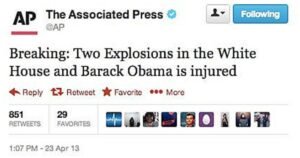
The most prominent operation associated with the case dates back to April 23, 2013, when the Twitter account of the American news agency Associated Press (AP) was hacked. A fabricated report was published claiming that two explosions had occurred inside the White House and that then-US President Barack Obama had been injured.
The false report triggered panic in financial markets and caused a sharp but temporary decline in US stock prices. The market capitalization of stocks listed on the Dow Jones Industrial Average fell by approximately $136 billion before markets recovered after the report was exposed as false.
The incident demonstrated how a single electronic message published through a trusted media account could disrupt financial markets within minutes, at a time when markets were becoming increasingly dependent on the real-time flow of news and information.
Hacking the Marines and Attempts to Target the White House
Agha’s activities extended to websites and institutions linked to US national security. In September 2013, he managed to hack a company hosting the website used to recruit members of the US Marine Corps and redirected visitors to a message urging military personnel to disobey orders and stand alongside the Syrian army.
According to US investigations, approximately 3,500 visitors saw the message during the operation, which carried clear political and military implications.
Agha also made two attempts to access the White House’s social media accounts using credentials linked to employees’ email accounts. He successfully accessed one email account and exploited it in an attempt to expand the scope of the breach.
Other operations caused direct financial damage to targeted institutions. One company, for instance, incurred estimated losses of approximately $35,000 per day over a six-month period as a result of the operational consequences of the attacks.
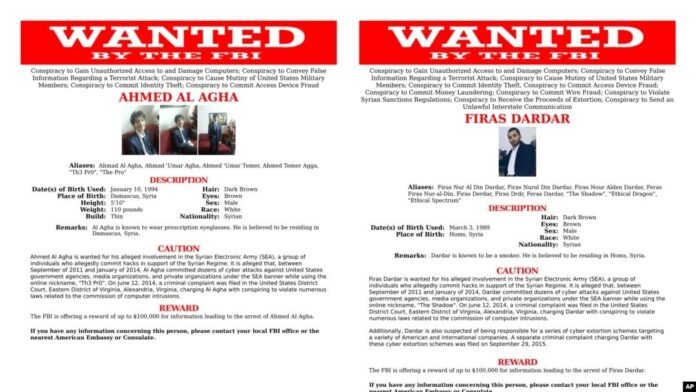
The US judicial proceedings against Agha began in June 2014, when he was initially charged with participating in a cyber conspiracy. The case was publicly announced in 2016, and his name was added to the FBI’s Most Wanted list.
US authorities offered a reward of up to $100,000 for information leading to his capture. A formal indictment was subsequently issued against Agha and his Syrian accomplice, Firas Dardar, in May 2018.
The pursuit continued for years, culminating in Agha’s appearance before a US court and the issuance of the final sentence in October 2026. Court records indicate that Firas Dardar, one of the main defendants in the case, remains at large.
The sentence handed down to Ahmad Omar Agha carries implications beyond individual punishment. It reflects the transformation of cyberspace into an arena for political and intelligence conflicts, as well as the ability of relatively small technical groups to target major institutions and cause significant economic and security repercussions.
The case also highlights the continuation of legal proceedings related to the activities of the former Syrian regime into the period following its fall in December 2024, amid US efforts to hold accountable those involved in cyber operations targeting American institutions.
From the beginning of his activities during the Syrian revolution to the sentence handed down more than a decade later, Agha’s story illustrates the intersection of technology, political propaganda and national security, demonstrating that the consequences of cyberwarfare can persist for years, even after the political circumstances that gave rise to it have ended.