
Dimasheq – Paris – Special Report:
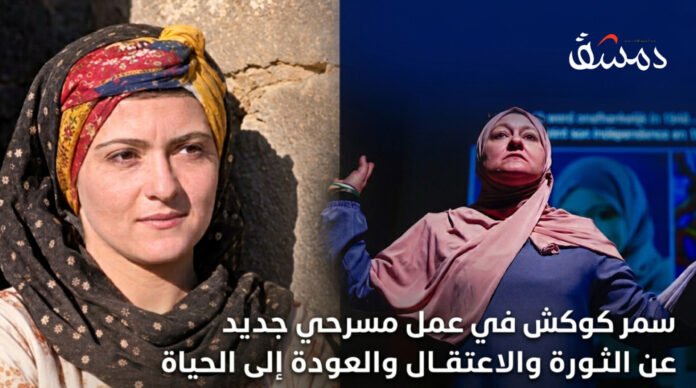
Syrian actress Samar Kokesh tells Dimasheq that the new theatrical work in which she will star means a great deal to her, as it does not tell only her own story, but also reflects the stories of thousands of Syrian women and men who endured the harrowing experience of detention. Beyond its content, the production also represents an artistic challenge to the actor’s abilities on stage.
The theatrical performance “Samar”, which will be presented on 9 October at the Studio of the National Theatre Wallonia-Brussels, is directed by Omar Al-Jibai. Running for an hour and a half, the performance is presented in French and Arabic. It is produced by Sens Interdits in partnership with the National Theatre Wallonia-Brussels and La Villette Theatre, with Elias Largo and Omar Al-Jibai contributing through voice.
In this solo performance, which is already fully booked, according to the organisers, a woman reclaims her story and transforms the hardships she endured into theatrical material.
Samar once dreamed of becoming an actress and a mother in Damascus. Her life followed the path she had planned until 2011, when she was arrested in front of her daughters, Lin and Malak, because of her involvement in humanitarian activities during the Syrian revolution.
She spent more than three years in prison and lost everything. Her artistic career was shattered, her two daughters sought refuge in Belgium, while political threats made continuing her life in Syria unbearable.
She then embarked on a long journey to rebuild her relationship with life, particularly her relationship with her two daughters.
What fate does history impose on the most fundamental of human bonds? And how can an artist rebuild her identity after prison and exile?
On stage, Samar Kokesh engages in a dialogue with a voice that narrates, asks questions and shapes the scene.
The performance advocates the possibility of rebuilding, without seeking to evoke pity or excessive sympathy. Instead, it presents a life transformed by human choices and the courage to keep going despite everything.
The audience will watch the performance followed by an open discussion on the issues it raises. In statements to Dimasheq, Samar Kokesh says that she considers the current performance the beginning of a new phase, adding: “After this performance, I have a new project with Remi Sarmineh about female detainees, women and children.”
It is worth noting that actress Samar Kokesh has a distinctive academic and artistic background. She comes from a family held in high regard by audiences: her father was the late director Alaa Al-Din Kokesh, while her mother is actress Malak Sukkar.
She studied acting at the Higher Institute of Dramatic Arts in Damascus and graduated in 1995. She subsequently took part in numerous theatrical, television and radio productions.
She also gained regional recognition through dubbing, lending her voice to characters in animated series, most notably Ran in Detective Conan. She also participated in the Arabic dubbing of Digimon and Me and My Sisters. Her television appearances include works such as Al-Ababeed and Al-Shaqeeqat.
Kokesh participated in the Syrian revolution from its early beginnings and was arrested by the security services of the Assad regime in 2013. She was sentenced to prison on charges of financing terrorism and was released in February 2017.
Following her release, she left Syria after facing persecution and harassment by the former regime. She lived for a period in Sudan before moving to Brussels in 2019, where she has continued her artistic career.