

Beren Birsaygli Mout
August 12, 1976.
Fifty years ago.
Smoke was rising from the Tal al-Zaatar refugee camp east of Beirut. The camp had been established only a year after the Nakba, and most of its residents were poor Palestinians who worked in the surrounding factories.
They had come to Lebanon believing that they would return to the homes they had left behind in Palestine within a few weeks, or a few months at most. But weeks turned into years, and years into generations. Then came the 1967 war, when the West Bank, Gaza, the Golan Heights, Sinai, and Jerusalem all came under Israeli occupation, once again turning hundreds of thousands of Palestinians into refugees.
Tal al-Zaatar was no longer merely a camp. It had become a small city in which exiles had accumulated upon one another, along with lost homes, preserved keys, and a postponed return.
Every morning, people went out to the factories and worked long hours on their feet, often earning half of what a Lebanese worker was paid. In the evening, they returned to homes in a country that was not their own, trying to convince themselves that these had become their homes.
But the noose around the camp tightened day after day. Lebanese militias, particularly the Kataeb and armed Maronite forces, began surrounding it. Above all of this hung the dark shadow of Hafez al-Assad, the man who had not long before surrendered the Golan Heights to Israel without firing a single shot.
In June 1976, Syrian forces and Lebanese militias cut off water and electricity to the camp and then prevented food from entering. Around seventeen thousand people were inside: children, pregnant women, elderly people, and the wounded.
The calculations of those besieging the camp were simple: hunger, thirst, and fear would accomplish what bullets could not.
But Tal al-Zaatar did not surrender. Alongside Palestinian fighters were Syrian and Lebanese revolutionaries who had placed their lives on the line in defense of the Palestinian cause and the camp. Among them were poets, students, and writers, some barely in their early twenties, perhaps before they had even written their first books.
The camp was shelled from morning until night. Volunteer doctors were prevented from entering, while the few doctors who remained inside tried to save shattered bodies with the little medicine they had left, supplies that were rapidly running out.
Children’s drinking water was separated from the water reserved for treating the wounded. A single loaf of bread was divided among several people, and one bed held more than one wounded person. Tal al-Zaatar had been left to endure one of the most horrific forms of isolation in modern history.
The siege lasted fifty-two days. During those days, more than fifty-five thousand artillery shells fell on the camp—more than a thousand shells a day—for fifty-two days, over a refugee camp.
On August 12, 1976, when the camp’s defenses collapsed, those who remained inside had nowhere left to flee.
Militias operating alongside Syrian forces entered the camp. Thousands of Palestinians were killed, including women and children. Women were raped in front of their children. The bodies of the elderly were mutilated, and even the few coins they had hidden in their clothes were looted.
A large number of Palestinian, Syrian, and Lebanese fighters were also killed while defending the camp.
Tal al-Zaatar was no longer simply a destroyed refugee camp. It had become a vast wound opened in the body of Palestinian history, and a second exile planted in the heart of the first.
Ahmad al-Zaatar: “I am the bullets, the oranges, the memories”
Mahmoud Darwish would later give him a name: Ahmad al-Zaatar.
“I am the bullets, the oranges, the memories.”
Ahmad was not a single person. He was all the residents of Tal al-Zaatar. He was the child born in a refugee camp, the worker leaving for the factory, the doctor keeping watch beside the wounded, the young man carrying a weapon and standing at the camp’s entrance, and the old woman wearing around her neck the key to her home in Palestine.
Ahmad was the bullet and the orange at once: a target for death and an embodiment of life simultaneously.
He was the Palestinian uprooted from his land, yet no one could take the land out of him; whose house had been destroyed, yet who never abandoned the idea of “home”; who was expelled from one camp to another, yet never accepted seeing himself as a person without a homeland.
Those who besieged Tal al-Zaatar thought they had killed Ahmad. They destroyed the camp, scattered its people, and left their bodies in mass graves.
But half a century later, while the names of many who participated in the massacre have been buried in the depths of oblivion, Ahmad still looks at us from within the poem.
Because Ahmad was not merely a body.
You can kill a body, burn a house, and erase a camp from the map, but you cannot erase the memory of a people with the same ease. You can throw a person into a pit, but you cannot bury their will to return in that same pit.
Most of the residents of Tal al-Zaatar were the children of survivors of an earlier catastrophe. Their fathers and mothers had been the ones who closed the doors of their homes in Palestine in 1948, saying, “We will return in a few days.”
But those few days outlived an entire human lifetime.
Tal al-Zaatar was not Palestine, of course. But it had become the second home where Ahmad’s child was born, where he earned his living, raised those he loved, and buried his dead.
On August 12, 1976, that second home was taken from him as well.
And Ahmad began walking once again.
His tragedy was not merely that he lost his home. It was that others were always deciding where he would live, which borders he would cross, which camp he would stay in, which road he would flee along, and when he would have to leave his home.
Others made all those decisions. But in the heart of all these exiles, Ahmad never forgot one thing:
where he had come from.
That is why, years later, when we saw a blindfolded Palestinian in Tadamon, we were, in truth, seeing Ahmad once again.
Ahmad’s New Home: Yarmouk
This time, Ahmad’s journey extended to Damascus.
The Palestinians who sought refuge in Syria after the Nakba had not arrived in a geography entirely foreign to them. The ties between Damascus, Haifa, Acre, Nablus, and Jerusalem were far older than modern borders. The paths of Syrians who fought the French Mandate had intersected many times with those of Palestinians who confronted the British Mandate and the Zionist settler project.
Izz al-Din al-Qassam was one of the most prominent symbols of this connection. He fought the French in Syria before moving to Palestine.
Prominent figures in the Palestinian national movement, such as Muhammad Izzat Darwaza and Hajj Amin al-Husseini, also took refuge in Damascus at various stages and used it as a base for political activity.
Ahmad was not entirely a stranger to Damascus, but he remained a refugee.
Over the years, Yarmouk became the center of his second life.
With its shops, schools, hospitals, printing presses, cafés, libraries, poets, and artists, it became far more than a refugee camp. It was a small Palestine within Damascus.
Ahmad rebuilt his home there. He raised his children, perhaps held his grandchildren in his arms, told them about his village in Palestine, hung a map of Palestine on the wall, placed the old key in one drawer, and kept in another a few photographs he had managed to save from Tal al-Zaatar.
For all that had happened, the human being continued to live.
But Tal al-Zaatar had taught Ahmad a terrifying truth: even a refugee’s second home can be taken away.
A person may call a place “home” for thirty full years, raise a child there, bury a mother there, experience their first love on one of its streets, and leave all their memories on its walls. And yet one morning may come when they are forced to pack their bag and leave.
That is exactly what happened to Yarmouk.
In Damascus, Ahmad Starved for the First Time
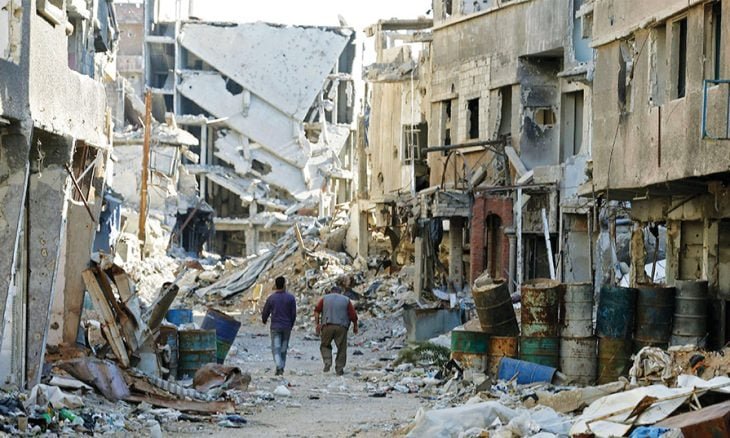
When the Syrian people rose up in 2011 against decades of repression, Yarmouk was also subjected to shelling and siege by regime forces. Food and medicine were cut off.
In the heart of Damascus, people began searching for a piece of bread.
It was one of the most painful images in Palestinian history:
Ahmad, who had been expelled from his home in Palestine in 1948 and sought refuge in Syria, was now dying of hunger in Damascus under Baathist rule, hundreds of kilometers from Palestine.
Ahmad had been unable to return to his first home. Now he was losing his second home as well.
This, precisely, is what it means to be a refugee twice:
for the second exile to begin before the first has ended;
to begin mourning another home before finishing mourning the previous one;
to carry the key to your home in Yarmouk in one pocket while the key to your home in Palestine remains in the other.
The Palestinians of Yarmouk were scattered once again along the roads—to Lebanon, Turkey, Europe, and other parts of the world.
And Ahmad walked once more.
But some of the “Ahmads” could not go any farther.
Their journey ended in Tadamon.
This Time, Ahmad Walks Toward the Tadamon Pit
April 16, 2013. Tadamon district, Damascus.
Blindfolded men were led to the edge of a pit of death.
They could not see what awaited them ahead.
They were ordered to walk a few steps. Sometimes they were shouted at to move faster. Then they were shot, and their bodies fell into the pit.
One was killed, then another was brought, then another.
The same few meters.
The same sound of gunfire.
The same pit.
As though the human body were no longer a name, a family, a memory, or a life, but merely something to be disposed of.
Yet behind every body that fell into that pit was a home, a mother, a child, an unfinished sentence, and perhaps people who were still waiting for that person to return.
When the footage emerged years later, and it became clear that Palestinians from Yarmouk were among the victims, Tadamon was no longer merely one of the darkest massacres in Syrian history.
It also became a new and terrifying chapter in the history of Palestinian displacement.
Because the Palestinians led to the edge of that pit had not arrived there only from the streets of Tadamon.
Behind them stood a long history of exile.
And the story that had led them to those few meters had begun long before.
It had begun in Palestine.
Ahmad was driven from Palestine in 1948 and forced to leave his home, village, and land.
He sought refuge in Lebanon.
Then he was shot at Tal al-Zaatar in 1976 and later heard the news of Sabra and Shatila.
He moved from camp to camp, from one border to another.
Then he came to Syria and tried to build a new life in Yarmouk, to construct within exile a small Palestine made of streets, shops, schools, and homes.
But Yarmouk was besieged years later.
Ahmad was starved, lived under bombardment, lost loved ones, and then came the day when his eyes were blindfolded in Tadamon.
Those few steps were, in truth, the final meters of the road he had been walking since 1948.
From Palestine to Lebanon, and from Lebanon to Syria.
From Tal al-Zaatar to Yarmouk, and from Yarmouk to Tadamon.
Decades of exile were compressed into those few steps, as though an entire human life—and the recent history of an entire people—had been confined to a few meters walked by a blindfolded man toward a pit of death.
This Time, Ahmad Was Not the One on Trial
Just one day before the fiftieth anniversary of the Tal al-Zaatar massacre, on August 11, 2026, Bashar al-Assad and Maher al-Assad were sentenced to death in absentia, while a death sentence was issued against Atef Najeeb, the former head of the Political Security Branch in Daraa, in his presence before the court.
Three names that had been associated for years with fear, torture, prisons, the disappeared, and mass graves now stood beside something else in the records of the judiciary:
Death.
A death sentence was issued against Bashar al-Assad.
A death sentence was issued against Maher al-Assad.
And a death sentence was issued against Atef Najeeb.
Perhaps we need to write the word again and again, because for decades in Syria it was those very names who issued the sentences—the men who ordered people to be taken from their homes in the darkness of night, who made people disappear into prisons, besieged cities, and turned hunger into a weapon of war.
Now, for the first time, they themselves stood beside a sentence of such severity.
And the verdict came just one day before the fiftieth anniversary of Tal al-Zaatar.
It is one of those horrifying connections that history sometimes creates by sheer coincidence.
Ahmad was among those who were starved in Yarmouk.
Ahmad was among those who disappeared in Syrian prisons.
Ahmad was among those whose eyes were blindfolded and who were led toward the pit of death in Tadamon.
Perhaps his name changed, his face changed, his age changed, the camp in which he was born changed, and the document he carried changed.
But his story did not change.
It is the story of the Palestinian refugee passed down from one generation to another:
a human being displaced once, then displaced again;
a survivor of one massacre who found himself in another siege;
a person who moved from one camp only to find himself in another place of death.
Many years ago, Mahmoud Darwish brought Ahmad out from beneath the ruins of Tal al-Zaatar and introduced him to us.
He did not present him merely as the hero of a poem, but as a shared name for the Palestinian refugee.
Since that day, we have followed Ahmad.
He emerged from the ruins of Tal al-Zaatar.
He heard the news of Sabra and Shatila.
He tried to establish a new life in the streets of Yarmouk.
Then Yarmouk was besieged, bread became scarce, people died of hunger, and Ahmad was there.
The prison doors closed, thousands disappeared, and Ahmad was there too.
And when the blindfolded men in Tadamon were led to the edge of the pit of death, Ahmad was among them once again.
We followed him from Tal al-Zaatar to Yarmouk, and from Yarmouk to the edge of the pit of death in Tadamon.
For fifty years, Ahmad’s story contained only the same words:
Exile. Siege. Hunger. Loss. Prison. Massacre.
And perhaps, on August 11, 2026, we saw another word written into Ahmad’s story for the first time.
Ahmad, who had been pursued for fifty years from Tal al-Zaatar to Tadamon, starved, hidden away, and finally led toward a pit of death:
Justice.
For the first time, we saw Ahmad al-Zaatar—the man Mahmoud Darwish brought out from beneath the ruins of Tal al-Zaatar and entrusted to us—meet justice.