



By Fares Al-Dhahabi
“O land of loss, Lebanon, is there a man
Who can restore to the people what they have lost?”
This poetic question encapsulates the essence of “Mount Barouk,” the poem written by Shawqi Bzeih following the assassination of Kamal Jumblatt in 1977. It was first recited during the commemoration of Jumblatt’s fortieth day after his death before Marcel Khalife later transformed it into a song that carried its message across generations.
Born out of one of Lebanon’s darkest moments, the question has travelled through nearly half a century of wars, foreign tutelage, political assassinations, and national collapse. Today, it echoes once again in Damascus—the city ruled for decades by the regime widely accused in Lebanese political memory of responsibility for the assassination of the leader of Mukhtara.
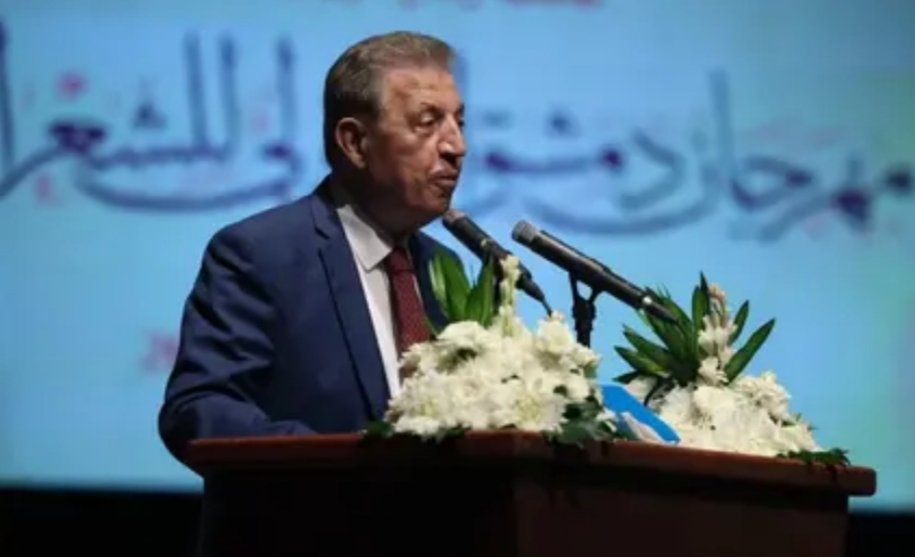
By choosing to recite this particular poem during the inaugural Damascus International Poetry Festival, Shawqi Bzeih turned the very act of recitation into part of the poem’s meaning. Words first spoken in mourning for Kamal Jumblatt returned to Syria at a profoundly different political moment, carrying with them the memory of a struggle between two opposing visions: a national reform project embodied by Jumblatt, and a regional authoritarian project led by Hafez al-Assad, based on dominating Syria while extending political control over Lebanon.
The phrase “O land of loss, Lebanon” lies at the heart of the poem. The loss extends far beyond the death of a single man, regardless of his stature. It signifies the loss of a political and social reform project, the loss of an opportunity to build a more just state, and the loss of a leader who united philosophy, political thought, and public action while championing ordinary people. With his assassination, Lebanon entered a prolonged era of political fracture, Syrian tutelage deepened, and decades of assassinations, wars, and imposed settlements followed.
Kamal Jumblatt envisioned a Lebanon capable of transcending sectarianism and establishing a more independent and equitable state. He regarded Lebanon as a platform for democratic and social transformation, advocating political reform and an Arab identity inseparable from human freedom and dignity. He stood firmly with the Palestinian cause and led the Lebanese National Movement during one of the country’s most critical periods.
This vision inevitably brought him into direct confrontation with Hafez al-Assad. Their conflict went far beyond personal rivalry; it reflected two fundamentally different understandings of politics, society, and the state. Jumblatt represented reform and national independence, while the Syrian regime viewed Lebanon as a strategic security sphere under its influence. Any independent Lebanese leadership capable of resisting Damascus was regarded as a threat to its regional ambitions.
Kamal Jumblatt was assassinated on 16 March 1977 on the road to Deir Dourit while travelling to Mukhtara. Ever since, the crime has remained deeply associated in Lebanese public consciousness with accusations against Hafez al-Assad’s regime, particularly in light of the intense political confrontation that had preceded the assassination.
The road leading to Mukhtara became a silent witness to a moment that altered Lebanon’s history, just as Shawqi Bzeih’s poem became a poetic testimony to the magnitude of that loss. Hence the enduring power of the poem’s central question:
“Is there a man who can restore to the people what they have lost?”
The question seems addressed to every Lebanese era that followed the assassination. Who can restore the Lebanese people’s independent national decision? Who can restore ethics to politics? Who can rebuild public trust in the state? Who can reconnect public life with thought, culture, and justice? And who can produce leaders capable of advancing projects that transcend sectarian loyalties and narrow interests?
The question also reflects an awareness that Kamal Jumblatt cannot easily be replaced. He combined political leadership with intellectual production, spirituality, and social struggle, while his influence extended far beyond the boundaries of his party, sect, or region. His loss was therefore the loss of an entire nation, and the elegy became, in many ways, a lament for the Lebanon that might have emerged through his vision.
When Marcel Khalife set Mount Barouk to music, the poem moved beyond the poet’s voice into the collective memory. The melody became an extension of the words, and Kamal Jumblatt’s name found a lasting place in the consciousness of generations who came to know his assassination through poetry and music. The song granted the poem renewed life, kept its central question alive, protected memory from erosion, and linked the image of the mountain with the man who left Mukhtara to become an Arab national figure.
Reciting the poem in Damascus gives that question an additional historical and political dimension. Damascus, which spent decades under the rule of Hafez al-Assad and later his heirs, now hears words written in farewell to one of the most prominent opponents of his project in Lebanon. Between the poetry stage and the memory of assassination emerges a profoundly symbolic moment: Kamal Jumblatt’s name is spoken openly in the Syrian capital, while Shawqi Bzeih restores the story of the victim to a place where the former regime long monopolized historical narrative.
The poem’s return to Damascus after the fall of the Assad family’s rule resembles the symbolic return of the victim to the very heart of the place from which repression once emanated. The family’s fifty-four-year rule has ended, and Syrians have entered a new era that allows for questioning the legacy of intervention, political assassination, imprisonment, and repression that shaped the former regime’s relationship with both Syrians and Lebanese alike.
Under Assad’s rule, Damascus was governed by a system of political and cultural taboos. Even mentioning Kamal Jumblatt alongside the circumstances of his assassination inevitably raised the question of responsibility—a question capable of undermining the official narrative that portrayed Syria’s intervention in Lebanon as an act of salvation. Yet for large segments of Lebanese society, that intervention was experienced as a system of political and security tutelage accompanied by arrests, assassinations, and continuous interference in public life.
Today, the arrival of Mount Barouk on a cultural stage in Damascus symbolizes the city’s recovery of its right to hear narratives that had long been suppressed. A single poetry evening can open a symbolic window toward justice, break the monopoly once imposed over memory, challenge official definitions of patriotism, and dismantle the restrictions governing what could—and could not—be spoken in Damascus.
When Mount Barouk Returned to Damascus
The Syrian revolution enters the meaning of this moment through the gateway of memory and justice. Syrians confronted the same regime that had extended its power over Lebanon and employed mechanisms of repression, disappearance, killing, and imprisonment both inside Syria and beyond its borders. Through their sacrifices, the shared nature of the experience between the two peoples became visible: one ruler created fear in Damascus, imposed tutelage in Beirut, and left behind a long record of bloodshed and unanswered questions.
The Syrian revolution has prevailed? Perhaps in one of its deepest meanings, when Damascus regained its ability to welcome a voice mourning a man who stood against its tyrant. This victory goes beyond the fall of a political authority; it reaches toward the triumph of memory over oblivion, and the right of victims to have their stories told in places where even speaking their names was once forbidden.
The recitation of Mount Barouk in Damascus carries the meaning of a shared victory of Syrian and Lebanese memory. Syrians reclaim their city and its cultural platforms, while Lebanese reclaim the voice of a man whose assassination became associated with the era of Assad’s expansion and dominance in their country. The Lebanese aspiration for sovereignty and statehood meets the Syrian aspiration for freedom and dignity within a single poetic space that speaks of loss and the possibility of recovering what was taken away.
One of the most striking paradoxes of this moment lies in the return of the poem to Damascus without a language of revenge. Poetry preserves names, protects memory, and prevents bullets from having the final word. The assassins wanted the crime of Deir Dourit to mark an ending, but Shawqi Bzeih transformed it into an endless beginning of speech and remembrance.
In the poem, Mount Barouk becomes a symbol of endurance against time. The mountain remains, the name remains, and the words continue their journey across generations and cities. Meanwhile, the authority that relied on fear has lost its ability to monopolize the stage and control memory. Thus, Shawqi Bzeih’s voice reaches Damascus carrying Kamal Jumblatt from Mukhtara, through Barouk, into the heart of the Syrian capital.
Between Mount Barouk and Mount Qasioun, the geographical distance is short, yet decades of fear, security barriers, and bloodshed turned it into a difficult passage. In a Damascus evening of poetry, the poem finally crossed that distance. Kamal Jumblatt entered the city through the voice of a poet who had carried him since 1977, entering with the spirit of peace he advocated. He entered to declare once again that truth will eventually reach those who deserve it, no matter how long it takes—through words set to music by Marcel Khalife and preserved by a wide Arab audience.
The meaning of the poetic line is renewed through this journey:
“O land of loss, Lebanon, is there a man
Who can restore to the people what they have lost?”
What Lebanon lost after Kamal Jumblatt’s assassination requires a national project, popular determination, a memory that protects truth, and a politics that restores its connection with ethics. Remembering Jumblatt today becomes a call to revive these values and transform his presence from nostalgia for an absent leader into a search for a project capable of reforming the state, protecting sovereignty, and restoring the importance of social justice.
The phrase “O land of loss, Lebanon” summarizes a history of assassinations, wars, foreign domination, migrations, and collapse. Yet the poem carries within it a seed of hope. The question preserves the possibility of recovery; recovering memory paves the way toward recovering the homeland; and the arrival of the poem in Damascus confirms the ability of words to cross the age of tyrants and reach beyond them.
When Shawqi Bzeih stood in Damascus and recited Mount Barouk, he was declaring, forty-nine years after the assassination, that the murdered man had returned to the city, and that the regime which sought to erase his legacy had disappeared, while the poem continued to live.
Mount Barouk met Mount Qasioun, and Kamal Jumblatt’s memory met the memory of Syrians who confronted authoritarianism. In that poetic encounter, a profound meaning of the Syrian revolution’s victory emerged: the return of voices once silenced by the Assad regime, and the presence of the names of its victims and opponents in a space that had once been subjected to its control.
The question returned from Damascus to Lebanon:
“Is there a man who can restore to the people what they have lost?”
Perhaps the answer begins with preserving memory, naming the crime, and transforming loss into a force that drives Syrians and Lebanese toward freedom, sovereignty, justice, the rule of law, and the rejection of sectarianism and hatred. The poem, born from the departure of one man, became a declaration of the survival of his idea and of peoples’ ability to reclaim their voices, their cities, and
their history.
And the mountain remained.
Source: Al-Modon Newspaper