
Dr. Mohammad M. Arnout
The centenary of Syria’s first declaration of independence, on 8 March 1920, passed amid complete disregard by the leadership and institutions of the “Syrian Arab Republic.” The anniversary commemorates the proclamation of Prince Faisal bin Hussein as King of the Syrian Kingdom, as well as the beginning of discussions by the Syrian Congress, which subsequently became a Constituent Assembly, on the provisions of the draft Constitution of 1920 and their approval. Foremost among these was Article 1, which stipulated that Syria would have “a civil, representative government, with Damascus al-Sham as its capital and Islam as the religion of its King.” Article 28 also stipulated that the Cabinet would be “accountable for its actions before the representative council,” rather than before the King.
During 2020, the anniversary was commemorated only through a symposium held under the patronage of Prince Hassan in Amman and a lecture delivered by the author of these lines at the Arab Thought Forum in Amman.
Perhaps comparing the 1920 Constitution, which adopted a parliamentary system and made the Cabinet accountable to Parliament rather than King Faisal, with the 1973 Constitution, which placed almost all powers in the hands of President Hafez al-Assad, under which father and son ruled Syria until the end of 2024, would explain the official disregard at the time. This was particularly evident after Bashar al-Assad’s authorities had lost control over the entire geographical territory of Syria and no longer corresponded to the boundaries of the “Syrian Arab Republic” under Assad family rule.
The notion of “Damascus, the beating heart of Arabism” served to obscure Syria’s history before the Assad era in university history departments and school textbooks covering modern Arab history, while simultaneously glorifying the achievements of the two Assads, who ruled Syria for more than half a century, and even longer if we take the Baath Party’s rule since 1963 into account.
Thus, the first half of modern Syrian history (1918–1963) became ideologically distorted and disfigured. There was no longer even a dedicated course on contemporary Syrian history in the History Department at the University of Damascus.
For this reason, suppressed sentiments began to emerge after 24 December 2024, expressing competing visions of the desired or envisioned identity of a new Syria. These ranged from restoring the legacy of Umayyad Damascus to reaffirming the democratic Syria that began with the Constitution of 1920. Opinions differed over Syrian national identity and its historical or imagined foundations, amid an absence of studies addressing the first half of the “Syrian Century.”
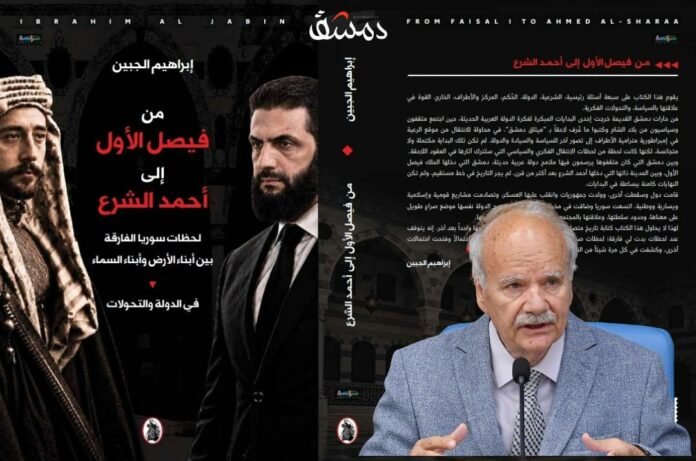
Apart from the second edition of the book From Government to State: The Experience of the Arab Government in Damascus, 1918–1920, published in Amman in 2025, and the symposium How Do We Write Syria’s History?, organised in Damascus at the beginning of 2026 by the Arab Center for Research and Policy Studies, another significant publication appeared this year: From Faisal I to Ahmad al-Sharaa: Defining Moments in Syria Between the Sons of the Earth and the Sons of Heaven: On the State and Its Transformations, by Ibrahim al-Jabin (Amman, Arab Institute for Studies and Publishing, 2026, 448 pages).
The book covers more than half of the previously obscured century and offers a new approach to examining the entire “Syrian Century,” including its transformations, governments, constitutions, coups, and regional and international interventions, all of which have left the future of the state and society open-ended.
Following his poetic and literary works, including Eye of the East and Diary of a Jew, among others reflecting his historical interests and his desire to present a different perspective on developments in Damascus and Syria, al-Jabin turned to writing about Arab and Islamic history. He published studies offering alternative approaches to established narratives and extremist tendencies expressed in the name of religion.
One such work was his book The Language of Muhammad, in which he explained that the Prophet’s language was diverse, neither rigid nor racist, in contrast to the discourse of Islamist groups that multiplied in Syria before and after 2011.
With his involvement in the opposition, both through writing and participation in its institutions abroad, al-Jabin moved towards political studies grounded in a broad historical, intellectual and cultural background. This was evident in his book The Road to the Republic, 1800–1952, which examined how early intellectual pioneers were preoccupied with the idea of the state, an enduring concern among intellectuals after the state was monopolised by a party or a family and Syria became an arena for regional rivalries and the struggles of major powers.
His connections with opposition forces also enabled him to anticipate what was coming with Operation Deterrence of Aggression, which ultimately led to the fall of “Assad’s Syria” on 24 December 2024. He subsequently wrote and published several articles in Al-Modon, which formed the foundation of this latest book.
This book reveals al-Jabin’s passion for contemporary Syrian history, a subject that had been overshadowed by decades of ideological manipulation and the suppression of the constitutional and parliamentary experience of the national movement, as well as the history of Syria’s emerging state institutions. The 1973 Constitution had consequently come to appear as though it were a monumental plant growing in a barren desert.
For this reason, the author took care to document his sources and references, from which he drew the information underpinning his analyses and conclusions. Between these analyses and conclusions lies the important comparative approach on which the study is based, reflected in its title, From Faisal I to Ahmad al-Sharaa, particularly in its conclusion.
The subtitle, On the State and Its Transformations, expresses the author’s central concern, which he explores through seven questions or sections addressing legitimacy and the state, governance, the centre and the periphery, external influences, power and its relationship with politics, and intellectual transformations.
In this context, the author explains in his introduction that the book offers an “attempt to read the history of the Syrian state and its transformations, not by examining how power is attained, but by asking what the new authority does when it moves from overthrowing a regime to administering a state.”
He then raises a fundamental question: “What matters is not who the man ruling Syria is, but what happens when he comes to power. Does the ruler create the state he wants, or does the state, with its history, society, geography and complexities, shape the kind of government it can tolerate?” (pp. 10–20).
While this review focuses on the troubled beginnings and open-ended conclusions suggested by the book’s title, From Faisal I to Ahmad al-Sharaa, it is important to note that the book provides Syrian readers with a rich historical foundation covering the periods between Faisal I’s arrival and reign (1918–1920) and Ahmad al-Sharaa’s arrival in Damascus and election as transitional president (2025–2026).
This is particularly valuable for a generation that has been deprived of knowledge about those periods because of the dominance of the official historical narrative concerning developments in Syria after 1970.
The author’s critical examination of Syria’s union with Egypt (1958–1961) is particularly useful, given its devastating consequences for economic and political life, including party and parliamentary activity. The “Syrian Arab Republic” (1961–1963) was unable to recover from these consequences before entering a cycle of coups and purges (1963–1970), which ultimately paved the way for a hereditary Assad republic (1970–2024).
The first section of the book begins with the significant coup that took place within the Ottoman palace in 1876, when reformist figures in the Ottoman state compelled the young Sultan Abdul Hamid II to accept a constitution limiting the absolute authority of his predecessors.
This constitutional system became known by the Arabic term al-Mashrutiyya, until the Sultan suspended its implementation in 1878. Syrians subsequently adopted the Persian word Dastur (constitution) following the constitutional revolution against Sultan Abdul Hamid in 1908. He was deposed in 1909 on charges of leading a counter-revolution against constitutional rule, paving the way for new elections and parliamentary life characterised by debate between supporters and opponents of the government.
This continued until the second military coup by the Committee of Union and Progress in 1913, which led to the Ottoman Empire entering the First World War alongside the Central Powers (Germany, Austria and Bulgaria), ultimately resulting in the collapse of the Ottoman Empire at the end of 1918.
In this context, elections were called for the Chamber of Deputies, known as the Majlis al-Mab’uthan, with 109 members, each representing approximately 50,000 voters. This gave rise to the first parliamentary experiment in the Ottoman Empire (1877–1878), which immediately began discussing new legislation, including the electoral law, press law, decentralisation law and the government’s general budget.
Among the Syrian pioneers of this parliamentary experience was Khalid al-Atassi (1837–1908), the Mufti of Homs, who was open to the changes of his era and keen to send his sons to modern schools.
One of them was Hashem al-Atassi (1873–1960), who graduated from the Higher School of Administration in Istanbul and returned to his homeland. He later emerged as one of the founding figures of the parliamentary movement, represented by the Syrian Congress, which became a Constituent Assembly (1919–1920), and one of the architects of Syria’s first Constitution (1920).
This was indeed a significant turning point, as the author describes it. “Parliamentary life changed Syrians’ understanding of loyalty to the state, moving them from a culture of unquestioning obedience into the arena of competing political programmes affecting their lives and future, thanks to the debates held in Parliament” (p. 19).
Among those who experienced this parliamentary system, restored following the return to constitutional rule in 1908, was Prince Faisal bin Hussein (1885–1933). He had lived with his father in Istanbul between 1896 and 1909, where he learned Turkish, English and some French.
He later returned to serve as Jeddah’s representative in the Chamber of Deputies, gaining political and parliamentary experience and establishing relations with prominent state officials.
After joining the Arab Revolutionary Society, known as al-Fatat, in Damascus, which lay along the route between Mecca and Istanbul, he became involved in the Arab project led by his father to establish an independent Arab state. His father negotiated with the Allied Powers in pursuit of this goal but failed to secure their recognition of its borders.
Faisal entered Damascus at the head of the Arab Army on 3 October 1918. Two days later, on 5 October 1918, he announced “the establishment of an independent Arab constitutional government encompassing all Syrian territories.”
However, this government, or state project, existed on paper without clearly defined borders, while Allied forces, Britain and France, held the real military power. French forces occupied the Syrian coast under the arrangements reached with Britain after France relinquished its claim to Mosul in favour of the British.
Yet Faisal’s participation in the Paris Peace Conference and his speech on 6 February 1919, in which he expressed the Arabs’ desire for independence, attracted the attention of US President Woodrow Wilson.
Wilson asked him what kind of mandate the Arabs preferred. Faisal replied that the Arabs preferred unity and independence, but if a mandate were unavoidable, they would prefer an American mandate.
Following a private meeting with President Wilson, Prince Faisal stated that Wilson had promised to support Syria if it declared its independence.
Indeed, as al-Jabin notes, President Wilson proposed at the Peace Conference, and insisted upon, holding a referendum to ascertain the wishes of the Syrian people. He also proposed forming an international commission to visit the region and investigate those wishes.
Although Britain and France formally agreed to the proposal, the commission ultimately consisted only of two Americans, Henry King and Charles Crane.
One positive outcome of this commission, al-Jabin adds, was that “Syrians, in preparation for meeting it, moved towards convening a national congress” (p. 25).
In fact, during his participation in the Paris Peace Conference, Faisal had recognised the importance of diplomacy and the need for an elected body representing the Syrians and defining their demands, so that his requests would not appear to be merely his personal position or that of his father.
Therefore, immediately upon his return to Damascus on 7 May 1919, he called upon the Syrian elite to elect a Syrian Congress to present the Syrians’ demands to the King-Crane Commission and subsequently prepare a constitution for the country.
The Syrian Congress convened on 3 June, after most of its members had been elected in accordance with the latest Ottoman electoral law. However, residents of the coastal regions, Palestine and Transjordan were unable to participate in the elections because of opposition from the British and French authorities. They therefore resorted to nominating individuals whom they considered suitable to represent them in the Congress.
Here, al-Jabin identifies a dilemma: Syrians were “seeking a new national identity after the Ottoman identity, while they were now required to accept their former representatives in the Ottoman Chamber of Deputies.”
Nevertheless, the essential point was that Syrians held important discussions among themselves about the new constitution and eventually agreed to declare the independence of the Syrian Kingdom on 7 March 1920, thereby presenting the European powers with a fait accompli (p. 33).
This decision was officially announced before crowds gathered in Marjeh Square on 8 March 1920. A new government was formed under the leadership of Rida al-Rikabi, deriving its legitimacy from the Syrian Congress, which had by then become a Constituent Assembly tasked with approving the proposed constitution.
Comparing this development with what happened 105 years later, al-Jabin notes that “in contrast to its dealings with Ahmad al-Sharaa’s administration today, the international community refused to recognise the Syrian Kingdom established at that time” (p. 32).
Although this pioneering experiment in building a Syrian state, which ultimately took shape following the declaration of independence under a civil parliamentary system and a monarch who reigned but did not rule, lasted less than two years, it left behind important foundations of statehood.
These included the establishment of state institutions, a national army, a currency, the first Arabic Language Academy and the foundations of the Syrian University, among other achievements. It also introduced freedom of political parties, the press and publishing.
In this context, al-Jabin highlights the major transformation in freedom of association and the establishment of political parties and newspapers. Approximately ten parties emerged, including the Arab Independence Party, the Democratic Party, the Progress Party, the Syrian Union Party and the Syrian National Party, alongside more than ten newspapers, such as Al-Istiqlal al-Arabi, Fata al-Arab and Al-Asima.
He therefore recalls the words of Sheikh Rashid Rida, who chaired the Syrian Congress and knew how to manage constitutional debates and secure majority support for the provision establishing a “civil government” in Article 1.
Rashid Rida described the experience as follows: “The Syrian Kingdom established a genuine democracy, with freedom in all its forms and freedom of publication, something that other countries in the region, including Egypt, could only envy” (p. 43).
However, the collapse of the Syrian Kingdom following the Battle of Maysalun on 24 July 1920, and King Faisal’s withdrawal to Haifa and subsequently to Europe, eventually led to his return as a candidate to rule Iraq in 1921.
There, he succeeded in achieving gradual independence for Iraq, which joined the League of Nations in 1932 as its first Arab member state.
This led al-Jabin to compare “Faisal of Syria” with “Faisal of Iraq”, concluding that “Faisal of Syria wanted an independent state before possessing the means to defend it, whereas in Iraq he worked to build those means, namely institutions, within an incomplete form of independence until full independence became possible” (p. 52).
It appears that “Faisal of Syria” had been prepared to follow this approach, based on the principle of “take what you can and continue demanding more.”
He had signed the Faisal-Clemenceau Agreement, initialled on 6 January 1920, which opened the way towards an independent Syrian state following the Iraqi model that he would later pursue.
However, the agreement faced fierce opposition from the Syrian street, led by Sheikh Kamel al-Qassab, whose movement declared its readiness to resist both French and even British intervention.
This pushed Faisal to accommodate the opposition and move towards declaring independence on 8 March 1920 for the “Syrian Kingdom”, despite knowing that the Kingdom did not control the territories included within its declared borders and understanding the consequences of such a decision.
Turning to the second central figure in the book’s title, Ahmad al-Sharaa, al-Jabin examines in a chapter entitled “The Damascus Spring and Killing the Father” the circumstances surrounding Bashar al-Assad’s succession to power in 2000 and the Damascus Spring.
During that period, I was able to deliver a lecture at the Civilisation Forum in Damascus on 25 November 2000, entitled “The Civilisational Prospects of the First Syrian Constitution”, marking its eightieth anniversary.
The chapter then traces the rapid setback of the Damascus Spring and the rise of opposition movements, which gained momentum from the Arab Spring and eventually developed into the 2011 revolution against the Assad regime.
As the conflict evolved, various entities subsequently divided control over Syrian territory: the northeast under the Autonomous Administration led by the Syrian Democratic Forces (SDF), Idlib and its surrounding areas under Hay’at Tahrir al-Sham, and the coast and south under the Assad regime.
Al-Jabin highlights how, after 2021, signs of “a loss of hope and a tendency towards negotiation and power-sharing with Assad” began to emerge. Leaders of the official opposition had become convinced that the international community and regional powers wanted to rehabilitate Assad.
This culminated in Assad’s participation in the Arab-Islamic Summit in Riyadh, held on 11 November 2024 (p. 314).
However, the author’s pessimism quickly dissipated a few days later, following a phone call he received on the eve of Operation Deterrence of Aggression. The call revived his hopes and prompted him to anticipate what was about to happen.
He describes himself as having been “almost the only person who was certain that this battle would end with the fall of the Assad regime”, given that “the conditions had come together for change to take place.”
Although he had previously published “angry writings” about Islamist currents and jihadist movements, his perception changed after meeting Ahmad al-Sharaa,
Against this backdrop, the final chapter, entitled “Al-Jolani–Ahmad al-Sharaa: From Commander to President”, becomes particularly important in terms of the comparison al-Jabin draws between the two central figures in Syria’s history from 1920 to 2025: King Faisal and President Ahmad al-Sharaa.
From al-Jolani to Ahmad al-Sharaa
Al-Jabin begins by considering al-Jolani as representing “a new generation of Salafi jihadists seeking to develop their ideology and positioning in order to live in the modern age, within an environment that had been hostile to them, transforming it and transforming themselves alongside it, towards producing new equations.”
He established the Nusra Front, which “owes some of its ideological roots to Abu Musab al-Suri (Mustafa Nasar), who advocated moving beyond closed jihadist organisations and operating through more flexible cells.”
Al-Jolani subsequently moved from being “a branch within a transnational jihadist network (Al-Qaeda) to a local Syrian force capable of integrating with other factions and administering territory.”
In 2022, he also undertook a significant opening towards Christians and Druze living in Idlib Governorate, eventually stating that “their conversion to Islam was not necessary and that there should be no compulsion in religion.” He also abolished the religious morality police, known as al-Hisbah (p. 223).
Another development noted by al-Jabin was the transformation of the stereotypical image of jihadists. “Formal suits and youthful T-shirts began to appear,” while al-Jolani’s image “was being reshaped and evolving towards that of a moderate national leader.”
Nevertheless, he remained, in the eyes of Syrian opposition figures, a dangerous man classified as a terrorist (p. 325).
In this context, the Syrian Salvation Government was established, bringing administration and politics together while maintaining a degree of separation between the military organisation and civilian governance, based on the principle that “the religious scholar was no longer the only one who knew how to run a state” (p. 327).
On this basis, al-Jabin reaches an important observation: “These transformations in the north did not receive the attention they deserved from large segments of the Syrian elite until al-Jolani announced his new role in November 2024 as commander of the Military Operations Administration, which launched its surprise offensive” (p. 327).
In this context, al-Jabin observes how the first hours and days following Ahmad al-Sharaa’s arrival in Damascus revealed his transformation from a fighter into a statesman.
This began with his message to Prime Minister Mohammad al-Jalali on 8 December 2024, urging him to “preserve state institutions”, followed by a telephone conversation in which he stated that “the primary objective of the military operations was to change the head of the regime and its political system, not to destroy the state.”
This was followed by the appointment of Mohammed al-Bashir as head of the caretaker government, culminating in the “Victory Conference” on 29 January 2025, which announced landmark decisions.
These included appointing Ahmad al-Sharaa as President of the Republic during the transitional period and authorising the President to establish a People’s Assembly to assume legislative responsibilities until a permanent constitution could be drafted (p. 336).
At the end of the final chapter, al-Jabin further highlights Ahmad al-Sharaa’s emergence as a statesman through his new regional relations.
These included countries that had supported him from the outset, namely Qatar and Turkey, as well as Saudi Arabia, where al-Sharaa was born in 1982, which welcomed him and opened up significant opportunities for him in the United States, a country that had continued to classify him among terrorist groups.
His relations also extended to countries that had initially been cautious, including Jordan, Lebanon and Egypt, while relations remained severed with Iran and tense with Israel.
Can the New Ruler Shape Syria According to His Vision?
Despite the richness of the final chapter, which includes further comparisons such as “Al-Sharaa Between Two Islams” (pp. 363–365) and “Local Communities Between National Identity and Its Pretence” (pp. 375–376), space permits us only to move to the conclusion, where the author draws together the essence of his comparison and future vision regarding King Faisal and President Ahmad al-Sharaa.
He leaves the answer open to both supporters and opponents of al-Sharaa:
“More than a century after Faisal bin Hussein entered Damascus, Ahmad al-Sharaa entered it through a different door, carrying a different history and a different project, and inheriting a state and society fundamentally different from those Faisal encountered at the beginning of the twentieth century.
Between these two arrivals lies a long period filled with constitutions, coups, wars, unifications, separations, revolutions and authoritarianism.
Yet one question remains open: Does the ruler create the Syria he wants, or does Syria, with all its complexities, history and society, shape the ruler with whom it can live?”
Ultimately, al-Jabin’s book can be considered highly valuable for the generations born during the Assad state (1970–2024), as it contains a wealth of information about Syria throughout its first century, pending the publication of further academic works that contribute new findings.
It is also valuable for intellectuals because of the approaches, analyses, comparisons and forecasts it presents regarding the two central figures of the “Syrian entity”: King Faisal and President Ahmad al-Sharaa.
These perspectives open the door to an ongoing public debate in which everyone can participate, concerning the “second century” of the Syrian state.