

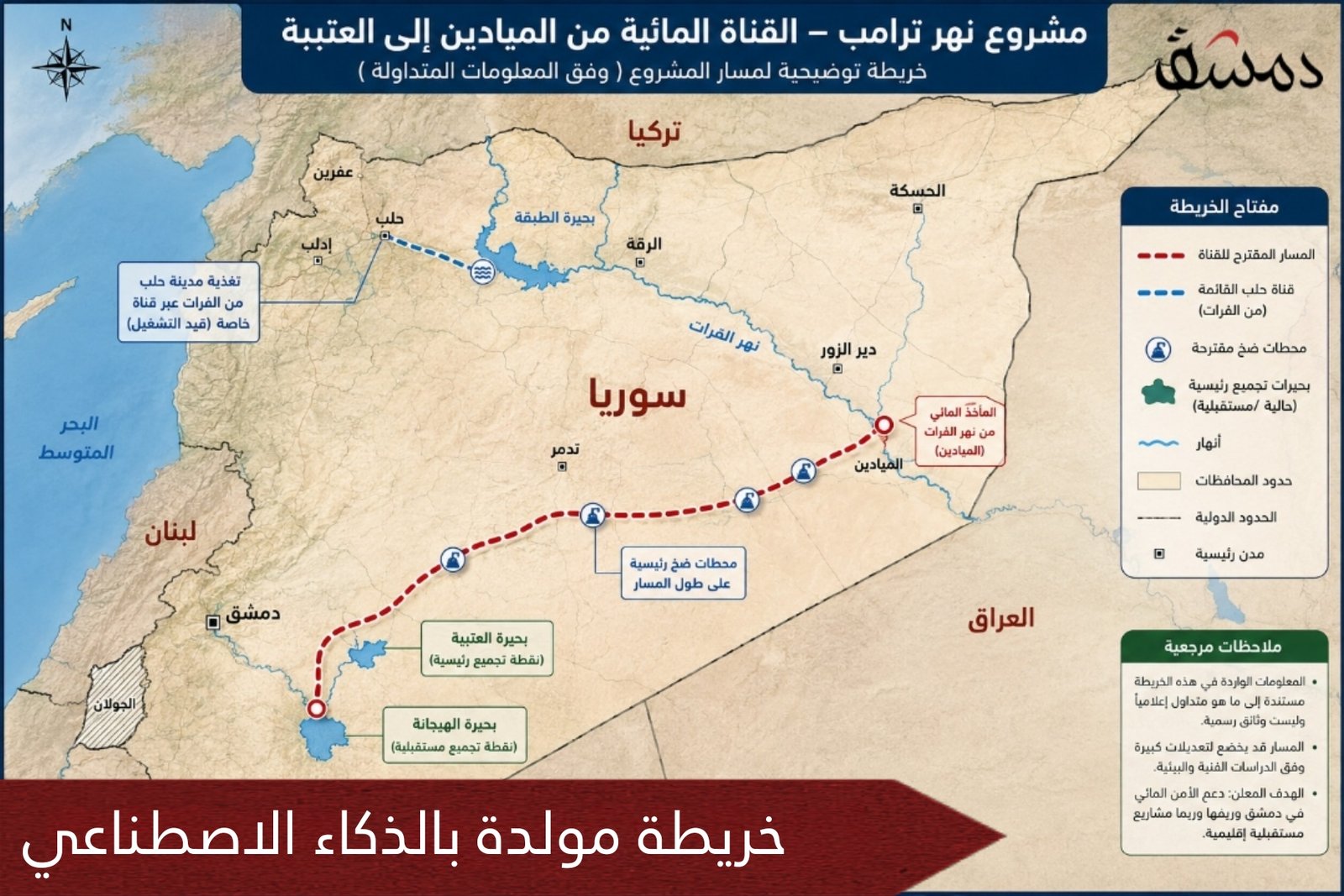
Sources following Syria’s reconstruction file have been circulating information about a large-scale water project reportedly being discussed behind the scenes under the name “Trump River.” The circulating concept is based on diverting water from the Euphrates River, starting from the Al-Mayadin area in the countryside of Deir ez-Zor, toward Lake Al-Otaybah in the Damascus countryside, through a long route crossing the Syrian desert toward the outskirts of the capital.
The circulated information places the project within a scope broader than a simple water channel. Discussions revolve around an integrated water transport system, including a water intake from the Euphrates, pumping stations, pipelines, storage reservoirs, and possibly agricultural reclamation areas along the route. So far, the project remains within the realm of political and media discussion, pending clear official information regarding the sponsoring entity, funding, maps, feasibility, and legal framework.
The importance of the idea stems from the escalating water crisis in Damascus and its countryside. The capital is facing increasing water pressure, and the Ghouta region has lost a large part of its former agricultural and environmental role. Meanwhile, Lake Al-Otaybah appears, according to the circulating vision, as a possible collection point that could help reshape part of the water landscape east of Damascus. In this sense, Al-Otaybah could shift from being merely a geographic location into a potential hub in Syria’s water security map.
However, the broader question raised by the project goes beyond Damascus: Can the Euphrates supply both Aleppo and Damascus?
Aleppo has for many years had a special system for receiving Euphrates water through facilities linked to Lake Assad, the Al-Khafsah station, and pipelines extending toward the city. This reality makes the proposed Al-Mayadin–Al-Otaybah project, if it develops, an extension of an old Syrian concept: transforming the Euphrates from an eastern river into the backbone of national water security. Aleppo previously occupied a place in this equation, and Damascus may now enter it through a more ambitious and complex formula.
From this perspective, the “Trump River” becomes a test of Syria’s ability to build a major water network connecting the east, north, and south. If Aleppo has already been linked to the Euphrates through its own route, connecting Damascus to the same river would mean the creation of a new water map, where the Euphrates becomes a central source for supplying major cities and a tool for redistributing population, agriculture, and investment.
The proposed route from Al-Mayadin to Al-Otaybah passes through a highly sensitive area. The Syrian desert appears in this scenario as both a corridor for water and a corridor for influence at the same time. Every pumping station, reservoir, and security point would require administrative and security agreements, because the proposed channel would pass through open areas vulnerable to local, tribal, and military dynamics.
Some interpretations go beyond Damascus itself. According to scenarios discussed in limited circles, the dry Al-Otaybah Lake, along with the dry Al-Hijanah Lake in the Damascus countryside, could later become two massive collection points for Euphrates water. In this case, the project would become more than a water rescue plan for the capital. It would transform into a regional storage and distribution infrastructure, through which water could be pumped southward toward Jordan and perhaps northern Saudi Arabia at a later stage.
This possibility gives the project major geopolitical significance. If Al-Otaybah and Al-Hijanah become part of a massive water collection system, they could turn into two water gateways on the edge of the desert and southern Syria. From there, one could imagine a network of pipelines or closed channels extending toward the Jordanian border and later connecting with water projects serving thirsty areas in northern Arabia, such as Dumat Al-Jandal. In this sense, the Euphrates would become part of an equation extending beyond Syria to the entire desert region of the Levant.
The name of Donald Trump, as mentioned in the leaks, gives the project a clear symbolic dimension. The name suggests a major deal more than a traditional irrigation project. Syria needs large-scale infrastructure projects, and Washington holds influence over files related to sanctions, energy, and eastern Syria. From this perspective, “Trump River” could be read as a title for testing a new political relationship, or as a trial balloon measuring Syrian and regional acceptance of linking water issues with broader matters.
From a technical perspective, the cost appears extremely high. The long distance between Al-Mayadin and Al-Otaybah would require continuous pumping stations, energy, maintenance, and security. Adding Al-Otaybah and Al-Hijanah as massive collection points would increase the need for precise geological and environmental studies, because transforming dry lakes into water reservoirs requires deep understanding of soil, permeability, salinity, evaporation, groundwater movement, and possible impacts on surrounding villages and lands.
A project of this scale would raise sensitive questions about water justice inside Syria. Residents of the Euphrates region would naturally ask: What share of their water remains in the east if it is transferred to Aleppo, Damascus, and then the south? Damascus residents would raise questions about water security after years of drought and population pressure. Southern Syrian communities may see Al-Otaybah and Al-Hijanah as a possible opportunity to revive water-starved areas. These questions require a clear national agreement, because water in the future Syria will be part of the definition of the state itself.
Regionally, other questions would emerge regarding Turkey, Iraq, Jordan, and Saudi Arabia. Any large-scale diversion of Euphrates water would require careful calculations, because the river is a transboundary resource, and every quantity withdrawn in one location affects others. Therefore, if the project moves toward seriousness, it would become a regional issue par excellence, where water intersects with energy, food, borders, and stability.
If the idea becomes a real project, it could produce major results on multiple levels. Damascus and its countryside could gain an additional water source that reduces pressure on traditional supplies. The Ghouta region could restore part of its agricultural role if the project is connected to a well-planned environmental and agricultural strategy. The desert could witness new employment and infrastructure activity. Large agricultural projects could potentially produce wheat on a scale comparable to what Ukraine produces today. Aleppo would become part of a broader national equation. Meanwhile, Al-Otaybah and Al-Hijanah could transform into the heart of a new water reservoir system reshaping Syria’s relationship with its south and neighboring regions.
However, environmental risks would remain central in any serious discussion. Pumping large amounts of water into dry basins could alter groundwater balances, increase salinity, change soil characteristics, and create new problems if managed without strict scientific oversight. Water that appears to be a solution in one place could become a burden elsewhere if handled as a matter of prestige or political deals.
The future of the project, according to the information currently circulating, depends on five main conditions: the availability of major funding, a political agreement regarding eastern Syria, security guarantees along the route, a clear legal framework for dealing with Euphrates water, and regional understanding regarding any possible extension toward Jordan or northern Saudi Arabia. These conditions make the transition from rumors to implementation a long process, but they also make the project a potential bargaining tool even before the first stone is laid.
Therefore, “Trump River” at this stage appears to be primarily a political title. It could be an initial study, a proposal inside negotiation rooms, or a test of public opinion and regional powers. Its current importance lies in the fact that it reveals a shift in the Syrian debate from the question of power alone to the question of resources and regional partnership: Who owns the water? Who distributes it? And who decides its destination? Could Syria become a regional water hub?
In a country that has emerged from a long war and entered a severe climate and water crisis, water becomes the essence of sovereignty. The project of transferring Euphrates water to Al-Otaybah, and possibly later to Al-Hijanah and the wider south, raises a question bigger than the channel itself: Can a fair Syrian water policy be built, making the Euphrates a unifying national river that serves the east, north, capital, and south, rather than becoming a new source of conflict?
Until official documents clarify the matter, “Trump River” remains a project circulating behind the scenes — intriguing, open to political use, and subject to multiple possibilities awaiting regional settlement. Between an engineering dream and a political test, Syrian water today stands at the center of a new phase, where future channels may draw the boundaries of influence as much as they may quench thirst.