





By Historian Amr al-Mallah
Historian Kamel al-Ghazzi, in his famous book Nahr al-Dhahab (The River of Gold), attributes the main reason behind the dismissal of Aleppo Governor Raif Pasha by Sultan Abdul Hamid II in 1900 to his replacement of the “Sultan’s Water Fountain” (Qastal al-Sultan), which had been built by Sultan Suleiman the Magnificent in Aleppo in 1533 and was on the verge of collapse, with the “Clock Tower, one of the inventions of the Europeans.”
This account, which resembles an oral narrative, oversimplifies the matter and fails to address the deeper reasons behind the governor’s removal. It is well known that the construction of the Bab al-Faraj Clock Tower, completed during Raif Pasha’s tenure in 1899, coincided with the erection of similar clock towers in many Ottoman cities, including Istanbul itself, upon the encouragement of Abdul Hamid, who viewed them as symbols of modernization and progress.
Although al-Ghazzi noted, in his discussion of the circumstances surrounding Raif Pasha’s dismissal, that Abdul Hamid “warned against him and viewed him with suspicion, believing that he was following the political path of Midhat Pasha, the hero of the Ottoman Constitution, since he had once served as his assistant,” he did not explore these facts in sufficient depth despite their significance in understanding the Sultan’s governing philosophy.
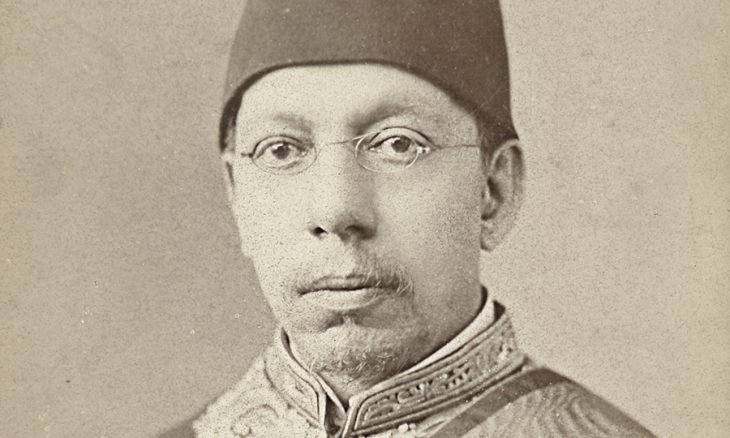
This article seeks to uncover the real reasons behind the dismissal of Raif Pasha, one of the most prominent protégés of Midhat Pasha, the leading figure of the Ottoman Tanzimat reforms and a strong advocate of constitutional government modeled after European systems. Turkish historian and academic Ramadan Güllü even describes Raif Pasha as “the disciple of Midhat Pasha.”
Who Was Raif Pasha?
Ottoman historical records indicate that Raif Efendi was born on the island of Crete, then part of the Ottoman Empire, in 1836. After completing his education in Istanbul, he joined the central administration. His professional career began in earnest with the establishment of the Danube Vilayet in the Balkans in 1864, where he was appointed assistant to Governor Midhat Pasha. He later served alongside him again when Midhat became governor of Baghdad in 1869.
Upon Midhat Pasha’s recommendation, Raif was appointed Mutasarrif (district governor) of Beirut in 1878, when Beirut was still attached to the Province of Syria under Midhat’s governorship. In 1880, Midhat sent him to Istanbul to discuss reform initiatives with the central government, but Sultan Abdul Hamid retained him there and appointed him Minister of Trade.
The Sultan continued to entrust Raif Pasha with important positions even after the downfall of Midhat Pasha, seeking to ease tensions with the modernizing Tanzimat elite and relying on their expertise to implement his own modernization projects. In 1884, Raif was promoted to the rank of Minister and granted the title of Pasha.
Raif Pasha remained active in public service even after Abdul Hamid’s deposition, due to his status as one of the leading advocates of political modernization and his extensive administrative experience. He died in Istanbul in 1911.
Raif Pasha as Governor of Aleppo
Raif Pasha assumed the governorship of Aleppo in early 1896 during a period marked by significant instability. Armenian separatist movements had reached the peak of their armed rebellion in several Ottoman provinces with substantial Armenian populations, and serious disturbances had affected parts of Aleppo Province.
Soon after the Armenian unrest subsided, the Ottoman-Greek War of 1897 broke out. Marshal Edhem Pasha, who had commanded the forces that suppressed the Armenian uprising in Aleppo, was appointed commander-in-chief of the Ottoman armies fighting Greece. Lieutenant General Ali Muhsin Pasha, one of the Sultan’s military aides and a participant in the suppression of the rebellion, was appointed Extraordinary Commander over the provinces of Aleppo and Adana and their surroundings, reflecting the broad powers granted to him.
This arrangement likely reflected Abdul Hamid’s desire to maintain a balance between Governor Raif Pasha and Ali Muhsin Pasha, both personally and institutionally, during a particularly turbulent period.
According to Ramadan Güllü’s research in the Ottoman archives, conflict soon emerged between the two officials over their differing approaches to handling the Armenian issue. Their disagreement stemmed largely from their professional backgrounds: Ali Muhsin, as a military officer, favored security-oriented measures, while Raif Pasha, a lifelong civil administrator, advocated political solutions.
Beginning in 1897, this rivalry intensified and shaped the remainder of Raif Pasha’s tenure in Aleppo, as both men continuously exchanged accusations until the governor’s eventual dismissal.
The Governor and the Military Commander Exchange Accusations
Following the suppression of the Armenian uprising, the confrontation evolved into what could be described as a “war of reports,” with both officials submitting complaints to the Imperial Palace Secretariat (Mabeyn-i Hümayun).
According to Ottoman archival documents, Ali Muhsin Pasha accused Raif Pasha of attempting to expand his personal influence through close ties with Aleppo’s elite and of adopting an excessively lenient approach toward Armenian affairs and their aftermath. He demanded greater authority over provincial administration, arguing that Armenian separatists were preparing another revolt.
In the summer of 1898, Istanbul dispatched a special investigative commission to Aleppo to examine the dispute. However, it proved unable to resolve the growing conflict.
In his own reports, Raif Pasha denied that the dispute stemmed from personal differences. Instead, he argued that their disagreements reflected fundamentally different views on governance. He accused Ali Muhsin Pasha of interfering in civil administration and exploiting his position for personal gain, citing his acquisition of vast agricultural lands allegedly purchased from local owners at unfairly low prices.
The Struggle for the Presidency of the Municipality
Research by Güllü indicates that the conflict between the governor and the military commander negatively affected provincial administration.
A close examination of Ottoman newspapers reveals an administrative crisis surrounding the Aleppo Municipality in the summer of 1899. A correspondent for the Beirut newspaper Lisan al-Hal reported the appointment of Muhammad Mar‘i Efendi, a respected local notable, as municipal president.
The report explicitly suggested that an unnamed party had sought to remove the municipal presidency from Aleppo’s local landowning bureaucratic elite and assign it to an outsider who was not even registered among the city’s taxpayers. The correspondent praised Raif Pasha for blocking this effort and ensuring that the position remained in the hands of a qualified local figure.
Although the report did not identify the rival party, the struggle over municipal leadership cannot be separated from the broader conflict between Raif Pasha and Ali Muhsin Pasha.
The Dismissal of Raif Pasha
Complaints against Raif Pasha continued to accumulate, eventually forcing Sultan Abdul Hamid to side with one of the two rivals. After considerable hesitation, he ultimately favored Ali Muhsin Pasha.
One important factor was reports concerning Raif Pasha’s strict measures against tobacco smuggling, which benefited the Régie Company, the monopoly responsible for tobacco production and trade and closely linked to the Ottoman Public Debt Administration dominated by European creditors.
These measures contradicted the government’s informal policy of tolerating tobacco smuggling and avoiding cooperation with the Régie in suppressing it. As British historian Donald Quataert has shown, the Ottoman state often viewed such smuggling as a form of popular resistance against foreign control over revenues dedicated to debt repayment.
Aleppine historian Raghib al-Tabbakh, in his book I‘lam al-Nubala’, notes that when Raif Pasha received notice of his transfer from Aleppo, he asked local notables about his mistakes during his tenure. Among the criticisms they listed was his support for the Régie administration, whose policies had inflicted significant hardships on the population.
Consequently, Sultan Abdul Hamid dismissed Raif Pasha and appointed Anis Pasha as his successor in July 1900.
Notably, the dismissal occurred only two months before celebrations marking the twenty-fifth anniversary of Abdul Hamid’s accession to the throne. These celebrations were to include the inauguration of several major urban projects completed during Raif Pasha’s administration, including the Bab al-Faraj Clock Tower, the Aziziyah Police Station, and numerous other public works.
Some scholars engaged in local historical studies have attempted to enrich Arabic historiography on late Ottoman Aleppo by relying primarily on works by historians such as al-Ghazzi and al-Tabbakh, and occasionally on Ottoman yearbooks (Salnames), without consulting the official documents preserved in the Ottoman archives. As a result, their work has often remained incomplete.
In reality, any attempt to write the history of the Ottoman period while neglecting the Ottoman archives and other relevant Western archival sources will remain deficient and far removed from the scientific standards and methodological requirements of historical scholarship.