





Ibrahim Al-Jabin
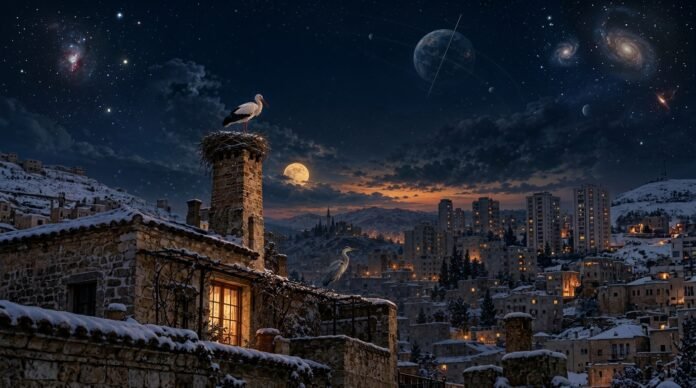
The world was small. We believed that the moon lived on the rooftop, that the sun came through the window, and that the old chimney had originally been built to serve as a nest for the grey heron. This heron alone was the ultimate authority on its own existence and nonexistence, though it possessed neither religious nor any other kind of authority. All it had was its whiteness and the sadness it brought with it along its migratory route from thousands of kilometres away.
The world grew larger. We came to believe that the moon was a tiny thing, far too insignificant to live on the rooftop, and that the sun was a ball of fire that could not pass through the bars of a window. The grey heron stopped coming. They had demolished the old chimney and the house, and new apartment buildings had risen in their place. When I asked about it, I was told that the heron and its kin had changed their migration route, according to a study conducted by a team of researchers led by Andrea Flack of the Max Planck Institute for Ornithology in Germany, using the Global Positioning System (GPS). Those flocks no longer passed over our country, sparing themselves the sight of things that might displease them.
More importantly, however, the knowledgeable volunteered an explanation: the bird that nested atop chimneys had not been the grey heron at all. The grey heron preferred small lakes on the outskirts of cities and in the countryside as nesting sites. It was the stork that nested on chimneys.
I am not the only one who has confused the grey heron with the stork. Just two days ago, Nidal Qassoum, a former researcher at NASA, said that the internet, rather than serving as a means of transmitting information, had become a means of spreading scientifically false information.
Such misinformation includes the claim that the four seasons—spring, summer, autumn and winter—follow one another on our planet because of its changing distance from the sun. This is entirely incorrect. If that were the case, given that the Earth rotates on its axis once every 24 hours, the entire planet would be experiencing winter these days, rather than just one part of it or another. The actual reason is the tilt of the Earth’s axis.
That is not all. Modern science is now dismantling our deeply held beliefs about the zodiac signs, the planets and their relationship with human beings. It is true that around 80 per cent of our bodies consists of water, and one might therefore assume that our bodies should be subject to the same effects as seawater, with its tides influenced by the moon’s proximity or distance. Yet the human body is exceedingly small compared with celestial bodies, and no tidal effect can occur within it.
Another widespread misconception is that microwave ovens have harmful radiation effects. This, too, is nothing more than an illusion.
As for milk, modern science tells us that it does not benefit bones and teeth simply because it is rich in calcium. In reality, bones themselves attempt to resist the strong acidity of milk, and this causes them to produce more calcium.
But perhaps the most painful piece of misinformation is the claim that sunflowers do not turn towards the sun, but instead always face east.
How much, then, must we reconsider the information and ideas we have grown accustomed to accepting?
Yet the world was small, and throughout the night we would listen to the sound of falling snow and to the grey heron as it wove its nest atop the chimney.