



Dimasheq News Platform
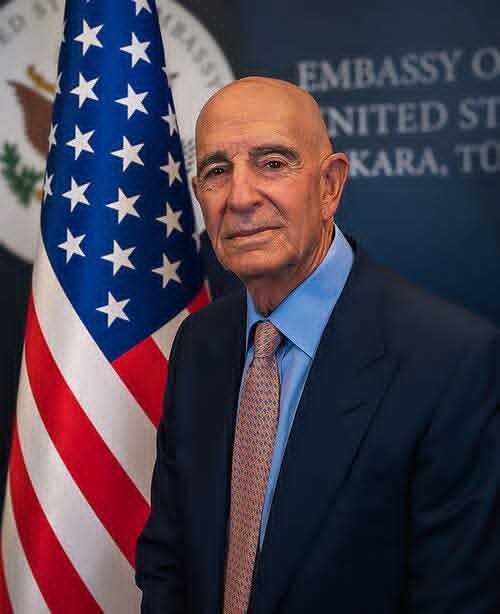
The US Special Envoy to Syria, Tom Barrack, expressed his dissatisfaction with the renewed escalation in Sweida Governorate, calling on all parties to exercise restraint and return to dialogue.
In a post on the platform X, Barrack said that Washington had signed, around a year ago, alongside Syrian Foreign Minister Asaad Al-Shaibani and Jordanian Foreign Minister Ayman Safadi, a “tripartite roadmap for peace in Sweida,” aimed at reintegrating the governorate into Syria while ensuring “the dignity, rights, and duties of citizenship for members of the Druze community.”
He stressed that this path remains, in his view, the “only” one capable of sparing Sweida further grief and tension, emphasizing that Syria’s Druze are “a people with a noble and ancient history.”
Barrack pointed out that the absence of governance creates a vacuum that allows gangs to fill it, accusing “a very small number of individuals with toxic motives” of turning against members of their own community. He specifically mentioned Atef Huneidi, whom he said had been subjected to arbitrary detention and forced to leave his home.
He added that the US team is in contact with Huneidi and others whom he said had become caught up in a “campaign of violence within the same community.”
The US envoy called for continued cooperation between the Druze, Arab tribes, and Syrian parties neighboring Sweida, based on tolerance and mutual understanding. He stressed the need to view Syria as “one nation and one people,” while respecting the diversity of cultures and beliefs.
He also emphasized the need to place any “hasty military reactions” exclusively in the hands of the national state, considering community dialogue and empathy to be the most appropriate path for addressing differences.
Regarding the events of last July, Barrack said that the Syrian government had begun confronting the serious crimes committed by its forces during those events and holding those responsible accountable before Syrian courts, describing this as “the direction of hope” that should continue.
He stressed that the way forward requires dialogue that ensures accountability, restores security, paves the way for the return of displaced people, and supports the reconstruction of areas that have suffered destruction.
Barrack concluded by calling on all parties to commit to restraint and engage in serious and sincere communication, warning that “the alternative to dialogue is not victory, but another round of mourning.”