



Fares Al-Dhahabi
The fall of Bashar al-Assad’s regime changed Syria’s political landscape, while the repercussions of the Syrian phase remained strongly present in Lebanon. The shared geography, long borders, and networks of interests, weapons, and smuggling that developed over decades have made the two countries part of an interconnected security and political space that is difficult to separate merely through a change of power in Damascus.
Since the fall of the former Syrian regime in December 2024, Syria has entered a new political and security phase, while Lebanon has found itself facing additional repercussions from the Syrian conflict. Some of its border areas have become potential transit points for individuals and networks associated with the former regime, while regional powers continue to use the Lebanese arena as part of broader struggles for influence in the region.
Here, the crisis of the Lebanese state becomes particularly clear. Weak institutions, multiple centres of power, the spread of weapons outside official institutions, and fragile control over parts of the border all provide local and regional forces with wide room for movement and influence.
The fall of Damascus led a number of officers, military personnel, and figures associated with the former regime to move to Lebanon. At the beginning of 2026, Syrian demands emerged for the pursuit of more than two hundred former officers who were said to have fled to Lebanese territory following the collapse of the regime. In August of the same year, Lebanese authorities handed former Major General Adel Issa over to Damascus, a move that revealed the scale of the emerging security file between the two countries.
These developments give Lebanon particular importance for networks that were formed over decades of Syrian presence and the security and political influence of the Assad regime. Family, commercial, and security ties extending across both sides of the border, along with unofficial crossings and old smuggling networks, provide an environment that allows individuals to move, hide, and rebuild channels of communication.
The areas of the northern Bekaa and Hermel have acquired additional sensitivity because of their geographical location and their historical connections with neighbouring Syrian regions. During the previous period, accusations were raised regarding the presence of figures or groups associated with the former regime in some of these areas, prompting Lebanese security agencies in a number of cases to carry out raids and investigations.
These realities place Lebanon before an increasing security and political challenge: how can it prevent its territory from becoming a rear base for the reorganisation of networks linked to the Assad era, and how can it manage its relationship with the new Syrian authorities from the standpoint of a state and its institutions?
The border between Lebanon and Syria represents one of the most influential points of weakness in relations between the two countries. The border, which stretches across vast mountainous and rural areas, has witnessed intensive smuggling activity for decades, movement through unofficial crossings, and deep social and family connections between villages on both sides.
With the transformations that Syria has witnessed following Assad’s fall, the importance of this area has increased. The border has become a space in which the interests of the new Syrian state, the Lebanese army, local clans, smuggling networks, and armed forces linked to the Lebanese and regional landscape intersect.
In March 2025, clashes erupted along the border involving Syrian forces and armed elements from the Lebanese side, prompting both governments to strengthen security coordination. The following year, the Syrian-Lebanese border witnessed a broad Syrian military deployment aimed at controlling the movement of weapons and fighters and preventing smuggling networks from using the area.
These events reveal the nature of the challenge. Relations between Lebanon and Syria are entering a new phase that differs from the period of direct Syrian domination that characterised previous decades. However, weak central control over the border allows the space to remain open to numerous local and regional actors.
Thus, the crisis shifts from one form to another: from official influence exercised by Damascus within Lebanon to a border space where security networks, armed interests, and regional calculations intersect.
Hezbollah, Iran, and Multiple Centres of Decision-Making
The second factor behind Lebanon’s continued role as an arena of conflict is linked to the presence of Hezbollah, its military strength, and its strategic relationship with Iran.
The party possesses a broad political and military structure and enjoys significant social influence in parts of the south, the Bekaa, and Beirut’s southern suburbs. Over the past decades, it has also formed a fundamental element of the Iranian regional project extending from Tehran to Iraq, Syria, and Lebanon.
The Assad regime provided this project with strategically important geographical depth. Syrian territory served for years as a major route for weapons and support coming from Iran to Hezbollah. With the fall of the former Syrian regime, this route suffered a major strategic setback, and the party found itself operating in a different regional environment.
Nevertheless, Iran’s influence continues within the Lebanese equation through its close relationship with Hezbollah, the party’s military capabilities, and its presence within Lebanese political institutions.
For this reason, the issue of restricting weapons to the state has become central to the Lebanese debate. In August 2025, the government tasked the army with preparing a plan to place weapons exclusively under official institutions, quickly turning the issue into one of the country’s most prominent political and sectarian dividing lines.
Hezbollah and its allies view its weapons as an element connected to confronting Israel and maintaining the regional balance, while other Lebanese forces believe that restoring the state’s authority over decisions of war and peace is the essential gateway to rebuilding Lebanese sovereignty.
Here lies the core of the dilemma: Lebanon has official state institutions, while at the same time containing an armed force that possesses an independent military decision-making capacity and capabilities exceeding those of many state institutions. This overlap often makes Lebanese security decisions connected to developments stretching from Tehran to Damascus, Tel Aviv, and Washington.
Lebanese divisions over foreign influence are clearly reflected geographically, politically, and socially.
In the south, the Bekaa, and Beirut’s southern suburbs, Hezbollah enjoys considerable political and social weight, while the relationship with Iran holds a strong presence in political and security discourse. In other areas, particularly among broad segments of Christian, Sunni, and Druze communities, the idea of restricting weapons to the state and opening up to the Arab and international environment enjoys broader support.
Yet the map remains more complex than a fixed sectarian division. Within every sect there are competing currents, and even within the Shiite community there are multiple voices regarding Hezbollah’s role. Christian, Sunni, and Druze communities also contain differing orientations in their relations with Syria, Iran, the Gulf states, and the West.
However, the sectarian political system adds another dimension to these divisions. Every shift in the regional balance of power is reflected in internal dynamics, and every external conflict finds allies and opponents within the Lebanese arena.
For this reason, Lebanon repeatedly becomes a meeting point for multiple regional projects.
Iran views Hezbollah as one of the most important elements of its influence in the Levant. Israel sees southern Lebanon as a major security front. The new authorities in Damascus monitor the border, networks of the former regime, and the movements of armed forces. Gulf states follow the future of Lebanon’s political balance. The United States, France, and other international powers link Lebanon’s stability to strengthening state institutions and the army.
Amid this broad network, Lebanon itself stands with weak institutions, an exhausted economy, and a political system highly sensitive to sectarian balances.
The fall of Assad gives Lebanon and Syria an opportunity to redefine their relationship.
The new phase could open the door to addressing issues that have remained unresolved for decades: border demarcation, the regulation of crossings, combating smuggling, the cases of detainees and missing persons, the issue of Syrian refugees, security cooperation, and the regulation of economic relations.
This phase requires a transition from relationships based on networks of influence, security agencies, and political parties to official relations between the institutions of the two states.
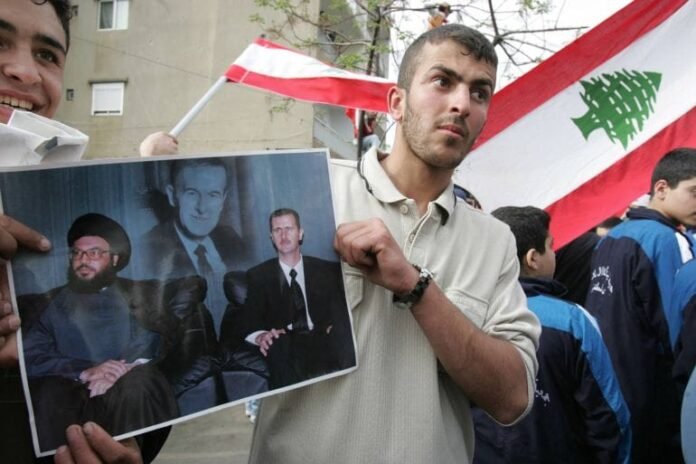
The previous period left a heavy legacy inside Lebanon. Lebanese political and security forces were linked to the former Syrian regime, while networks of interests developed during the years of Syrian tutelage and extended into the state, economy, and security sectors. Following the withdrawal of the Syrian army in 2005, some of these relationships continued in different political and security forms, and some were reinforced during the Syrian war after 2011.
Lebanon has now become a place where figures associated with the former Syrian era meet Lebanese forces that have maintained historical relations with Damascus, alongside Hezbollah, which participated militarily in the Syrian war in defence of the Assad regime. Meanwhile, the new Syrian authorities view some of these networks as a potential security threat.
Thus, the relationship with Syria has become another component of the Lebanese division over the identity of the state and its regional orientation.
Lebanon’s crisis goes beyond the names of countries and organisations. Its core is connected to the state’s ability to impose its authority.
A strong state controls its borders, determines its foreign policy, monopolises organised weapons, decides through its institutions whether to enter war or negotiate peace, and prevents its territory from becoming a base for groups linked to external conflicts.
Weakness in these functions, however, opens the way for the most organised, armed, and well-funded forces to fill the vacuum.
For this reason, Lebanon continues to occupy the position of an arena.
The effects of the Syrian war, networks of the former regime, Iranian influence, Hezbollah’s calculations, Israeli pressures, and American and Arab interests all intersect on its territory. Internal divisions become channels through which these conflicts penetrate the heart of the Lebanese political system.
The fundamental problem, therefore, lies in the structure of the Lebanese state itself.
The fall of Assad changed one of the most important balances of power in the Levant, but it left Lebanon facing a more urgent question: who holds the decision-making power over Lebanese territory?
The answer to this question will determine the country’s future.
If Beirut succeeds in strengthening the army, security agencies, and civil institutions, controlling the border with Syria, ending the duality of weapons and security decision-making, and establishing a balanced relationship with the new authorities in Damascus, Lebanon could gradually move from being an arena of conflict to becoming a state capable of making its own decisions.
However, the continuation of divisions over weapons and foreign influence, combined with porous borders and weak state institutions, means that Lebanon will remain vulnerable to absorbing the region’s crises and transforming them into internal crises.
From this perspective, the relationship with Syria becomes a test of Lebanon’s own future.
What is required goes beyond ending the legacy of the old Syrian tutelage or dealing with remnants of the Assad regime. What is required is the construction of a state capable of protecting its borders, organising its relations with neighbouring countries, restricting armed power to its institutions, and formulating its foreign policy according to the interests of the Lebanese people.
Only then can the geography between Lebanon and Syria be transformed from a corridor for conflicts into a space for cooperation between two states, and Lebanon can move from being an arena contested by competing regional axes into a country capable of shaping its own choices.