





Dimasheq
Dr. Nizar Al-Ani

The remarkable public turnout for the play Dress Rehearsal for Judgment Day, recently staged in Damascus, is truly striking. Written by Fares Al-Dhahabi, directed by the outstanding Maher Salibi, and performed by acclaimed actors Yara Sabri, Robin Issa, and Jaber Jokhadar, the production attracted exceptional interest. It took me two days of waiting, crowds, and even personal connections to finally secure a seat. This was my first time attending a theatre performance in Damascus in forty years, due to my years of living abroad.
In my view, this overwhelming attendance can be attributed to two main factors. First, the current scarcity of cultural activities, combined with the Ministry of Culture’s support for the production, has encouraged people to seek entertainment and a break from routine. Second, the play itself raises pressing questions about the very essence of justice following the fall of the former regime.
The story revolves around two women, Sama and Thuraya, who were imprisoned and repeatedly assaulted over a period of three years because of their involvement in local coordination committees. When Thuraya encounters Fouad, the man she believes was their prison guard and abuser, she kidnaps him, sedates him, and takes him to the basement of the tailoring workshop where both women now work.
Fares Al-Dhahabi employs the classic Shakespearean dramatic device found in works such as Hamlet and Macbeth: the conflict between certainty and doubt, reality and illusion. The central question remains whether Fouad is truly their former jailer or simply a man who resembles him. Their only evidence lies in the unforgettable stench they remember and the terrifying image of his teeth. Should they kill him in revenge, or should they put him on trial and perhaps even acquit him? Throughout the play, the dialogue revolves around the philosophy of justice itself. This uncertainty keeps the audience fully engaged, provoking questions and creating genuine dramatic tension.
The Playwright’s Theoretical Foundation
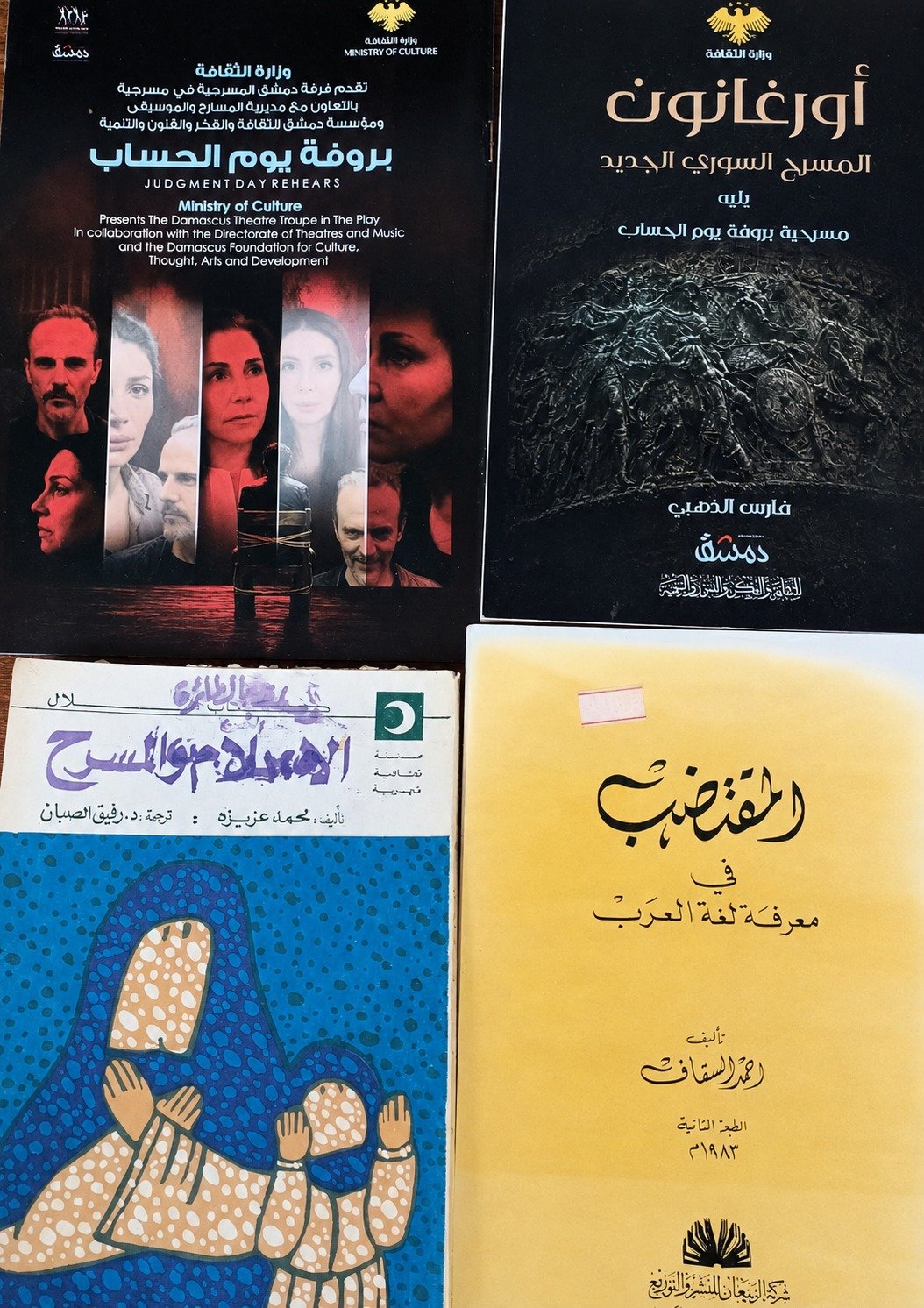
In his book Organon, Fares Al-Dhahabi argues that Syrian theatre suffers from a crisis in dramatic writing, aesthetics, acting, and artistic vision. He advocates a comprehensive renewal of theatrical production through a modern perspective, calling for reform of theatrical institutions alongside improvements in criticism and the economic sustainability of theatre as an industry.
How, then, does Dress Rehearsal for Judgment Day reflect these theoretical ideas?
The play serves as a practical model for the vision presented in Organon—a title referring to a new intellectual guide for theatre, echoing the critical and theatrical philosophy once advanced by George Bernard Shaw.
In my personal reading, the play addresses urgent social and political realities. It asks questions rather than offering ready-made answers. It is deeply connected to everyday life, dynamic, surprising, and firmly grounded in ideas and human values. I believe Al-Dhahabi has successfully translated much of his theoretical vision into dramatic practice.
Direction and Production
The programme distributed to the audience outlines the director’s artistic vision, introduces a production team of nearly thirty members, and summarizes the play’s intellectual foundations in the following words:
“A journey toward survival, led by a memory that believes justice may be delayed but never dies. A psychological play. How do we judge the past when memory is the only witness left?”
The minimalist staging is nevertheless rich in symbolism. Dolls represent the absent segments of society, while colourful ropes and threads suspended across the stage and ceiling create a visually striking theatrical space. The casting of the three lead actors proves highly successful, and much of the production’s acclaim is due to their exceptional performances.
Islam and Theatre
Does this production signal profound transformations in Syrian and Arab theatre? Ambition is always welcome, although reality remains burdened by many obstacles.
More than fifty years ago, the pioneering theatre scholar Dr. Rafiq Al-Sabban translated the book Islam and Theatre by Mohamed Aziza.
The book argues that Arabs and Muslims excelled in almost every literary genre adopted from the West—except theatre. According to the author, theatre is fundamentally built upon conflict, a concept rooted in the myth of Prometheus, who stole the sacred fire from the gods.
By contrast, the author contends that the dominant concept of complete reliance on God within Islamic thought, together with belief in divine destiny and limited human agency, has historically made the theatrical tradition less likely to flourish.
He further argues that the structure of the Arabic language—with its grammar, morphology, and dialectical diversity—is less naturally suited to theatrical performance than the linguistic environment in which ancient Greek theatre developed.
Our civilization has produced many great poets and novelists, yet relatively few major playwrights. In my humble opinion, theatre remains an art form that depends upon tools of development which may not always align with religious priorities. I sincerely hope that my assumptions are mistaken, for no one has the right to deny optimism.
Dress Rehearsal for Judgment Day was like a stone cast into the still waters of Damascus’s cultural life. It stirred the waters, encouraged audiences to break away from routine, and dispelled a sense of stagnation.
My sincere thanks go to Fares Al-Dhahabi, Maher Salibi, Yara Sabri, Jaber Jokhadar, Robin Issa, the entire production team, and the theatre staff, who worked under exceptionally difficult circumstances to manage the unprecedented crowds. My apologies if this reflection has been somewhat lengthy.