

Fares Al-Dhahabi
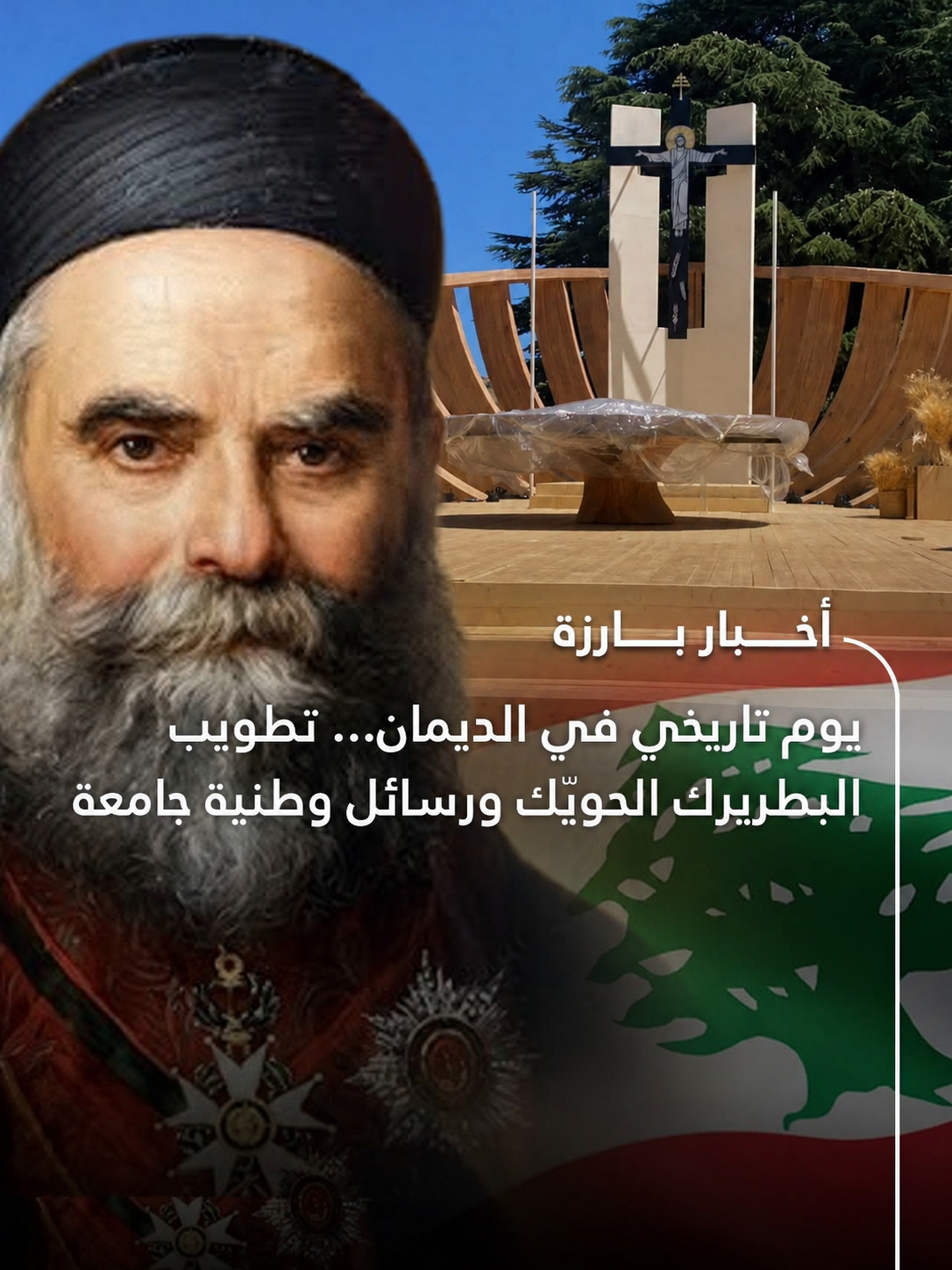
The beatification of Patriarch Elias Al-Houwayek carries a meaning that goes beyond a Church occasion or the celebration of a great spiritual and national figure. It is a beatification of Lebanon’s historical experience, a recognition of its civilizational mission, and a renewal of the commitment to the idea upon which this country was founded: freedom, pluralism, openness, partnership among its communities, and the ability to transform diversity into cultural and human strength.
At this difficult moment for the Lebanese people, and in a time of profound turmoil across the Middle East and the world, the beatification of Patriarch Al-Houwayek comes as a foundational and pivotal moment. Through it, Lebanon rediscovers the meaning of its origins and looks toward its future through the life of a man who carried the cause of his people to international forums and contributed to transforming the Lebanese dream into a recognized political entity.
Patriarch Al-Houwayek was a man of far-reaching national vision. In the aftermath of the collapse and dissolution of the Ottoman Empire, he understood the Lebanese people’s need for a state capable of protecting their freedom and diversity and giving them the ability to participate in shaping the future of the Levant. He carried Lebanon’s demands to the Paris Peace Conference and advocated the establishment of Greater Lebanon within borders capable of securing its economic, social, and political viability.
This path culminated on September 1, 1920, when General Henri Gouraud proclaimed the establishment of Greater Lebanon in the presence of Patriarch Al-Houwayek and a number of religious, political, and national figures at the Pine Residence. That moment marked the birth of an entity whose founding project extended beyond geography: a homeland of freedom, a platform for enlightenment, a laboratory for coexistence, and a bridge between East and West.
Lebanon stood at the heart of the Arab renaissance following the fragmentation of the Ottoman Empire. From its cities, schools, universities, newspapers, and printing presses emerged ideas of renewal, modernity, and reform.
Its thinkers, writers, journalists, and emigrants contributed to reviving the Arabic language, developing journalism, spreading modern political thought, and advocating freedom, constitutionalism, citizenship, and human rights.
Lebanon gave the Arab renaissance its names, platforms, and spaces of freedom. From Beirut and Mount Lebanon, the movements of writing, translation, and printing extended throughout the Arab world. Lebanese people contributed to building cultural, journalistic, and artistic life in Cairo, Damascus, Baghdad, Alexandria, and the capitals of the diaspora.
For this reason, the rise of the modern Arab world is closely linked to Lebanon’s freedom and its ability to fulfill its intellectual and cultural role.
Today, Lebanon is preparing to lead a new Arab intellectual renaissance following its anticipated and complete liberation from Iranian hegemony and from the system of weapons outside the authority of the state. Lebanon’s renaissance requires the restoration of national decision-making and the establishment of a sovereign state that alone possesses the authority over defense, security, war, and peace, while protecting its borders, institutions, and citizens.
The liberation of Syria and Iraq from Iranian influence remains interconnected with Lebanon’s freedom and renaissance. The region constitutes a politically and civilizationally interconnected space in which projects of control cross borders through militias, arms networks, and parallel economies.
The liberation of the Levant will be complete when its states regain their decision-making authority, armed forces and militias are brought under the control of legitimate institutions, and the era in which Arab societies are used as arenas for regional conflicts comes to an end.
In Lebanon, this transformation begins by moving beyond the logic of militias, addressing the phenomenon of uncontrolled weapons linked to the Iranian project, extending state authority across the entire country, ending the occupation in southern Lebanon, and establishing full national sovereignty free from external tutelage or equations imposed by weapons.
Lebanese sovereignty requires the liberation of both territory and decision-making. Liberating the south from occupation and freeing the state from the domination of illegal weapons constitute a single national path whose goal is to establish a state that protects Lebanon through its legitimate power, institutions, the unity of its people, and balanced Arab and international relations.
In this context, the beatification of Patriarch Al-Houwayek carries a clear call to restore the state. Honoring his legacy means building a republic based on citizenship, freeing institutions from corruption and sectarian patronage, restoring the standing of the judiciary, education, and a productive economy, and establishing the rule of law above all.
Al-Houwayek envisioned Lebanon as a homeland for all its citizens and a space where Christians and Muslims could meet in full national partnership. He saw the protection of the Christian presence in the East as a cultural presence and a mission of openness and service, and Christian-Muslim coexistence as the foundation of a civilizational model capable of offering the world a different example.
Here, Al-Houwayek’s life connects with the vision expressed by Pope Saint John Paul II during his historic visit to Lebanon in 1997, when he affirmed that Lebanon is more than a country: it is a message of freedom and pluralism for both East and West.
Lebanon as a message is Lebanon of the free human being, the free university, the free press, and free thought. It is the Lebanon of Said Akl, the Rahbani Brothers, Michel Chiha, Ghassan Tueni, Elias Al-Houwayek, Bechara El-Khoury, Riad Al-Solh, the Yaziji and Bustani families, the Eddes, and Ahmad Faris al-Shidyaq; the Lebanon of Gibran and May Ziadeh.
Lebanon of books, theater, music, and the arts. It is the Lebanon that allows every person to preserve their faith and identity while meeting others within the framework of citizenship and mutual respect.
Lebanon’s message today requires liberation from rigid slogans and a return to becoming a living political and cultural project. Lebanon can be a center of a new Arab renaissance, a space for producing ideas, a platform for dialogue, and a capital of culture, economy, and creativity when it restores its sovereignty and rebuilds its institutions.
The beatification of Patriarch Al-Houwayek reminds the Lebanese that nations need, at every stage, to be founded anew. Al-Houwayek contributed to the geographical and political founding of Greater Lebanon, while the present generations bear the responsibility of founding the Lebanon of the future.
A Lebanon of a just civil state, full sovereignty, a productive economy, advanced education, equal citizenship, and firmly rooted Arab relations.
This is a moment to move from Lebanon as an arena to Lebanon as a state; from a society governed by fears to a homeland protected by institutions; from an economy of emigration and collapse to an economy of knowledge and creativity; and from a culture of militias to a culture of citizenship and law.
Lebanon will rise because the foundations of its renewal are deeply rooted in its history, its composition, and the potential of its people. It will rise through its universities, schools, creators, and communities spread throughout the world, and through its enduring ability to transform pain into culture, crisis into opportunity, and diversity into a message.
Lebanon will rise because the destiny of messages is to reach their destination, no matter how long the journey of carrying them may be.
The message may stumble. One generation may carry it and hand it on to another. It may pass through wars, divisions, and exiles, yet it ultimately finds its way to the world. This is the strength of Lebanon as a message: its ability to remain alive in moments of collapse, to recover its voice after silence, and to launch a new renaissance whenever others believe its role has ended.
Today, with the beatification of Patriarch Elias Al-Houwayek, Lebanon rediscovers the image of its spiritual and national founder and renews its promise to itself, to the Arabs, and to the world: the promise of freedom, sovereignty, renaissance, enlightenment, and coexistence.
It is a moment of beatification for a man, a beatification of a national experience, and the founding of the Lebanon of the future.
Lebanon, which contributed to the first Arab renaissance, is capable of leading its new intellectual renaissance. And Lebanon, which carried the message of freedom through its darkest moments, will carry it once again, because its message is greater than its crises, and because the destiny of messages is to reach their destination.