

Ibrahim Al-Jabin
The Syrian Reality
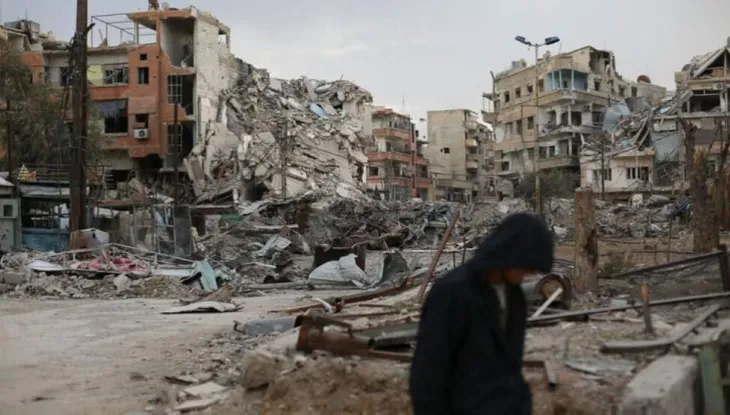
The last thing occupying the minds of those engaged in Syrian affairs and concerned with the country’s political and economic future is to take a deep look into the local communities inherited from a regime that ruled Syria with an iron fist for decades. The effects of that authoritarian rule were not limited to administrative structures, state institutions, currency, oil, agriculture, and other sectors. Its most profound and dangerous impact was on the Syrian people themselves.
A common assumption is often made when comparing three periods: pre-Ba’ath Syria, the Ba’ath era, and the post-Ba’ath period of today. Those who adopt this perspective tend to assume that Syria’s regional, ethnic, and sectarian communities remained unchanged from their condition before the Ba’ath Party’s coup of March 8, 1963, and that all that has happened today is simply the disappearance of authoritarianism, allowing the wheel of progress to resume turning unhindered.
There is no doubt that authoritarian rule inflicted devastating damage across all aspects of life. Yet two important questions arise: What exactly did authoritarianism do to Syria’s local communities? And were those communities truly in good condition before the Ba’ath Party and its sectarian military committee seized power?
Much has been written about the first dimension, particularly through the efforts of opposition movements documenting the regime’s crimes against individuals and communities. Syrians did not fail to expose the major massacres committed in cities and rural areas since the 1960s and throughout the decades that followed. This period witnessed the imposition of Hafez al-Assad’s constitution, the creation of the Progressive National Front tailored to his rule, the targeting of Syrian political life and parties to legitimize the Ba’ath Party’s leadership of both state and society, and the regime’s direct confrontation with the Muslim Brotherhood. These developments culminated in major events in Hama, Aleppo, Deir ez-Zor, Jisr al-Shughur, and elsewhere, followed by a system of domination aimed at programming Syrian society through repression, intimidation, and widespread arrests targeting political movements of all orientations without exception.
The Ba’ath regime in its Assadist form also obstructed development, encouraged corruption, institutionalized discrimination between supporters and opponents of the regime, and systematically sought to “Ba’athize” the Syrian family. This process began in childhood and accompanied individuals throughout their lives through ideological indoctrination and the promotion of corrupt values in schools, universities, workplaces, and professional associations.
Yet real life is not confined to political, cultural, and academic circles, nor to students and professional unions. It exists primarily among the masses living outside the spotlight—the majority of the population, diverse in ethnicity and culture. Were these communities, largely overlooked by political opposition figures, researchers, and critics before the Ba’ath era, truly thriving? Or did they already suffer from deep structural problems of their own?
Perhaps the most dangerous consequence of authoritarianism was its obstruction of the intellectual development of local communities. It prevented them from moving forward and prohibited them from engaging in creative and constructive interaction with others. Such interaction would have threatened the regime’s formula of control and domination. Consequently, these communities remained attached to outdated ideas, untouched by meaningful modernization. They were managed by local power structures that survived under the protection of authoritarian rule, living off the scraps it provided while preserving their limited interests.
With the fall of authoritarianism and the dawn of a new era of freedom, these deeply rooted local forces became active once again. However, they resumed their role based on centuries-old convictions and ideas that had never undergone modernization. They continued to perceive “the other”—any other—as a threat, constantly plotting their destruction or erasure.
Ethnic communities that had suffered oppression and been denied their most basic rights continued to assume they would remain oppressed even after the fall of authoritarian rule. They needed time to experience the conditions of freedom and to realize that others did not seek to harm them, forcibly assimilate them, or deny them the right to preserve their language, culture, and heritage.
Likewise, some sectarian communities never experienced genuine growth and development. Unlike their counterparts outside the confines of the former Ba’athist state, they lacked opportunities for quality education, civic engagement, and interaction with diverse groups. As a result, they remained suspicious and fearful of others, shaping their perceptions through narratives that continuously reproduced anxiety and spread hostility.
When movements advocating the reform and renewal of religious discourse emerged globally—especially after September 11, 2001—efforts focused on modernizing educational curricula and religious preaching in order to counter extremist ideologies. Governments adopted varying approaches, ranging from strict measures against sources of extremism to more balanced strategies combining firmness with flexibility. These efforts encouraged Islamic discourse to develop new tools and find ways to coexist with modernity without confronting it. In neighboring countries, sectarian groups followed similar paths and evolved alongside these developments.
President Ahmed al-Sharaa acted wisely when, in February of last year, he attended and supported the launch of the “Charter for the Unity of Islamic Discourse.” The initiative sought to unite scholars and preachers from various schools of thought around common religious concerns while promoting a moderate discourse rooted in affection and social cohesion and rejecting incitement, sectarianism, and hatred. Al-Sharaa described the charter as a step in the right direction because it contributes to balance, unity, and the avoidance of fragmentation over minor and secondary disagreements. As he stated, “We are not in a position of luxury that allows us to engage in intellectual disputes that are centuries old.”
In Syria, the former authoritarian regime did not merely halt the development of the state, economy, education, and technology. It also prevented participation in the global movement for the reform and renewal of religious discourse. Instead, it used its role in counterterrorism as a bargaining chip with Western governments to secure its own survival. Those who managed to escape this imposed stagnation were often the very people who rose against the regime and eventually defeated it during the Syrian revolution. However, the discourse of smaller sectarian communities largely remained untouched by this process and retained many of its longstanding problems.
The same applies to tribal communities. For decades, tribal structures were never truly tested because the former regime empowered selected tribal figures who served its interests. These figures contributed to the marginalization and impoverishment of their communities while tying them to the regime’s influence. Consequently, these communities failed to benefit from experiences in other countries where tribal systems coexist with development rather than obstruct it, as seen in several Gulf states that successfully integrated tribal traditions into frameworks serving individuals, society, and the nation as a whole.
Some may ask: What about local communities in Syrian cities?
Urban society in Syria follows much the same logic. It is essentially a collection of local communities living side by side in city centers, impoverished neighborhoods, and informal settlements. Genuine urbanity presupposes advanced forms of representation and participation. Yet, in the past, the only visible options available were participation in chambers of commerce and industry, joining relatively limited professional associations, becoming part of state institutions, or, at best, engaging in independent civil society organizations whose emergence was difficult and whose progress remained slow.
Civil society institutions in Syria continue to be burdened by a legacy of hostility toward the state inherited from the previous era. There remains a widespread assumption that the state is inherently opposed to independent civic action because both the state and civil society seek to influence local communities. Yet this assumption is flawed. There is no inherent competition between the two unless the objective is domination and control over public consciousness. Independent civic work requires no permission from anyone. On the contrary, it strengthens civil society while improving and refining government performance. This skeptical attitude is not limited to civil society activists; it can also be found among some state officials and members of professional organizations. One can still observe expressions of discomfort and suspicion on the faces of certain officials whenever the phrase “civil society organizations” is mentioned.
Today, reforming the intellectual discourse of Syria’s local communities—whether ethnic, sectarian, tribal, urban, or otherwise—is an urgent necessity. It is indispensable for establishing genuine coexistence based on interaction and partnership with others rather than merely pretending to accept them. Such coexistence must be founded on true citizenship, not on the performance of citizenship.
Achieving this goal requires a broad intellectual effort supported by the state and carried out in partnership with independent actors. It requires organizing dialogues, workshops, and forums that encourage society to reconsider its inherited traditions—not to destroy them, as some did in the past, but to modernize and renew them, just as Damascus has done throughout its long history.
almodon