



Dimasheq
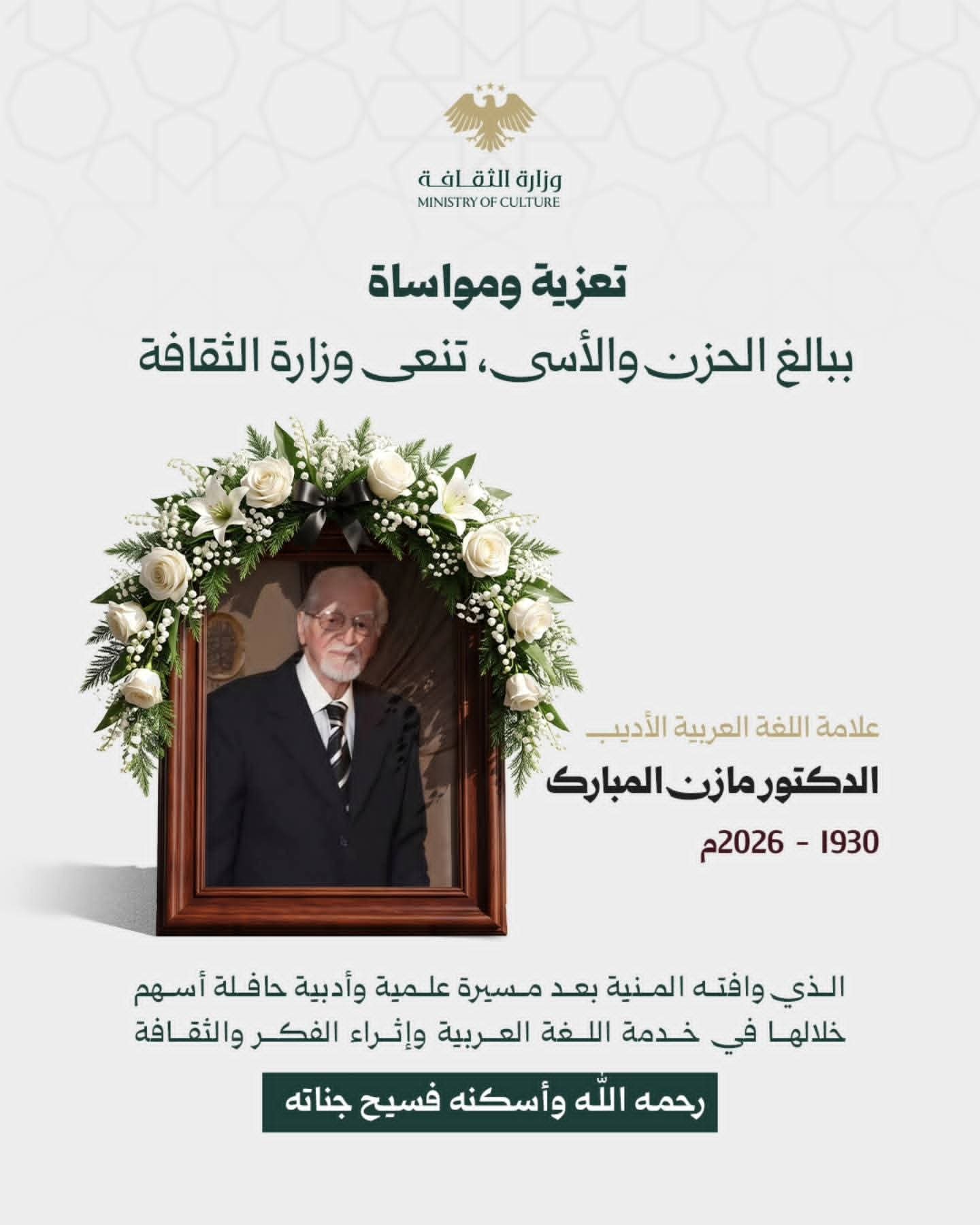
The Syrian Ministry of Culture mourned the renowned linguist and writer Dr. Mazen Abdul Qader Al-Mubarak, who passed away after a distinguished academic and literary career spanning more than six decades, dedicated to serving the Arabic language and advancing scholarly research. Throughout his career, he enriched the Arabic library with numerous authoritative books and specialized studies.
The Ministry stated that the late scholar, born in Damascus in 1930, grew up in an academic environment and studied under a number of prominent figures in Arabic language and literature. He later continued his studies at the Universities of Damascus and Cairo, where he earned both a master’s degree and a doctorate in Arabic language sciences.
Dr. Al-Mubarak held academic positions at several Arab universities, including the Universities of Damascus, Riyadh and Qatar, as well as the Lebanese University. He also contributed to the establishment and development of several academic and scholarly institutions. He was among the founding members of the Arab Writers Union and a full member of the Arabic Language Academy in Damascus, where he participated in the work of several scientific committees, including committees dedicated to Arabic lexicography, Arabic language and its sciences, and the Historical Dictionary of the Arabic Language.
The late scholar left behind a distinguished academic legacy comprising dozens of books, research papers and specialized studies. Among his most notable works are Al-Rummani the Grammarian in Light of His Commentary on Sibawayh’s Book, Al-Zajjaji: His Life and Works, Renewal in the Rules and Methodologies of Arabic, The Arabic Language: Identity and Lineage, and The Arabic Language: The Fortress of the Nation, in addition to numerous articles and research studies that contributed to the advancement of linguistic scholarship and the preservation of Arab heritage.
Dr. Mazen Al-Mubarak is regarded as one of the most prominent scholars of the Arabic language in Syria and the Arab world. His name was closely associated with grammatical and linguistic studies, and he contributed to educating generations of researchers and scholars, leaving behind a lasting academic and cultural legacy that will continue to resonate across the fields of language and literature.