


Ali Al-Dhafiri
On the road from his home in Damascus’s Mezzeh district to the mosque where Syrian President Ahmad al-Shar‘ used to pray, there was a tree-shaded passageway between the buildings. It was his daily route to the dawn prayer and the other prayers. With a shy smile, Abu Muhammad turned to me as we were walking toward the mosque and said: “It was called the Lovers’ Passage”—an irony that would accompany the man throughout the rest of his life.
While teenagers of his age were preoccupied with the pleasures of life, the handsome young Damascene was consumed by an obsession with duty. And “duty” is a key word in al-Shar‘’s journey: duty in its religious, intellectual, and activist dimensions, which inspired thousands of young Muslims to pursue jihad in the version established specifically by al-Qaeda, beginning with the Soviet war in Afghanistan.
It was this same duty that later took al-Shar‘ from Damascus to Iraq and then back toward Syria, on a long and arduous journey that lasted roughly a quarter of a century. It is not known whether that journey relieved him of this heavy burden, or instead laid the foundations for him to carry it after liberating the country and taking the lead in governing it.
When al-Shar‘ meets you, you sense remarkable appreciation and warmth toward you, but he does not become absorbed in you, nor does he really speak to you. The idea he expresses makes you feel that its sentence began in Iraq’s Bucca prison, extended through Idlib, and continues to produce its meanings in Damascus.
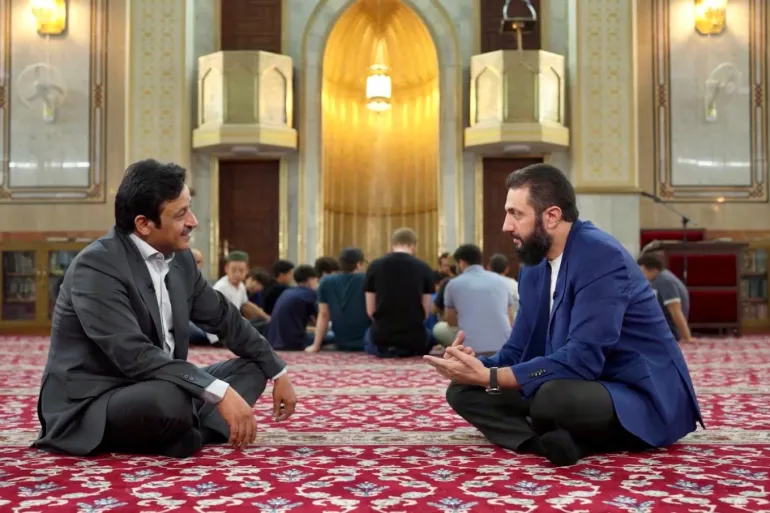
I spent more than seven hours with the man on July 25, with the purpose of recording a television interview whose date had been postponed several times since last year. Al Jazeera broadcast the first part last Sunday, while the second, personal part is scheduled for next Sunday night.
Before meeting him, I received several warnings. The gentlest came from a friend who cares about both him and me. He warned me against falling under the “spell” of the leader, as he put it, which might affect my professional commitment and objectivity in the interview—especially with someone like me who believed in the Syrian revolution throughout its difficult years and who today is living his own special moment by visiting a free Damascus and meeting its leader.
At five in the afternoon, I met al-Shar‘ in his office at the People’s Palace, which became the People’s Palace with his arrival, though it had not been so before. It seems the warnings were justified: remarkable kindness, warmth, and courtesy that help explain the affection and fascination many leaders have for the man, most notably President Trump.
Trump appears to be impressed not merely by Ahmad al-Shar‘ on the surface and in public, but also by his way of thinking, his vision of matters, his understanding of events, and his ideas about the future. I do not mention Trump’s admiration here as a form of celebration, but rather to underscore a striking quality in President al-Shar‘: he appears to know very well what he is doing, and to have almost clear ideas about his next steps, their timing, and how they should be carried out. We saw this during the liberation, and, in my view, we will see it frequently in upcoming files.
When al-Shar‘ meets you, you sense remarkable appreciation and warmth toward you, but he does not become absorbed in you, nor does he speak to you personally. The idea he expresses makes you feel that its sentence began in Bucca prison in Iraq, extended through Idlib, and continues to produce its meanings in Damascus.
The man does not answer your question within the limits of what you are asking. He is not preoccupied with the boundaries of your inquiry. He lives in the world of “duty,” which exhausted his emotions and filled his inner dialogues in the “Lovers’ Passage” and at al-Akram Mosque in Mezzeh, rather than in a simple conversation with you.
This is not to diminish the dialogue. What I mean is that you are facing a method, a set of concepts, and a comprehensive vision that is almost fully formed regarding where he is heading—and that vision already contains the questions and criticisms you bring with you.
The man does not stop at small details, of which there are many, complicated and endless. He takes you directly to the broader and more general picture. At times, he may have to overlook certain mistakes or pass over shortcomings—sometimes intelligently, and at other times because he recognizes that they are realities and necessities whose time for correction has not yet come.
He is, as he appears to me, a man of timing.
Did I fall into the forbidden trap? Did we fall under al-Shar‘’s spell? Perhaps. Yet I will not avoid the criticism voiced by some activists concerning two principal issues: describing him as the leader of the revolution—meaning particularly during its later years—and the issue of democracy and my comment about its decline as an idea around the world. I will also address his position, interpretation, and response concerning the question of Syria’s identity.
I traveled with him by car from the People’s Palace to Mezzeh. He drove the car smoothly himself. The convoy was small and reasonable considering the presumed security concerns. The president knows Damascus better than his team and sometimes moved ahead of those accompanying him.
During the personal conversation, I addressed him as “Mr. President,” then “our Sheikh,” imitating the way his followers in Hay’at Tahrir al-Sham addressed him, as well as ordinary people who still call him by that title.
Eventually, we settled on “Abu Muhammad” or “May you live long,” as we traditionally say in the Gulf when showing respect to someone of high standing.
Incidentally, in his manner, language, appearance, warmth, and temperament, al-Shar‘ was very close to the people of the Arabian Peninsula. The private conversation on the way to Mezzeh was not intended for publication. There were no secrets or anything particularly confidential; it was simply a personal chat while we made our way to the filming location in Mezzeh.
This was the most important and enjoyable aspect for me. I spoke to him as a friend to such an extent that I forgot that the man driving the car was “Abu Muhammad al-Julani,” or President Ahmad al-Shar‘.
The most striking thing one can say about al-Shar‘ is that he speaks as a leader, as a president, and also as an extremely warm and close brother. I did not sense any affectation or deliberate performance in this. It is clearly his nature.
On Qasioun, I was preoccupied by a question about Ahmad al-Shar‘: How did this man manage to endure years in Iraqi prisons and emerge from the crisis of living among a stream of people consumed by confused ideas about religion and reality, while he himself did not resemble them?
What happened in Mezzeh, his first school, his mosque, and his home, I will leave for the second episode, which we devoted to this aspect. You will see the people and al-Shar‘ without prior preparation.
I witnessed the shock as we moved from one place to another and the number of people increased moment by moment. The shock and joy on their faces were not staged: the mosque’s worshippers, the people of the neighborhood, the woman who ululated, the children, and the Egyptian worker who nearly cried after asking to greet al-Shar‘, only to have the president embrace him.
What was most striking—and all my colleagues noticed it—was the man’s extraordinary energy. He was able to stand, walk, and take photographs for more than three hours, then immerse himself among the people surrounding him without changing or showing signs of irritation.
I told them that leadership in the field, combat, and a difficult journey give a person this exceptional energy.
My only fear regarding these intense emotions is that we may end up worshipping individuals—a phenomenon behind many of our disasters in the Arab world. It has produced more than one dictator and tyrant who never doubted for a moment that people loved him, because he never saw people as they truly were, or never allowed them to show him who they really were.
We finished the long and exhausting filming in Mezzeh, and I got back into the car with him toward Qasioun. Once again, I returned to the most beautiful conversation with “Abu Muhammad.”
“Why insist on Qasioun when evening has already fallen, Mr. President?”
There are three places al-Shar‘ visited on the day of liberation: the Umayyad Mosque, his home in Mezzeh, and Mount Qasioun.
There is Damascus from above, Damascus in its most magnificent form, and Damascus as “duty”—the Damascus that weighed heavily upon the man.
Damascus of which our noble friend Muhammad Yassin al-Saleh, Syria’s Minister of Culture, wrote in his magnificent Damascene poem:
“I adore you as a retreat and a destination,
And see in you a beauty beyond reason.
My eyes imagine, every time they look,
That they are seeing you for the first time.
O Sham, basil of the world,
O our unsheathed Umayyad sword.
I killed so that I might live here,
And remained—when I came—slain.”
Once again, the president corrected the route for the team at the location we wanted to reach on Qasioun.
Behind the president, I prayed Maghrib from a high point on the mountain overlooking Damascus. It is impossible to describe the feelings of that moment.
Before my eyes passed the suffering of Syrians during the dark years we all lived through for a decade and a half, and the stream of painful images that made us feel helpless and humiliated.
The entire scene was there: our imam reciting the Qur’an with complete calm and dignity, while the verses of the late Nader Shalish echoed in my ears:
“Night must have a dawn to dispel it,
And light must shine as darkness departs.
Truth will rise high above the universe,
Its white banners raised, without disbelief or deception.
Signs of dawn have appeared, heralding its coming;
No idols remain upon the land, neither ‘Uzza nor Hubal.”
And indeed, the light of Damascus shone on the morning of December 8, when al-Shar‘ delivered his speech at the Umayyad Mosque, saying:
“The chains have been broken by God’s grace, the afflicted have been freed, and we have shaken from Syria’s shoulders the dust of humiliation and disgrace. The sun of Syria has risen anew.”
The man understands how to remain constant while transforming in his own way—and so far, it has worked. He moves within the boundaries available to him, and the ancient Arabs advised that a man should be neither so rigid that he breaks nor so soft that he can be squeezed dry.
That seems to be the path al-Shar‘ has followed with remarkable success and competence.
On Qasioun, I was preoccupied by the question of Ahmad al-Shar‘: How did he endure years in Iraqi prisons and emerge from the crisis of living among a stream of people consumed by confused ideas about religion and reality, while he did not resemble them?
How did he join ISIS, with its mad and destructive program, while inwardly believing that this program was not his program, his project, or the duty he was supposed to fulfill?
How did he free himself from it and from al-Qaeda’s legacy, then enter the Syrian battles over influence, the limited horizons, and the small ambitions for control—something that annoyed some people when he was described as the leader?
How did he begin communicating with the entire world about the new-old vision, prompting some to accuse him of secret relations with the West and even of being an agent for security and intelligence services there?
How did he manage relations with Turkey, taking the best from them while retaining decision-making power for himself and his front, despite inaccurate claims that Operation Deterrence of Aggression was a Turkish decision—claims reflecting widespread ignorance of Turkey’s lack of support for the operation, its warning to Hay’at Tahrir al-Sham against it, and the fact that its position did not change even after the complete capture of Aleppo and the move beyond it?
How did al-Shar‘ defeat the remnants and the defeated who today seek to impose a model for how the man should govern the country—those who destroyed, killed, and committed atrocities?
And how does he respond to the intellectual who never achieved the slightest success for his own model anywhere or at any point in history, yet comes today to offer lessons?
How did a man of jihad and wars manage to melt the ice and establish relations with all states, including those that were hesitant or hostile toward such ideologies?
The most important conclusion I came away with from this extraordinary day is that Ahmad al-Shar‘ is a man of compromise and politics, and that he is doing so without making concessions on principle.
The man understands how to remain constant while transforming in his own way, and so far, it has worked. He moves within the boundaries available to him, and the ancient Arabs advised that a man should be neither so rigid that he breaks nor so soft that he can be squeezed dry.
That seems to be the path al-Shar‘ has followed with remarkable success and competence.
I imagine the state of the Syrian revolution during the phase of endless fragmentation and factionalism that characterized it at one point: countless factions, political bodies, and groups, and a situation that barely reflected the reality of the people who paid the highest price to regain their country and freedom.
Yes, al-Shar‘ was not the leader of the Syrian revolution to whom all Syrians unanimously pledged allegiance, particularly those outside Syria. These are revolutionaries of a particular kind, a subject requiring a lengthy discussion that is beyond the scope of this article.
Al-Shar‘ provided a guarantee for Syria that includes and embraces all its sons, except those involved in Syrian bloodshed. At least for now, this is sufficient to define the basic contours of Syria’s identity, and it should not provoke anyone’s anger, resentment, or anxiety.
With all due appreciation for their positions and views, and all my respect for them personally, perpetual objection to everything is gradually distancing them from reality.
Al-Shar‘ accomplished three principal things. First, he eliminated ISIS—the dubious project—and destroyed its major banners, despite the survival of its ideology and remnants.
Second, he removed al-Qaeda from Syria as an idea, program, and project.
Third, he established the “state of the liberated,” offering a remarkable experience under the most difficult circumstances; he unified the factions through a combination of persuasion and force, led Operation Deterrence of Aggression, liberated Syria, and brought down the dictatorship in its entirety and its regional project.
All of this makes him more than simply a leader of the revolution.
So who, in the view of the revolutionary intellectual, could occupy this position?
It should be noted that the description of “leader of the revolution” was limited to a particular aspect and a specific phase of the revolution. It was never an absolute and generalized title, as some have attempted to portray it.
When the driving force of the Syrian revolution began to decline, its support weakened, and doubts about its viability increased, the clear and effective transformations of “Abu Muhammad al-Julani” began at the level of methodology, slogans, discourse, and mechanisms.
These transformations produced Idlib and the experience it went through over many years, which in turn paved the way for the later liberation operation.
The issue here is not about glorification or the arbitrary granting of titles. The man’s historical role, together with that of his comrades, and the major transformations in thought, methodology, and vision, provide us with a clear picture and an accurate understanding of where we are today.
Let the proponents of theories and ideas forgive us for saying so.
What has been described here is his leadership of the revolution during difficult and extremely dark years, not absolute and total leadership of it. This is a clear distinction that cannot reasonably be exaggerated or questioned by some.
I asked al-Shar‘ about identity: How does he see the identity of the new Syria?
He said that it is a Syrian identity.
He did not elaborate or philosophize. Formally, the answer may not appear convincing. But in reality and in depth, it is more significant than that.
Does Syria really need someone to tell it how to be Syria?
In my view, the man is preoccupied with Syria’s status, influence, and stability amid a threatening regional environment. His mind tends toward geopolitics, major challenges, and reaching a point of stability and secure footing.
So far, he has done what is necessary regarding pluralism and national identity. He has not imposed the religious program some expected and feared. He granted the Kurds what the Assad regime had denied them, while suppressing attempts by some to pursue separatism at a moment of brutal exploitation.
He dealt with the issue of other minorities and rebellion in a disciplined manner. It is not free from mistakes and abuses, but it is far removed from the mentality of revenge and unilateralism that dominated many of those belonging to the new military and security apparatuses.
Al-Shar‘ provided a guarantee for Syria that includes and embraces all its sons, except those involved in Syrian bloodshed. At least for now, this is sufficient to define the basic contours of Syria’s identity, and it should not provoke anyone’s anger, resentment, or anxiety.
What I saw in Damascus, the behavior of the institutions surrounding the government, and the president himself inspire hope.
I met young Syrians working in the most important positions, with ambitions for the new Syria that know no ceiling. Conversations with the president about his vision invite optimism and are connected to reality and to what has been achieved so far.
We do not necessarily know what tomorrow will bring.
I feared a major disappointment regarding a revolution, a people, and a country we loved. This is what often happens during major transformations and transitional periods.
But the five days I spent in Damascus were enough to show me something different from those expectations, and enough to inspire hope for a new Syria capable of contributing to the reordering of the region and freeing it from the chaos of predatory and destructive projects, from one end to the other.