

Dr. Ahmad Ibish
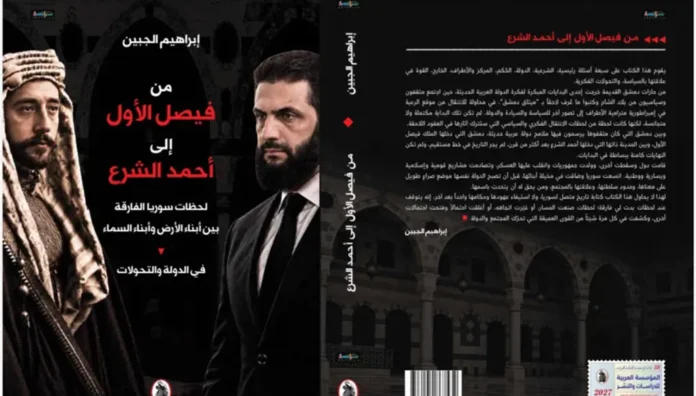
I shall begin with what ought to be said first: the author of this book is my friend, and I do not claim a neutrality I do not possess. Friendship, however, does not absolve the reader of the responsibility to read honestly. I have read this 448-page book with the intention of doing its author justice, and I believe I have come away with an impression that goes beyond mere courtesy: this is a serious work, written with the passion of a witness and the discipline of a historian. It raises questions that deserve lengthy discussion.
A Book That Begins with a Question, Not a Biography
In his introduction, the author rejects the notion that he has written a continuous history of Syria. He explains that the book focuses on specific “moments” and that its premise is neither a straight line connecting King Faisal to Ahmed al-Sharaa nor an assertion of similarities between the two men. As he tells us, its chapters originated as a series of articles written after the fall of the Assad regime on 8 December 2024. This journalistic origin explains the book’s accessible tone and its ability to grasp events while they are still unfolding and before their immediate impact has faded.
The question the author poses on page eleven is the key to the entire book: “The question, then, is not who the man ruling Damascus is, but what happens to everyone who reaches it? Does the ruler create the state he wants, or does the state, with its history, society, geography and complexities, create the ruler it can tolerate?”
This question shifts the Syrian debate away from scrutinising individuals and towards examining the underlying structure. In my view, this is the book’s greatest contribution. How many books about Syria have focused on the ruler’s biography while neglecting the society he governed?
The book is structured around seven major questions: legitimacy, the state, governance, the centre and the periphery, external relations, the relationship between power and politics, and intellectual transformations. These are questions that can be posed to any modern state, not Syria alone, giving the book a scope that extends beyond the circumstances of its publication.
The Birth of the State: Faisal, Damascus and Baghdad
The first chapter, “The Invention of the State” (pp. 13–52), opens with the period preceding Faisal: the Ottoman General Assembly and its elections, the Damascus Protocol and the question of the Caliphate, followed by the meeting between Faisal and Clemenceau, the proceedings of the First Syrian Congress, the 1920 Constitution and the Battle of Maysalun. It also examines Rashid Rida’s debate on religion and the state (pp. 38–40), as well as political parties and the beginnings of political life (pp. 42–43). Throughout this account, the author does more than narrate events; he knows how to capture the phrase that encapsulates an entire historical period.
The finest passage in the chapter is the comparison between Damascus and Baghdad, which concludes with one of the book’s most memorable statements: “In Damascus, Faisal learned how a state is lost; in Baghdad, he learned how a state is built under constraints” (p. 52).
The same chapter contains an observation that recurs throughout the book and later proves to be one of its central threads: “A politically weak state may find its army becoming stronger than it is” (p. 51). This statement lays the groundwork for understanding what followed a century later: coups, expanding military dominance and a society stripped of its decision-making power.
The second chapter, “An Independence That Was Never Completed” (pp. 53–122), moves from the Great Syrian Revolt of 1925 to the 1936 Treaty and the National Bloc, then to the assassination of Abd al-Rahman al-Shahbandar in 1940 and the birth of the Baath Party (pp. 120–122). It includes valuable pages on the French division of the country into separate state entities (p. 57), Sultan Pasha al-Atrash and al-Shahbandar (pp. 60–64), and the economic consequences of the revolt (p. 65). What stands out is the author’s treatment of independence as an unfinished process rather than an event that occurred and then came to an end. This is an interpretation to his credit.
From the Army to the President, and from the President to Society
The subsequent chapters follow a familiar trajectory for those interested in Syrian history: “A State Weaker Than Its Army” (beginning on p. 123), “The Decline of the State” (beginning on p. 171), and “The President’s State, Not the People’s State” (pp. 239–278). The latter examines purges within the Baath Party, the conflict between Salah Jadid and Hafez al-Assad, the 1973 war, the assassination of Kamal Jumblatt, the 1980 Tadmor massacre and Law No. 49.
Throughout these pages, the author maintains a narrative rhythm that prevents the abundance of historical events from becoming an overwhelming mass of information.
However, chapter six, “The Inheritance of the State and the Explosion of Society” (pp. 279–312), is, in my view, one of the book’s strongest chapters. Here, the author moves from the history of political power to the history of what that power did to society. Under headings such as “The End of Syrian History” (p. 281), “A Society Without an Elite” (p. 282), “Corruption as a Theory of Existence” (p. 283), and “Who Produces the Elite?” (p. 295), he develops a diagnosis that is neither lacking in severity nor in fairness.
The chapter includes a passage drawing on an article the author himself wrote for An-Nahar in 2002, showing that concerns about this outcome had already emerged years before the revolution. It concludes with “The Revolution – A Springtime of Minds” (p. 298), a personal recollection of Damascus etched into his memory.
Returning to Damascus: The Witness and the Historian
Chapter seven, “Returning to Damascus” (pp. 313–368), is what gives the book its distinctive character. The author opens with an admission that few historians would dare to make: he had withdrawn from participation in television programmes, then was asked to comment on the Battle of “Deterring Aggression” despite having no field information. What did he do? He responded with what he did possess: analysis.
“The children who had been displaced from their homes and cities in green buses to Idlib have grown up today. They want to liberate them and return to them” (p. 316).
When he saw Ahmed al-Sharaa’s photograph on the walls of Aleppo Citadel, he wrote: “I understood that this was not an ordinary scene, but rather the inauguration of a new era” (p. 316).
The chapter’s treatment of al-Jolani/al-Sharaa is distinguished by its refusal to demonise or glorify him. The author traces his background from his birth in Riyadh and upbringing in Damascus in a Nasserist nationalist household, through Iraq and American imprisonment, to Jabhat al-Nusra, his break with Al-Qaeda and the establishment of Hayat Tahrir al-Sham. In doing so, he draws on reports by the International Crisis Group and Jerome Drevon’s book From Jihad to Politics (pp. 320–324).
In examining this transformation, he advances an argument worthy of discussion: the decisive shift was not in the tools employed, but in the question itself, “from asking ‘How do I defeat the other?’ to asking ‘How do I manage their presence?’” (p. 326). This is an elegant formulation that condenses into a single sentence what might otherwise require lengthy academic studies.
Among his original intellectual observations is his reading of the paradox of ideological absence following the fall of Assad. He describes Syria before 2011 as “a state of ideological absence, a black hole in whose darkness the prevailing ideas collapsed” (p. 329).
He also examines al-Sharaa’s speech at the Umayyad Mosque, arguing that he sought to create the “defining historical moment” himself (p. 332), demonstrating how he combined the language of an Islamic leader with the tone of a statesman presenting victory as the fruit of the Syrians’ steadfastness.
The same chapter revisits an article the author wrote in 2021 entitled “The Armed Seer” (pp. 328–330). In it, he examines Isaac Deutscher’s biography of Trotsky and draws on the trilogy “The Prophet Armed”, “The Prophet Unarmed” and “The Prophet Outcast” to question the fate of Syrians amid their difficult circumstances.
He then arrives at a painful question at the end of the article: Has anyone emerged among the Syrians who possesses a vision of the future, “that awaited ‘armed seer’?” (p. 330). This passage reveals that the author does not separate history from thought, nor politics from the question of the intellectual and his role.
I must also point to the sense of balance that governs the book’s treatment of the new phase. The author notes that al-Sharaa’s administration in Idlib moved from “control” to “governance”, and that the experience of the Salvation Government provided civil administration with expertise that few others possessed (p. 327). At the same time, he observes that this phase requires prolonged testing, refraining from rushing into either praise or condemnation. This is a rare virtue in contemporary Syrian writing.
Syria and the World: The Geography of Politics After Assad
In chapter eight, “The New Syria and the World” (pp. 369–422), the author turns his attention to Syria’s regional surroundings. He examines how the Gulf states viewed an Islamist figure reaching power, why Riyadh was the first capital al-Sharaa visited, how rapprochement with Doha and Abu Dhabi developed, and the concerns of Amman, Cairo, Baghdad and Beirut.
These pages conclude with a measured observation: the various Arab parties “converged on one point: Syria could not remain outside the Arab system. Al-Sharaa understood that” (p. 379).
The section on Turkey is among the finest parts of the chapter because it examines relations between Ankara and Damascus through the lens of interests rather than emotions. It arrives at something resembling a guiding principle: “States do not remain indefinitely on the territories of other states under the banner of friendship” (p. 382).
This statement could serve as a title for any relationship between an emerging state and its former patron. Furthermore, the author’s precise enumeration of Turkey’s strategic assets – borders, the military, influence, water, refugees, the economy and energy – demonstrates his understanding of how foreign policy files intersect and overlap.
“The Shadow of al-Jolani” and the Conclusion
The final chapter, “The Shadow of al-Jolani” (pp. 423–440), is the most personal and perhaps the most beautiful. It opens with “Muawiya’s Lost Paradise”, in which the author reflects on the return of the Umayyad symbol to the Syrian imagination after 2011. He is careful to clarify that the intention is “not to establish a comparison between Muawiya and Ali” (p. 426), but rather to observe that Damascus retained in its collective memory an image of the state, encompassing “administration, an army, government departments and relations”.
Here, he introduces the idea of the absent “context of the state”, one of the book’s most valuable insights. The state is neither merely a founding decision nor an expression of popular will; it is a solid system capable of functioning. When this context disappears, “nature abhors a vacuum. The moment you leave a vacuum unfilled, you find it occupied by others and by other ideas” (p. 429).
The author devotes insightful pages to the relationship between intellectuals and political power, revisiting Julien Benda, Edward Said and the questions raised by Raef Zreik (pp. 430–433) in an exploration of “critical distance”.
He then returns to Damascus itself, travelling back from Beirut after an absence of twenty-four years. In a scene where memories of the road intertwine with the poetry of Nizar Qabbani, Maarouf al-Rusafi and Said Akl, his arrival concludes with a heartfelt statement: “I did not feel the passage of time. It was as though I had been here just this morning” (p. 435).
In my view, these pages confirm that Ibrahim al-Jabin is not a historian writing from a distance, but a son of the city who carried its memory with him across many years of absence.
In the conclusion (pp. 441–444), the author returns to the comparison implied by the title. He neither projects Faisal onto al-Sharaa nor establishes an equivalence between them. Instead, he focuses on the legitimacy of military power and the test awaiting anyone who reaches Damascus: Can he transform power into legitimacy? He leaves the door open to his original question: Who makes whom?
This willingness to leave the question unresolved is one of the hallmarks of a book that respects its reader.
The Book’s Language and Methodology
Before beginning a book on the history of the state, readers might expect a dense and demanding work. Yet Ibrahim al-Jabin writes with the pen of a literary writer who understands that a good sentence is part of a good argument.
He draws on poetry when appropriate, personal biography when it serves the argument, and comparison when it illuminates an event. Nor does he hesitate to position himself as a witness within the text when doing so is the more honest approach.
This makes the book accessible to general readers without diminishing its value to specialists.
Broadly speaking, his methodology is one of “moments”: he pauses at a critical juncture, unpacks it, then moves on to the next, allowing the reader to discern the thread connecting them. This approach has its advantages, freeing the book from the burden of exhaustive coverage and allowing it to devote space to what truly deserves reflection. The author has done well not to claim more than he has accomplished.
History as an Open Question
One of the book’s most significant strengths lies in its rejection of a simplistic, linear conception of history. Ibrahim al-Jabin does not view the emergence of the modern Syrian state as a straightforward, upward progression from independence to institutional development. Rather, he presents it as a complex process in which local aspirations intersect with external interests, national ambitions with social divisions, and grand ideas with stubborn realities.
The author chooses to begin with the intellectual and political origins of the idea of the state, going back to the late Ottoman period, when Syrian elites began to familiarise themselves with the concepts of parliamentary representation, constitutionalism, citizenship and sovereignty.
This choice reflects an important historical awareness: the state is not born on the day its independence is declared. Its foundations are laid much earlier, when people’s understanding of authority, their rights and their relationship with power begins to change.
In the pages addressing the experience of the Ottoman General Assembly, Ibrahim al-Jabin opens a window onto a period that rarely receives the attention it deserves in popular narratives of Syrian history. He traces the faltering beginnings of parliamentary life, the positions of Syrian representatives from Damascus, their demands for reform and equality, and the growing tensions between the Ottoman centre and the empire’s peripheries.
Thus, Syrian political awakening does not appear as something that suddenly emerged with the collapse of the Ottoman Empire. Rather, it is presented as the outcome of a lengthy process involving the press, cultural associations and political forums, before crystallising into clearer nationalist and independence demands.
This approach reaches one of its high points in the treatment of the “Damascus Protocol”, which the author revisits as a foundational document in the history of modern Arab political thought. The protocol is not merely a forgotten political text, but evidence of the transition of Arab elites from demanding reform within the empire to contemplating sovereignty, independence and a redefinition of the political community.
Revisiting these early moments gives the book historical depth and prevents the temptation to interpret the present in isolation from its roots.
Final Word
From Faisal I to Ahmed al-Sharaa is a book worth reading for three reasons.
First, it asks the right question: what does the state do to those who govern it, before asking what the ruler does to the state?
Second, it is written in the language of a literary author who knows how to make analysis accessible without sacrificing precision.
Third, it combines the historian’s composure with the witness’s passion, without allowing either to overshadow the other.
At a time when many books rush to pass judgement on the new Syria, this work reminds us that questions matter more than hasty answers.
I believe that my friend and brother Ibrahim al-Jabin has contributed a work to Syria’s intellectual library that scholars will return to whenever they seek to understand how states are built in Damascus, and how they are lost.
Annahar