




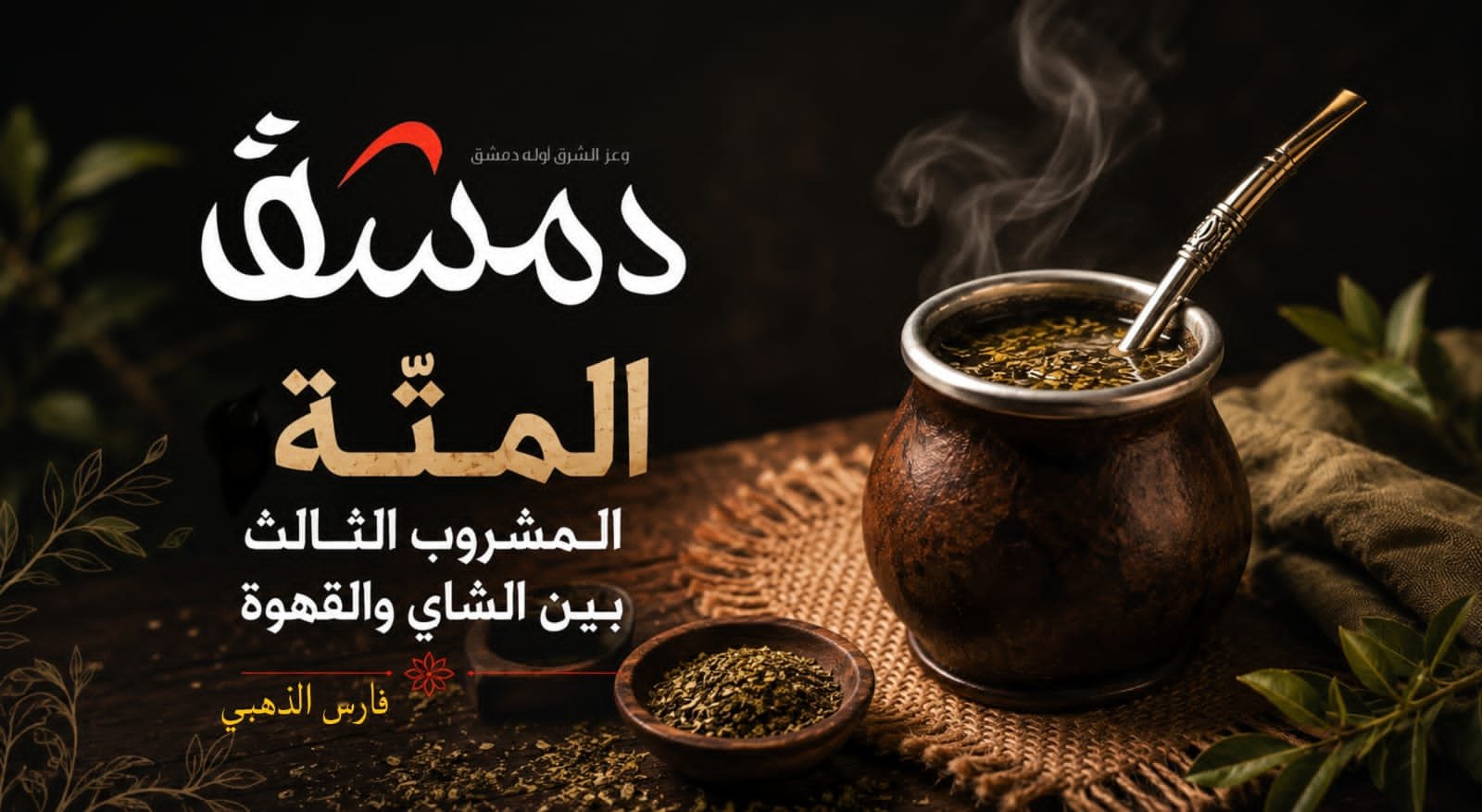

Fares Al-Dhahabi
The history of hot beverages in our region seems like a winding path shaped by migration, trade, and social transformations. Coffee reached the Middle East from Yemen, carried by shepherds and Sufis before becoming an essential part of Arab mornings. Tea arrived with merchants from India and China, a light herbal plant that was quickly embraced, eventually settling into homes and cafés and becoming part of the daily mood. Mate, meanwhile, entered the Levant through a different route; it was brought by migrants returning from Latin America in the late nineteenth and early twentieth centuries. It arrived surrounded by the unfamiliarity of its ritual and the slow process of becoming accustomed to it, until it carved out its own space among the region’s customs.
Coffee entered the Arab world relatively smoothly despite its strong character. It traveled from Yemen to the Hejaz, then to Damascus, Istanbul, and Cairo, eventually becoming one of the symbols of urban life. Its simple preparation helped it spread: roasting, grinding, and boiling.
Tea, likewise, requires little more than leaves placed in hot water, allowing both beverages to fit naturally into the rhythm of the household, the economics of everyday life, and tastes that favor simple, repeatable habits. Mate, by contrast, arrived with a more elaborate ritual: water at a controlled temperature below boiling point, a gourd made from a dried calabash, and a metal or wooden straw known as a “bombilla,” followed by a particular method of filling, pouring, sipping, and passing it around communally. The first serving is poured out because the mate leaves initially float; afterward, the actual ritual begins, giving the caffeine intake a social rhythm distinct from tea and coffee.
Mate’s rituals alone are enough to make newcomers feel that they are entering a custom with clearly collective characteristics. The drink requires a place, a period of time, and company, giving the gathering something closer to a complete social ritual. It can certainly be consumed alone, but its strongest presence emerges through sharing. In villages and mountainous areas, the gourd passes from one person to another, with each person drinking in turn before it is refilled several times. In this way, the gathering becomes a small moment of solidarity and symbolic kinship among those drinking, as though the gourd brings them together within a single lineage.
Here, the uniqueness of mate becomes particularly clear. Tea is associated with comfort, conversation, rain, and evening; coffee is associated with alertness, work, and stimulation; mate, by contrast, is more closely connected to social custom and regional belonging. Argentina, Paraguay, and Brazil helped shape a new identity for certain areas of the Levant, while the Levantine environment in turn reshaped mate to suit its own local traditions.
It evolved from a drink carried by returning migrants into a clear regional marker. It spread across the mountains of the Syrian coast, Mount Lebanon, the Qalamoun region, Jabal al-Arab, and parts of Jordan and Palestine, while maintaining a more limited presence in major cities, plains, and deserts. Its geography of distribution seems almost to trace the geography of its drinkers as well.
Tea and coffee expanded throughout the region, while mate maintained a more defined social circle. Within that circle, a strong connection developed between the drink and local identity. Mate drinkers demonstrate their attachment to it by carrying it in their bags, cars, offices, and on trips, openly declaring their choice of beverage with confidence.
The phrase “I drink mate” carries a meaning that goes beyond taste and preference. It hints at shared activity, region, community, and social memory. It can sometimes be enough to see the gourd in someone’s hand to read it as a sign of belonging to an invisible cultural community that symbolically stretches between the Middle East and Latin America.
This meaning becomes even clearer in the pride mate drinkers take in the transcontinental connection. They evoke Argentina and Latin America through widely recognized symbols such as Che Guevara, Messi, football stars, images of rebellion, and the experiences of migrants. Mate offers them a small window into another world, transforming a family beverage into a symbolic bridge toward a broader identity.
With every gourd passed around, a cultural connection is formed with millions of people in South America who share the same tradition. Mate thus appears almost as a brotherhood with its own language, tools, and vocabulary.
Because its connection to identity is stronger than its connection to mood alone, mate’s geographical range has remained concentrated in particular areas. It is associated with mountains and communities surrounding urban centers, while tea and coffee fill cities, rural areas, plains, and deserts alike. Its presence in cafés and restaurants is limited, whereas its domestic character stands out in living rooms, balconies, gatherings of friends, and village guesthouses. This closeness to family warmth and the table of friendship has given it a strong local identity and made its path toward global expansion slower than that of coffee and tea.
Mate’s relationship with other beverages is characterized by an uneven overlap. A mate drinker will often consume it alongside tea and coffee and participate in all three traditions, while the circles of tea and coffee extend to include people outside mate culture. The mate community therefore appears small and deep at the same time. Entry into it usually occurs through family, friendship, or living in an area where mate has become part of household tradition. Hence the feeling that acquiring the habit resembles joining a private club or cultural tribe, where the custom is passed from one person to another through companionship and inheritance more than through advertising or passing curiosity.
This distinctiveness gives mate a third position between tea and coffee. Mate emerges as a current that places belonging at the center of the experience. It is an independent space within the culture of table beverages, treating the drink as a means of building connections between people. For some of its enthusiasts, it represents a possible third future within the everyday beverage landscape—a future drawing its strength from community, ritual, and shared memory.
At the heart of the mate experience, the drink goes beyond taste, caffeine strength, and speed of effect. It is a social practice that accompanies the beverage and gives it its full meaning. Its flavor may seem bitter and reminiscent of medicinal herbs to some people, yet its presence endures because of the strength of the social bond it carries. The gourd becomes a marker of identity, and people who share the habit recognize one another quickly, as though they were citizens of a single symbolic city spread across geography, between the Levant and Argentina.
Tracing mate’s historical roots reveals a deep tradition in South American history, with origins among the Guaraní and Tupi peoples in the region now known as Paraguay. These communities steeped the leaves of the Ilex paraguariensis shrub, later known as “yerba mate,” in warm water to produce a bitter beverage with stimulating and ritual qualities, combining physical alertness with spiritual elevation. The term “mate” itself carries a cultural meaning connected to a Quechua word referring to the dried gourd in which mate is served, revealing a symbolic unity between the beverage and its vessel. This meaning demonstrates the depth of the ritual and the antiquity of its roots in Andean civilizations, where remains discovered near Lima suggest that mate reached beyond its original homeland, perhaps because of its medicinal value or ritual significance.
When the Spanish entered the Southern Cone in the mid-sixteenth century, they noticed the widespread use of the caffeine-containing leaves. The Spanish soon adopted mate in Asunción, with some accounts even describing an intense attachment that drove individuals to sell their possessions to obtain the precious herb. Colonial authorities viewed the custom with suspicion and prejudice and attempted to prohibit or restrict it under notions that portrayed it as primitive. Yet the beverage’s widespread popularity overcame those restrictions, and mate spread from Paraguay across large areas of the Spanish Empire, becoming an important commodity even in cities where its connection to the drink later declined.
The decisive phase in mate’s history came with the arrival of the Jesuit order in Paraguay in the seventeenth century. The Jesuits established what became known as the “Misiones,” small settlements that enjoyed a degree of political and economic autonomy from the Spanish Crown and needed a resource to finance their stability. They chose yerba mate. Over time, efforts shifted from collecting leaves in the wild forests to domesticating and systematically cultivating the plant after years of work. This achievement remained closely guarded until the nineteenth century. Jesuit mate became a pillar of the local economy, sold at low prices and even used as a form of currency in these settlements.
After the collapse of the Misiones and the expulsion of the Jesuits in 1767, Paraguay retained its position as a major center of mate production. The beverage continued spreading throughout South America until it became a national drink in Argentina and Uruguay, with a daily presence approaching that of water. During the nineteenth century, as coffee and tea rose in popularity in Chile and Brazil, mate continued to consolidate its position in the Southern Cone. Its history then took another turn when it crossed the continent and headed toward the Eastern Mediterranean.
In the late nineteenth century, Syrian and Lebanese migrants returning from Argentina brought this tradition to the Levant. In mountainous areas, particularly among the Druze, mate found a social environment similar to its original setting: strong communal ties, long gatherings, and traditions that gave the ritual a value comparable to that of the drink itself. Over time, the Levant became one of the most important regions for mate consumption outside South America, and the gourd became a symbolic bridge across the Mediterranean, connecting mountain communities with memories of migration to Buenos Aires and Montevideo.
Thus, mate maintains a marginal yet stable position while coffee and tea compete for a place in the Arab morning. Its spread moves at a quiet pace, and its strength comes from a community that knows what it drinks and why it drinks it. It is a household beverage closer to belonging than mere habit, and a cultural marker that precedes the flavor its devotees carefully choose. Through this distinctive character, mate has secured for itself a third position between the two giants of everyday life: coffee, which awakens; tea, which refreshes; and mate, which gives its drinker a clear social marker of identity an
d a taste they have deliberately chosen.