

By Biren Birsaigili Mot
Dear Mr. Fakhri al-Baroudi,
I want to tell you about Sharif Muhyi al-Din Targan. Perhaps you knew his name. Perhaps you listened to his oud, or heard someone speak of him in a gathering. Perhaps his name once reached your ears as an old piece of news that had traveled from Istanbul to Damascus and then disappeared into the past. As far as I know, your paths never crossed. Yet two people do not always need to have known one another personally in order to share a profound connection. Sometimes it is enough for them to have lived in the same era, witnessed the same world falling apart, and each tried, without knowing of the other, to remain standing in a different corner of the same vast cultural space. In that way, they may come closer to one another in a manner invisible to the eye.
You were in Damascus, at the heart of politics, poetry, music, and the struggle for independence. He, meanwhile, followed a long path stretching from Istanbul to the Hijaz, and from America to Baghdad, carrying his oud and trying to carry into the future the voice of a world that was disintegrating around him.
You were born in Damascus in 1887. Sharif Muhyi al-Din was born five years later, in 1892, in Istanbul. When you were a child, Damascus was still an Ottoman city; when he was a child, Istanbul was still the capital of Damascus. At the beginning of both your lives, before you would later be placed within two separate national histories, the borders we know today did not yet exist. The gates of the cities were open to one another. Caravan routes, pilgrimage roads, commercial ties, centers of learning, Sufi lodges, schools, military routes, and musical gatherings were not yet separate worlds.
A melody composed in Istanbul could be heard in Aleppo, Damascus, or Cairo, and a style of performance that had emerged in Baghdad could take new shape in another city. A poem could find its musical mode in the hands of a composer in a distant city, and a musician raised in one city could teach his students in another. In those days, culture had not yet learned the political borders that would later be drawn around it.
And above all, neither of you was a son of an easy age. You lived at a time when Western civilization was imposing its weight upon the world—not only through science, technology, and art, but also through politics and military power. It was an age when European colonial ambitions reached the borders of Ottoman geography and then began to directly determine the cities, boundaries, economies, and destinies of that geography.
New borders were being erected between routes that had once been open from Damascus to Istanbul, and from Baghdad to Jerusalem. Cities that belonged to the same cultural sphere were gradually being separated from one another. Yet the greatest rupture was not merely the interruption of roads. People began to be taught that they had become citizens of different states, children of different national histories, and sometimes even members of worlds that had no connection to one another.
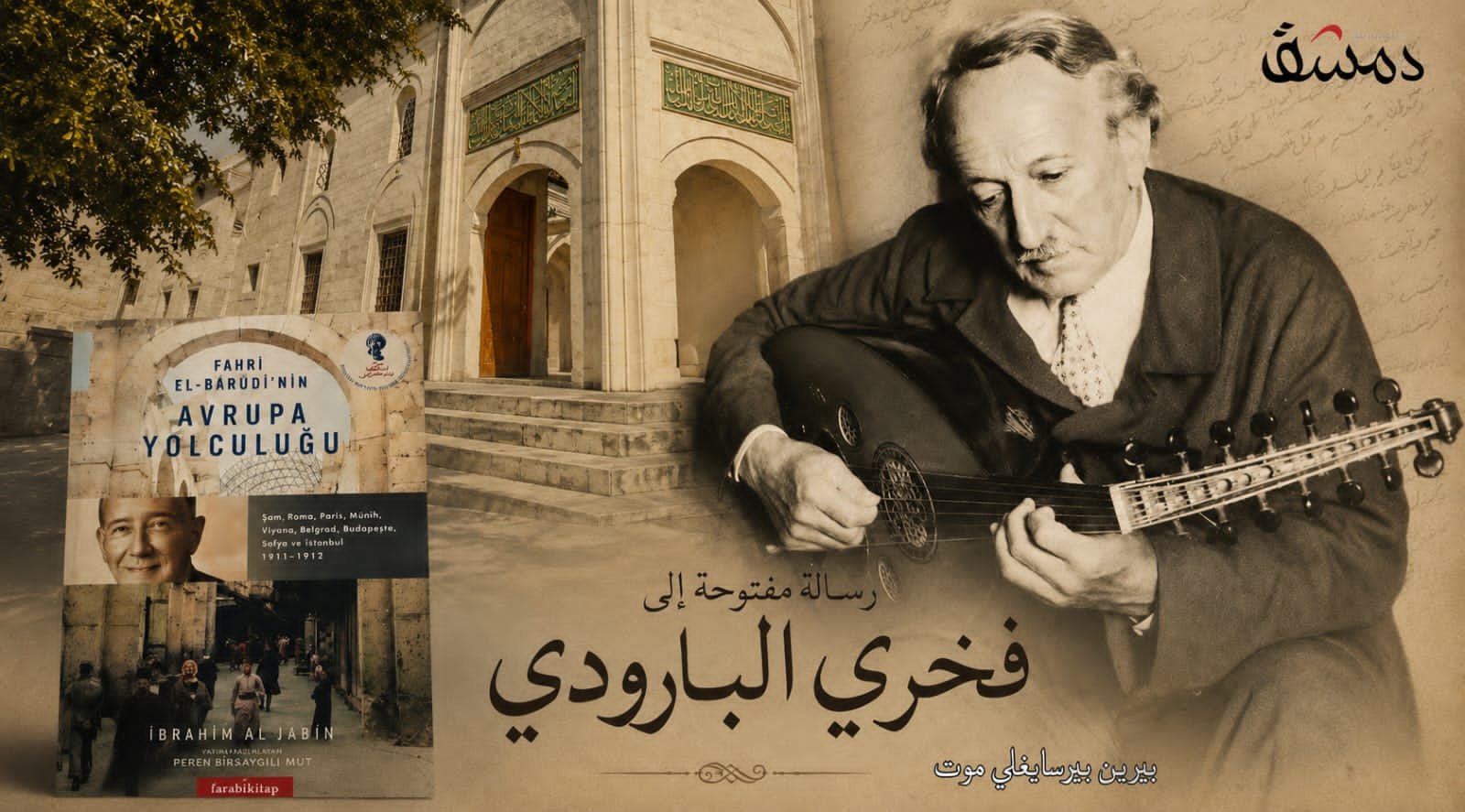
Nor were you merely a Damascene watching the West from afar. In your youth, between 1911 and 1912, you traveled to Europe. You saw Rome, Paris, Munich, Vienna, Belgrade, Budapest, and Sofia, and then came to Istanbul. The observations that would later be published under the title The European Journey carried the perspective of a young Syrian who had encountered European civilization face to face, before the system of colonial mandates descended upon Damascus with all its weight.
You walked through great cities, observing their squares, buildings, railways, factories, institutions, and everyday life. Yet no matter what you saw, Damascus always occupied a corner of your memory. You were a young Syrian who had gone out to see the world, but no matter how far you traveled, your city—your beautiful Damascus—remained at the center of your vision.
Perhaps this is one of the most precious aspects of your story to me: you saw the West and experienced it up close, yet you did not return to your city despising it.
Damascus was not, for you, an old world that needed to be left behind. It was a homeland that needed to renew itself, grow stronger, and stand on its own feet. You understood the difference between learning from the West and surrendering to its superiority. Benefiting from the knowledge, institutions, and technologies of another civilization did not mean being ashamed of your language, your music, or your memory.
And your generation had to learn, through experience itself, how much this distinction was a matter of life and death.
Dear Mr. Fakhri al-Baroudi,
I cannot speak to you about Sharif Muhyi al-Din without mentioning his father, Ali Haydar Pasha, and the city of Medina.
At the beginning of his story there were not only the palaces of Istanbul, the sounds of the oud, and refined musical gatherings. There was also the Hijaz, one of the most consequential theaters of the First World War. Sharif Ali Haydar Pasha, whom the Ottoman government had appointed Emir of Mecca, went with his family to Medina during the war years. Sharif Muhyi al-Din, still a young man, was part of this experience. The family lived through the early stages of the defense of Medina under Fahreddin Pasha, the weight of war upon the city, the interruption of roads, the disintegration of the empire, and the great collapse that took place in the Hijaz.
Ali Haydar Pasha left Medina in 1917, but the defense led by Fahreddin Pasha and his soldiers continued for much longer. The siege intensified, supplies ran out, and hunger became unbearable. Even after the signing of the Armistice of Mudros, Fahreddin Pasha did not surrender the city immediately. He stood at the head of a will that rejected surrender to such an extent that he could say: “It is better for us all to die than to hand over the beloved trust of the Prophet to the English.”
The last defenders of Medina found themselves in one of the harshest sieges in history, face to face with hunger, isolation, and the end of an entire empire. Fahreddin Pasha managed to keep his soldiers alive for seventy-two days, even feeding them locusts. The experience of the Hijaz left its full weight upon the memory of the young Sharif Muhyi al-Din. In his family’s memory, Medina was no longer merely a city; it became a name for the end of an era and for a tremendous historical rupture.
Perhaps this is what made one feel, years later, that the elegance of Sharif Muhyi al-Din carried not only the refinement of Istanbul, but also that silent dignity left by passing through the heart of such a heavy chapter of history. His story ran through the very core of the final great ruptures of the Ottoman state. Family, politics, lineage, religion, empire, and war were not things that could easily be separated in the memory of his childhood and youth.
Sharif Muhyi al-Din was not merely a man of music. He represented a generation that had emerged from the heart of a political system in collapse and was subsequently forced to create a new language for itself. Music, to a great extent, was the language he chose. And as it was for you, music for him was not merely beautiful sound. It was a much larger story, carrying within it cities, people, losses, and the memory of an entire civilization.
That is why what moves me most in the stories of the two of you is not only what you accomplished, but the dignity with which you accomplished it. On one side stood the great powers preparing to divide the world: armies, mandate administrations, conference tables, and colonial projects. On the other, there were you in Damascus, holding fast to politics, poetry, language, music, and independence; while Sharif Muhyi al-Din, whose path stretched from Istanbul to the Hijaz and from America to Baghdad, was creating another form of steadfastness within his own field.
On the surface, the balance of power was terrifyingly unequal. But when we look back today, we cannot help but think: they had the armies and the maps; you had memory, music, language, and the people you educated. Political power may be able to redraw borders overnight, but it cannot so easily erase a melody, a word, or a refinement that has settled into a people’s memory.
When the First World War ended, maps were spread across tables. In London, Paris, and San Remo, men spoke about the destinies of our cities while holding rulers in their hands. Damascus, Beirut, Jerusalem, Baghdad, and Istanbul—which only a few years earlier had belonged to the same political geography—were no longer separated merely by administrative borders. They also began to be separated by different historical narratives. The map did not divide only the land; it divided memory as well. Soon, the children of the same war were placed within entirely different national narratives.
One side’s hero became a suspicious figure to the other, and one side’s defeat became the other’s victory. Over time, shared suffering, shared ruins, and shared losses became scattered. Cities that had once known one another’s stories from within gradually began to know one another through history books written by others.
And here, precisely, dear teacher, your story comes close to Sharif Muhyi al-Din’s once again.
How?
Let us look at 1936.
You were in Damascus, one of the most prominent figures of the National Bloc struggling against the French Mandate. Your arrest became one of the symbols of the protests that spread throughout Syria and of the great general strike that lasted for weeks.
Syria no longer wanted merely the departure of foreign soldiers from its soil. It wanted to determine its own politics, economy, institutions, and voice. This struggle was not fought only in streets or prisons. The street, the newspaper, the poem, the song, the café, the meeting hall, and parliament all became parts of the same battle. Because independence was not merely a question of a flag and borders. A people’s ability to decide in what words it would tell its own story, what music it would teach its children, and through what eyes it would look at its past was also part of independence.
In those same years, Sharif Muhyi al-Din had gone to Baghdad. He did not carry a rifle; he carried an oud. He worked at the heart of the modern music-education project taking shape in Iraq, teaching the oud and cello.
A musician who had grown up in Istanbul, learned Western music, and performed concerts in America was now teaching in Baghdad, beyond the newly drawn borders. Looking back at that journey from the distance of time, it appears to be one of the clearest signs that the new political borders could not completely halt the old movement of culture between cities.
What Sharif Muhyi al-Din brought to Baghdad was not merely technical knowledge. It was a multilayered accumulation in which Istanbul and the Hijaz, Ottoman musical heritage and Western musical education, all became intertwined with his own personal search.
How strange those years were, were they not, Mr. Fakhri? You entered Damascus through the door of a French prison, while Sharif Muhyi al-Din entered Baghdad through the door of a school of music. At first glance, two events with nothing to do with one another.
But I do not see them that way.
Because a nation’s defense of its right to determine its own destiny and its defense of its right to possess its own voice are not entirely separate matters. If political independence means refusing to let another state decide on your behalf, then cultural independence also means refusing to let another civilization alone decide what you should consider beautiful, what you should consider valuable, and what you should call modern.
Perhaps one of the strongest points of convergence between you and Sharif Muhyi al-Din appears precisely here. In 1928, together with Tawfiq al-Sabbagh, you helped establish the Syrian Club for Eastern Music in Damascus. Through this institution, which the French Mandate would later close, you sought not merely to preserve music, but to prepare it for a new future. In the years that followed, you supported the institutionalization of music education and stood beside artists at the beginning of their careers. You were among those who opened the way for the young Sabah Abu Qaws, leaving an influence on his later transformation into Sabah Fakhri, whom the entire Arab world would come to know. Music in your life was not a minor interest standing beside politics. It was one of the strongest spaces in which the memory of a people could be preserved.
Sharif Muhyi al-Din, meanwhile, was helping to shape another generation in Baghdad. Through the path he opened for figures such as Jamil Bashir, Munir Bashir, and Salman Shukur, a new phase of Iraqi oud traditions would emerge. While you were trying in Damascus to build institutions for the future of Syrian music, Sharif Muhyi al-Din was helping in Baghdad to prepare a generation that would carry the future of the Iraqi oud.
In Damascus and Baghdad, the two of you were not merely teaching new generations notation, maqam, or performance. You were carrying into the future the shared musical memory of cities that political borders were gradually pushing farther apart.
The maps had begun to show different states, but the memory of music had not yet fully learned those borders.
Perhaps the issue that brings you and Sharif Muhyi al-Din closest of all is precisely this: you saw Europe without becoming ashamed of Damascus; and Sharif Muhyi al-Din learned Western music without becoming ashamed of the oud. Because one of the greatest questions facing your generation was: What does it mean to be modern?
Does modernity mean distancing ourselves from our past? Must a society leave its music, cities, aesthetic sensibilities, and history behind in order to progress? Or can it benefit from the technology, knowledge, and institutions of another civilization without losing its own voice?
Your lives said that the second possibility was possible. Sharif Muhyi al-Din’s art said the same.
He played the cello, understood the technical heritage of Western music, and performed concerts in America, yet he did not regard the oud as an old instrument that belonged in the past. On the contrary, he expanded its technical possibilities, opened broader horizons for it as a solo instrument, and proved that tradition and innovation did not have to destroy one another. Modernization did not require the loss of memory. Learning another’s technique did not mean abandoning one’s own voice.
Because colonialism was not merely a question of land. A country’s land may be occupied, but the most enduring occupation begins when the people of that country start looking at their own past through the eyes of others. When a people begins to associate its music with backwardness, its language with weakness, and its history with a burden of which it should be ashamed, the intellectual legacy of colonialism remains alive even after foreign soldiers have left.
That is why the cultural institutions you established and the students Sharif Muhyi al-Din trained are not merely subjects in the history of art. They are also examples of a society’s ability to enter the modern world without surrendering its voice to the standards of others.
Moreover, when Sharif Muhyi al-Din went to Baghdad, he did not carry with him “Turkish music” alone. Any attempt to tell the history of maqam traditions within today’s national borders is, in itself, an incomplete narrative. Istanbul, Aleppo, Damascus, Baghdad, Cairo, and Jerusalem were centers that influenced one another. They differed from one another, but they continued to listen to one another for centuries.
Teachers moved between cities. Melodies passed from one hand to another. Maqamat changed through local interpretations. The same poem was sung in different cities with different melodies. Each city created its own voice, but none of those voices was ever entirely alone. Sharif Muhyi al-Din’s influence in Baghdad was one of the finest modern examples of this. The oud in the hands of his students demonstrated that a geography torn apart by politics could still, within culture, understand itself.
Dear Mr. Fakhri al-Baroudi,
I will not tell you that “the Ottoman era was perfect in every respect.” I would be embarrassed even to say such a thing to you. You knew that era far better than I do. You witnessed the wars of the empire’s final years, the tightening of central administration, the pressures placed upon Arab intellectuals, and the deep wounds left by some unjust executions. A genuine closeness between Turks and Syrians cannot be built by romanticizing the Ottoman past. True friendship does not emerge from hiding the mistakes of the past, but from the ability to speak about them honestly enough to look one another in the eye.
Shared history is not, in essence, a story of perfection. It contains as much solidarity as conflict, as much loyalty as injustice, as much mutual longing as separation. It contains lives lived in the same cities, ears raised in the same streets, songs sung in the same maqamat, words that slipped from one language into another, and foods that traveled from one table to another. On one side there were the ruptures; on the other, a profound shared life that no one can easily erase.
To love the past does not mean defending all its mistakes. But remembering the mistakes of the past does not require denying a shared life built over centuries either.
And so, dear teacher, the stories of you and Sharif Muhyi al-Din seem to me, despite everything, to be among the most beautiful examples of that profound shared life. As though the two of you lived in two different rooms of one great house; the window of one room overlooking Damascus, and the window of the other overlooking Istanbul.
What brought you together was not merely that you witnessed the same catastrophes of the age. There was also, in both of you, something of that particular refinement of an old world that has become increasingly rare today. You were, in the truest sense of the word, two exceptionally cultivated gentlemen. Neither of you needed to raise your voice to demonstrate knowledge, nor diminish others to establish your own stature. You were among those whose courtesy entered the gathering before their words did.
Your Damascene elegance and Sharif Muhyi al-Din’s Istanbul refinement seemed like the style of two old friends, each emerging from a different city of the same ancient world. In you there was the delicacy of Damascus; in him, the dignity of Istanbul. Yet in both of you there was a quiet sense of nobility, saying that what truly elevates a person is not knowledge alone, but manner; not talent alone, but gentleness; not fame alone, but character.
And whenever an oud string trembled in Istanbul, or a muwashshah rose from Damascus, those borders disappeared again for a few minutes. Damascus could still find something familiar in the sound of Istanbul, and Istanbul could still hear something of itself in the music of Aleppo. The improvisation of an oud rising from among Sharif Muhyi al-Din’s students in Baghdad was not foreign to the ears of musicians in Damascus. A muwashshah sung in Damascus, or a maqam performed in Aleppo, could sound surprisingly familiar in a gathering in Istanbul.
Because the memory of music lives longer than the memory of politics.
Perhaps this is precisely what all those rulers, conferences, mandate administrations, and colonial maps failed to defeat completely:
the act of remembering.
And today, as Damascus and Istanbul try to get to know one another again after a long separation, perhaps we need more than ever the cultural legacy you left behind—and the oud of Sharif Muhyi al-Din as well.
And do you know what I did while carrying these feelings, dear teacher?
I took your book, written by the Syrian writer Ibrahim al-Jabin and translated by me into Turkish, and carried it to one of the most beautiful mosques in Üsküdar, on the shores of the Bosphorus—the Istanbul district that was among Sharif Muhyi al-Din’s favorite neighborhoods.
Perhaps, from the outside, it seemed like something very small: to take the memories of Fakhri al-Baroudi, written in Arabic decades ago and now bound between the covers of a book in Turkish, to an old mosque in Istanbul.
But to me, it was something much greater.
In the pages of that book, Damascus was present. And when I walked out of the mosque, Istanbul—and Sharif Muhyi al-Din—stood before me. For a moment, I felt as though I had been able to place, once again, in the same city, two great lives that history had once separated.
Peace be upon you, and upon Sharif Muhyi al-Din, and upon Damascus, and upon Istanbul, and upon all those voices that neither borders nor maps nor separation could tear apart, dear teacher.