

Interview by Fares Al-Dhahabi
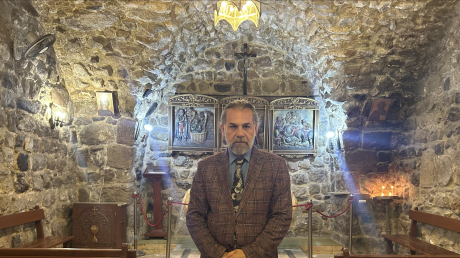
Syrian novelist and journalist Ibrahim Al-Jabin approaches his questions through adjacent gateways: Damascus, language, memory, fiction, politics, and the media. These gateways intersect within an intellectual project that sees place as a living being and language as a repository of identity, while considering writing an act of tracing what authoritarianism has attempted to erase or distort.
In his works, Damascus appears as a city, a memory, and a laboratory for the transformations of the Levant. Documents stand alongside stories, while history enters fiction carrying the voices of victims, perpetrators, and witnesses.
The interview moves from the idea of “worshipping the place” and restoring both stone and human beings, to “Syrian inner languages” and resistant memory. It then opens onto questions of political evil, the transformations of ideological groups, majorities and minorities, citizenship, and transitional justice.
Throughout, Al-Jabin is keen to dismantle ready-made classifications and approach phenomena through their histories and internal relationships, with a clear defense of law, knowledge, and independent civil action.
The interview with Al-Jabin reveals the deep connection between his fictional works and his media experience. For him, testimony is a living novel, the guest is a gateway to an entire era, and dialogue is a means of reclaiming a Syrian history that has long been subjected to falsification and exclusion. Here, he speaks about the Damascus that shaped his language, about Syria emerging from the walls of fear, and about writing as a space for preserving memory, understanding the present, and anticipating what awaits the country.
“I saw Syria as a new Andalusia, almost destined to fall through the passage of a brutal age. I imagined that a secret language had taken root in Damascus, the mother of Andalusia and its first womb, preserving its ability to survive for thousands of years.”
You introduced the expression “worshipping the place” in your novels and linked the restoration of Damascus’s Roman theatre to the restoration of memory and society. What does this expression mean, given that you are a true son of Damascus, one of its lovers, and the chairman of the Board of Trustees of the Damascus Institute for Thought? How does working on stone become a cultural and spiritual act?
“Worshipping the place” is not an invention. All forms of worship have been associated with a symbolic representation. The phrase, which appears on the lips of one of my fictional characters, reflects an attachment to Damascus that goes beyond nostalgia and the instinctive bond with a particular home.
Damascus possesses an attraction and an ability to make those who understand it fall in love with it. That is why it is “the eye of the East” and the living earthly paradise of the Arabs.
That is also why, in some of my novels, I publish architectural and engineering maps of places. This is a tool of influence that may seem unfamiliar in literature. Independent cultural work and caring for the restoration of places are an attempt to inject life into Syrian society, which has been paralyzed and crippled, while seeds of regionalism, sectarianism, tribalism, corruption, anger, and aggression have been planted within it.
Leaving this matter entirely to the state does not achieve the desired goal, because authorities have their own policies and orientations. Civil society therefore participates out of a desire to rebuild through working on both people and stone.
Does this project evoke the experience of Fakhri al-Baroudi, whose pursuit of cultural change through community work you examined? And how do you respond to those who see your love of Damascus as excessive attachment or regionalist sentiment?
Perhaps there is indeed an evocation of al-Baroudi. In my book The European Journey, I traced his eagerness to learn and travel, and then his involvement in cultural and community activism. He contributed to changing many things and remained, until the very end, determined to intervene in public affairs—from politics, music, and poetry to creating employment opportunities for qualified people and inventing the Samaḥ dance with the late pioneer Adila Bayhum.
The book also included another work on Damascus, its schools, theatres, houses, hospitals, mosques, and the clothing of its inhabitants.
As for my vision of Damascus, it does not stem from regionalist sentiment. I belong to a family whose roots go back to Deir ez-Zor on the Euphrates. The Euphrates also teaches you that place is not merely scenery, and that cultural geography shapes human beings and influences them. The awareness that has developed over thousands of years cannot be erased anthropologically.
In your novel Al-Khamiado, you explain that Syrians created “languages beneath languages” and “languages above languages,” which you call “Syrian inner languages.” Did this language end after the fall of the regime, or does its logic still exist?
In Al-Khamiado, I placed the reader before a secret language created by the Moriscos after the fall of Granada to preserve their civilizational identity from extinction. I saw Syria as a new Andalusia, almost destined to fall through a brutal historical age, and imagined that a secret language had emerged in Damascus, the mother of Andalusia and its first womb, preserving its ability to survive for thousands of years.
This language preserved the meaning of urbanity and the skill of reconstructing relationships among inhabitants, as well as creativity in manufacturing, trade, textiles, architecture, and the architecture of the human being himself.
The year 2011 represented a turning point in a long historical trajectory from which Damascus emerged victorious, from Timur to Hafez and Bashar al-Assad. The secret languages among Syrians still exist, and they explain their problems and offer solutions to them.
The multiplicity of languages and cultures represents richness and diversity, but it can also turn into sharp differences that hinder Syrians from feeling that they are one people. Differences in perceptions do not necessarily lead to civil war.
The logic of Al-Khamiado is still resisting extinction. That is why I call on everyone to come down from the tree and embrace humility and realism. Their fantasies now belong behind Syrians, while the present moment belongs to them.
Your interest in language is also evident in your book The Language of Muhammad, which was banned and led to fatwas declaring you an apostate in 2003.
Language is not merely a bridge for communication. Like place, it is a thinking entity.
I am pleased that many people still remember it. Although the book was banned from being printed and distributed in Syria, it was secretly published by a Syrian-Danish publishing house.
Some clerics attacked me, and Sheikh Zaghloul al-Najjar described me as a “heretic,” even though the book is a linguistic study that analyzes the language of Quraysh and the languages of the Arabs through condensed references intended for researchers.
Your works connect Nazism, euthanasia, the violence against the children of Daraa, and the storming of the Omari Mosque, examining evil when it becomes a complete structure. How can fiction reveal the roots and similarities of evil across different eras in a way that goes beyond documentation?
Most of the events in my novels are real and documented, particularly those relating to the Nazi presence in Damascus, which I was the first to write about.
In my view, Nazism is a phenomenon that transcends ideologies and cultures and is not limited to the German experience. Its defining feature is that it practiced brutality and hatred in the modern age, at a time when humanity was supposedly expected to have moved beyond such treatment of human beings.
Zionism and Assadism are analogous to Nazism, and what emerged in Saydnaya Prison and elsewhere confirms this similarity. That is why many regimes drew on Nazi expertise in building their security systems, just as the United States used scientists from Berlin to develop its missile industry.
Evil, as Hannah Arendt saw it, is linked to the absence of knowledge. The ignorance that dominates our societies explains many forms of evil, including the collapse of the discourse of intellectuals, academics, and opinion-makers into sectarianism, racism, and narrow identities.
When their rhetoric of hatred rises, they abandon the responsibility of knowledge they claim to carry. When the moment came to intervene to save people from authoritarianism, sectarianism, and genocide, many resigned from their roles and chose silence or joined groups they were supposedly intellectually superior to.
The novel embodies this failure through living and imagined characters. It can document the crime and immortalize the moment in which the killers, in their various forms, are apprehended.
“I engage with ideas from within because I do not feel the need to hesitate or ask permission before entering them. I studied jihadist groups and researched them, and I developed personal relationships with some of their leaders for a quarter of a century.”
In your novel The Eye of the East, which has received considerable attention and has been translated into German, Turkish, and other languages, its protagonist, the elderly painter Naji, is born with hyperthymesia, or an extraordinary memory. Syrian memory after 2011 appears simultaneously as a wound and a source of resistance. What role do you see memory playing in confronting authority and its attempts to impose its own narrative?
Naji is not the only one afflicted with hyperthymesia. I deliberately said that the writer and the reader are afflicted as well.
Memory is an extremely influential entity, and its excessive activity can lead either to enormous destruction or to a unique spiritual and intellectual awakening.
Authority can attempt to erase memory, but its impact remains temporary and disappears with its disappearance.
What endures are the traces and dynamics active within society, literature, the arts, and the media. If those who carry memory become lax in their mission, authority can establish its own narrative.
The Palestinian experience is a clear example. By clinging to the smallest details of memory, the occupation failed to convince the world of the absence of the Palestinian people, their culture, songs, history, stories, and poems.
That example inspired Syrians and inspired me personally. There is nothing more powerful than memory in confronting barrel bombs, chemical weapons, prisons, and displacement.
Damascus appears in The Eye of the East as a city that gathers fugitives and people fleeing justice. Do you write about it as a city or as an archive of political evil in the twentieth century?
Damascus is too vast and too cunning to be used as a threshold for reading history or reality.
It is a city of secrets and details. Every millimetre of it contains stories that have happened and are still happening.
It is also the geography of change in the Arab world. Ideas emerge from it, and when reality changes there, capitals and peoples change as well.
Reading the transformations of Damascus helps us understand the transformations of the entire Levant—from vegetable and newspaper sellers to the lives of politicians, criminals, artists, and lovers on the road to al-Rabwa on the outskirts of the city.
You combine diaries, documents, confessions, biographies, and historical research in your novels, placing real Damascus alongside an imagined one. Did you choose this form because the Syrian truth is scattered between testimony, myth, security files, and popular tales?
For years, I repeated that I had borrowed the techniques of cinema—its sense of time and its relationships—in writing fiction, in an inversion of what a screenwriter does when transforming a novel into cinematic language. Critics and textual analysts later confirmed this.
Later, I discovered that I had actually borrowed the language of Damascus itself, because events unfold there in precisely this way.
Ibn Taymiyyah appears beside Abd al-Rahman al-Shahbandar; a few metres away, you find yourself with a magician in the Jewish Quarter. Then you read the rhythms of the coppersmiths’ market, enter the future, before the place returns you to the Forty Guardians of Damascus.
In your journalistic interviews, you engage with ideas from within. How do you explain the ability of some jihadist groups to undergo political transformation? Do you compare this transformation with that of the left and other ideological movements, or do you call for testing them outside ready-made classifications?
What is problematic about thinking freely?
I engage with ideas from within because I do not feel the need to hesitate or ask permission before entering them.
I studied jihadist groups and researched them, and I developed personal relationships with some of their leaders for a quarter of a century, while taking care not to “fall in love with the agent.”
The ability of these groups to transform is no different from the ability of someone belonging to Marxist, nationalist, liberal, or neoliberal thought to evolve.
They are groups that became part of intellectual systems seeking to survive within environments that were hostile to them. They attempt to break through prohibitions by modifying their ideas, beliefs, and practices.
This transformation has historically occurred with other currents as well. It is therefore illogical to rule it out in advance for Islamists or to regard them as a closed circle.
It can also be treated as a political test. In democratic life, programs are subject to testing and revision, and practices are the standard.
But do you believe that the transformations undertaken by jihadist movements could soon, or one day, reach what Ibrahim al-Jabin himself hopes for—the Syrian-German citizen who lives in Europe, where freedom of thought, belief, and political practice are considered a model even within Europe itself? What is your personal reading of these intellectual transformations, particularly after they overthrew the dictatorship and became responsible for a people living in intellectually unsettled conditions such as the Syrian people? And what is your position on criticizing the new authorities today?
I do not need to be German to live with freedom of thought, belief, and practice. I have thought this way throughout my life and behaved this way in my daily conduct.
You may consider it an adventure or recklessness.
But when I look back, I discover that I had completely freed myself from many of the restrictions that normally govern our thoughts and activities, even in my personal and family choices. Of course, this came at a very high price that one has to pay.
What I wish for Syria is what I wish for Palestine, Jordan, Iraq, and Lebanon: that they invest the current moment of awareness and carry its momentum toward honoring human beings, improving their welfare, and developing their lives.
That is the purpose of political parties everywhere in the world. That is why politics exists.
On the other hand, I was the first to say, less than a week after Assad was overthrown, that a critical distance is extremely necessary for both the intellectual and the new authority—not a physical distance or rupture, but a flexible relationship based on freedom of vision and criticism whenever necessary, in order to push the state and society along the path toward the civil, republican, democratic state envisioned by the Syrian revolution.
Syria lived under a regime that presented itself as the authority of a majority while acting as an authority of a minority that exploited minorities and crushed the majority. Today, some speak of an authority governed in the name of the majority. How do you see the future of minorities, the legitimacy of their fears, and the limits of using the concepts of minority and majority?
I do not believe it is possible to generalize about groups.
I have always rejected the idea of a “supporting environment,” considering it a dangerous deception, because assuming that an entire human group agrees on one idea is unscientific.
When Assad used the expression “germs and terrorists,” the other side used the expression “the supportive environment of the revolution.” This is a destructive reflection of the same logic, because it opens the door to speaking of environments that support Assad as well.
Therefore, I do not accept the narrative of minorities and majorities as final truths.
Within minorities there are minorities, and within majorities there are minorities.
Thinking that categorizes the other according to sect or ethnicity is the source of mutual fear. Those who consider themselves a majority and those who call themselves minorities are equally implicated in it.
The solution is citizenship, where rights and duties are equal regardless of ethnicity, religion, or sect.
The real challenge is for everyone to accept this balance.
Syria cannot move into the future with a single color or a map fabricated out of colors.
What about your statement that caused controversy, which you attributed to the thinker Yassin al-Hafiz?
What I said about Yassin al-Hafiz was misunderstood.
The phrase “democracy does not suit minorities” means that it does not appeal to people with narrow minority thinking; it does not mean that democracy is unsuitable for minorities.
Those who demand sectarian power-sharing reject democracy, equality, and citizenship.
How can an inclusive state be built amid rising separatist tendencies and narratives of victimhood? Who is the victim when everyone claims victimhood, and where is the boundary between the right of communities to reassurance and the danger of fragmentation?
What we are seeing today is the Syria that existed behind Assad’s walls.
Its societies were deprived of development and economic, technological, and agricultural advancement, as well as intellectual and civic development.
They remained old societies that had not undergone serious modernization or reform of intellectual discourse, and they are now seeking self-realization after a long period of deprivation.
Anyone seeking separation today is fundamentally detached from reality.
Identifying the victim is the task of transitional justice. It must open itself to all dimensions of the question and not be limited to Assad’s crimes.
It must investigate the meaning of injustice and examine the myths that some regions and communities tell about historical persecution that supposedly led to their isolation.
Scientific examination may reveal that some of these narratives are popular myths passed down through generations.
This changes, while the enduring truth is that the Syrian people lived for dozens of centuries in peace, interrupted by a few temporary disturbances that affected all communities without exception.
Everyone feels afraid—minorities and majorities alike. How can the walls planted by dictatorship be removed and violence prevented from recurring?
Knowledge of history.
Not because I am an employee of the historians’ office, but because I am a passionate researcher of history, eager to present it with greater freedom.
I find that the absence of laws is a direct cause of fear. Citizenship means laws, commitments, duties, and rights.
That is why I assign these tasks to two parties: the state, and intellectuals and independent institutions—provided that everyone does their homework and arms themselves with a minimum level of knowledge.
Otherwise, massacres will recur if these actors attempt to hide the unresolved issues by sweeping them under the carpet rather than confronting them courageously.
You tend to dismantle binaries such as majority/minority, secular/Islamist, revolutionary/loyalist, civilian/jihadist. Has the tragedy