
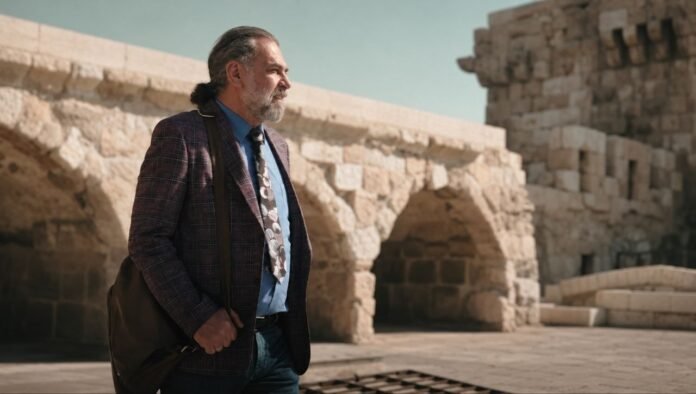
Hassan Qantar
From Poetry to Literature, History and Media
You began as a poet, then turned to novel writing, historical and political research, and media. What brings these different paths together?
I was simply searching for forms capable of accommodating the questions that occupy my mind. Poetry never left me when I began writing novels, and fiction never became detached from history. The question that has continued to accompany me is: How does a human being create their own story, and how does that story become memory and eventually history?
In media, I search for witnesses through dialogue with others, a journey in which the audience and I discover a world we do not know. A document may carry enormous narrative potential, while an oral testimony may reveal what official records cannot.
As for my personal project, it is about resisting oblivion by questioning the past and the present, rather than simply recording them as they are. Perhaps this is why I constantly reassess my work. I imagine it a thousand years from now in the hands of someone studying it, and ask myself every day: Will my work be worthy of that moment?
Historical Research and Media
You won the Ibn Battuta Award for Travel Literature, presented by the Center for Research and Intercommunication of Cultures in London and Abu Dhabi, for your research and publication of Fakhri Al-Baroudi’s The European Journey. What did this experience add to you?
I collected Fakhri Al-Baroudi’s scattered papers about his journey to Europe, which had never previously been published. I turned the book into a record of his life before, during and after the journey. He was a vibrant and creative figure, not merely a symbol of the Syrian national movement.
That experience taught me the importance of humility in the face of people’s suffering and concerns, while remaining bold in presenting ideas. It also deepened my interest in Syrian intellectual and political elites who were shaping their visions of modernity, independence and the national state.
In your novels, you combine documents, history and fiction, as we see in Ayn Al-Sharq (The Eye of the East). How do you strike a balance between documentation and creative freedom?
I begin in an area where history and storytelling overlap. Documents tell us what was recorded, not what people felt as they confronted their destinies. Fiction proposes human possibilities without claiming to be historical fact.
I treat documents as witnesses, not as absolute authorities over imagination. I search for the silences within Syrian memory. Consider, for example, Syrian cultural life from the 1960s until the fall of tyranny: it was held hostage by two patterns. The first was the Baathist pattern and its sectarian and ideological structures; the second was a pattern among some of its opponents that was no less exclusionary in its cultural practices. They differed politically, but both restricted other opinions. We are still paying the price for this monopoly. Does this scene not deserve to be documented through fiction?
Silence does not mean that stories are absent. It may instead result from fear or from myths that people have constructed about one another.
As a novelist, you have also presented talk shows and documentaries. What distinguishes media dialogue as a form of historical testimony?
I am not a television presenter in the conventional sense. I research and present television material from the same position. Dialogue becomes testimony when it goes beyond chasing statements to reconstructing events and their contexts.
In my programme Testimony for History, I see the guest as someone carrying a memory that may add to the documents or contradict them. However, testimony is not the final truth. Memory is selective, and the interviewer must compare accounts and expose contradictions without turning the conversation into a trial or a staged performance agreed upon by the interviewer and guest. This is what I find most objectionable. The intensity and spontaneity of dialogue, along with the debate that unfolds during it, are part of its credibility.
How do you assess the state of fiction and poetry in Syria today, and what does the cultural scene need to regain its vitality?
Syrian literature in general is going through an exceptional phase, standing between an era that has come to an end and another that is being written now. It exists between those inside Syria and those in exile, and between writers who experienced the revolution, war and displacement and others who remained under the rule of the former regime. Some supported it, while others remained silent in the face of its crimes as we suffered.
But pain alone does not produce a great novel, and an ethical position does not exempt a literary text from meeting its aesthetic and structural requirements. Conversely, much of what was published in Syria during the years of the revolution was filled with hatred and a desire for revenge against the revolutionaries. This is an aggressive mindset that must not be allowed to disguise itself as literature.
Poetry, meanwhile, should not be measured by the poet’s fame, connections, or the number of literary evenings and social gatherings they attend. Its value lies in what it contributes to language, literary sensibility, and the evolution of Syrian and Arab poetry. New poetic generations have emerged that will break the standards of clique-based literary culture, which elevated numerous figures who are now resisting the end of their relevance behind political slogans and disguises.
The cultural scene needs responsible freedom, one that intellectuals do not wait to receive as a gift from the authorities, but rather practise and defend its guarantees. Boycotting cultural life in the hope of bringing down the state is a futile endeavour.
Today, if you look closely, you will find articles written by deranged men and women claiming that Syrian cultural life was created exclusively by members of certain communities, while others failed to contribute to it. These are malicious insinuations intended to undermine broad segments of society by accusing them of lacking the ability to create.
An intellectual’s freedom begins with believing in it first and freeing themselves from the habits of servitude. We still see some people behaving with tension and aggression because they remain prisoners of a particular ideology or deeply rooted sectarian and racist impulses.
Damascus, History and Memory
Damascus features prominently in your work. How does the city transform from a fictional setting into memory, identity and a cultural project?
For me, Damascus is not merely a place where events unfold; it is a character that participates in shaping them. Different eras and historical layers coexist within the city without cancelling one another out.
Reclaiming Damascus means reconnecting memory with life, protecting diversity, revitalising institutions and involving residents in shaping the future. Damascus is an idea that can inspire a model for Syria as a whole.
Exile, Cultural and Social Work
How have experiences of censorship, persecution and exile influenced your vision of writing and media, and your relationship with Damascus?
Most of my books, films and programmes were banned before the revolution. My aim was never to seek out forbidden subjects, but simply to write freely.
Exile provides distance from which to see one’s homeland, but it splits a person between a place where they live and a memory that inhabits another place. During the years of exile, my father and brother passed away, and I was unable to say goodbye to them. Before experiencing this myself, I had not fully understood the bitterness of exile endured by displaced people.
Ironically, I once regarded the banning of certain works as an unbearable injustice, only to later encounter people who deliberately sought to have their books banned in pursuit of fame. I have never respected such behaviour. I turned away from it and directed my attention towards building a broad and ambitious relationship with Damascus.
Perhaps this is why you founded the Damascus Foundation with your colleagues. What does the foundation offer to culture?
Certainly. The Damascus Foundation works in the cultural, social and developmental fields, seeking to contribute to reconstruction and rebuilding. It does not hesitate to intervene in any matter where it believes its role can have a positive impact, without waiting for an invitation from anyone.
We do not want it to be merely a platform for ideas, but rather a bridge between culture and society.
In the cultural field, we signed a cooperation and support agreement with the Ministry of Culture. Among our most prominent activities were honouring the steadfastness of the Church of Mar Elias the Living in the Dwelaa neighbourhood with the Father Paolo Shield, following the terrorist attack targeting it; preparing and publishing the extensive encyclopaedia of the Great Umayyad Mosque in Damascus, authored by the distinguished historian Ahmad Ibish under the patronage of the Ministry of Culture; and producing the play A Rehearsal for Judgment Day, which is currently competing in the Carthage International Theatre Festival. The play presents the stories of Syrian women who survived detention, torture and assault, while addressing justice and revenge.
We attended the reopening of the studio of artist Fateh Al-Moudarres, which you worked to restore some time ago. What motivated your particular interest in Al-Moudarres?
Fateh Al-Moudarres was much more than a painter. He was also a writer and thinker with diverse interests, and he turned his studio into a centre for cultural and artistic gatherings.
We began our initiative to restore Syria’s visual arts heritage by renovating Fateh Al-Moudarres’s studio, following a proposal and under the supervision of our colleague and friend, artist Khaled Al-Attar, and artist Issam Darwish.
Our aim is to launch a major state-sponsored project to care for pioneering artists and preserve their legacy.
Dr Burhan Ghalioun suggested that we honour the legacy of the late artist Nazir Nabaa and his wife, artist Shalabia Ibrahim, and we have already begun working on this project.
The arts are interconnected. In music, as in painting, we organised a concert by committed artist Bashar Zarkan at the Opera House. A few weeks ago, our colleague, researcher and novelist Tayseer Khalaf put forward a voluntary initiative to establish a dedicated section for Abu Khalil Al-Qabbani in his house, which is currently being restored, under the patronage and support of the Ministries of Culture and Tourism. The initiative aims to equip the house with a large collection of rare photographs, documents and audio recordings.
Doesn’t this represent a dispersion of efforts across too many cultural fields?
This is the new Syrian culture: a culture of action, not empty talk, gossip and vulgarity. Why do you consider it dispersion? Look at it instead as enthusiasm for contributing to the revitalisation of cultural life.
For example, as part of our ongoing partnerships in support of justice, we also signed an agreement with the National Commission for Transitional Justice to cooperate on various research and cultural files and promote a culture of law.
We also have a partnership agreement with the German organisation War Child Relief Association to develop humanitarian, educational and cultural cooperation in Syria. This work is supervised by our Board of Trustees member, scientist Dr Adnan Wahoud, and includes caring for orphans and the children of martyrs, establishing and managing free schools for children returning from Turkey, and supporting and managing charitable kitchens in Idlib and the Damascus countryside, which provide free meals to around 1,000 people every day.
In addition, the partnership supports and manages four medical clinics that provide free treatment and medication to more than 2,000 patients every month in several areas, including Al-Yaqubiya.
Why Al-Yaqubiya in particular?
It is not limited to Al-Yaqubiya, but I mentioned it because Al-Yaqubiya and its surrounding areas are Christian regions whose residents have endured difficult circumstances while remaining committed to their land.
Dr Wahoud, in cooperation with Bishop Hanna Jallouf, the Apostolic Vicar for the Latin Church, began early and significant efforts to support the elderly and help them remain in their communities.
For us, preserving the Christian presence in Syria is part of a historic national responsibility to protect the country’s diversity and its population.
We do not have abundant financial resources, nor do we accept questionable funding. However, we have determination, ideas and expertise.
We do not want civil society to be an adversary of the state or a subordinate of the government. Rather, it should be an independent partner that retains its right to criticism and accountability.
Civic engagement is an intellectual’s duty, and withdrawing from it is evidence of helplessness and selfishness.
Today, a year and a half after we began our activities in Syria following liberation, the Damascus Foundation relies on the efforts of young people from the sons and daughters of the revolution in northern Syria, whose homes and villages were destroyed, yet who continued to stand firm until victory.
How do you see this activity as connected to your historical and literary research?
In my latest book, From Faisal I to Ahmad Al-Sharaa: Defining Moments in Syria’s History, I placed the Syrian present within the broader history of the Syrian state, from its establishment and the coups and union, through military regimes, to the revolution and the current transformation.
The lesson is that the state is what we build ourselves, not what we wait for someone else to build for us.
I explored what Damascus does to those who govern it and how it influences them. I also examined how the relationship between the state and the historic civic character of the capital can be assessed, distinguishing it from the behaviour of those who sought to subjugate Damascus, humiliate it and take revenge on it.
The question that has remained a central thread throughout the book and my ongoing research is: How can we move from a phase in which the state was an instrument of power to one in which authority becomes a function of the state, constrained by the constitution and the law and subject to accountability?
Syria and Current Transformations
How do you interpret the transformations taking place in Syria?
The Battle of Deterring Aggression, liberation and the overthrow of the criminal regime in December 2024 were not merely a transfer of power. They represented an opportunity to rebuild the relationship between the state and society.
This requires us to confront the cultural structures that dominated for a long time, including those within the opposition that continue to operate according to rigid loyalties and the logic of allegiance and disavowal.
Anyone who fails to recognise the radical nature of Syria’s transformations is living detached from reality, inhabiting a virtual world different from our own.
We are witnessing an intellectual and strategic transition: from revolution, jihad, military action, asylum and displacement towards politics; and from backwardness and narrow loyalties towards recognising the importance of progress, development and the full completion of state institutions.
Politics is a vocabulary that cannot be confined to political parties and organisational work alone. It extends to every creative collective action that contributes to the country’s revival.
In your opinion, what are the main challenges facing the establishment of a state based on citizenship and the rule of law?
The main challenges we face today include transitional justice, victims’ rights, the return of displaced people, reconstruction, the economy and security.
We need to move from a culture of domination and spoils to one of partnership and transparency, because political transformation alone is insufficient unless it is accompanied by a new political culture among the various parties.
Years of crimes and massacres have left behind issues that cannot be resolved through slogans or overcome through denial.
The state is not merely the outcome of a collective will; it is also institutions, laws and safeguards. However, these institutions cannot serve as guarantees for some if they do not believe in their sovereignty. This is the real challenge and test of citizenship.
You say this while previously emphasising that intellectuals must maintain a critical distance from those in power. How can they do so without becoming either opponents or followers?
Critical distance is neither hostility towards the authorities nor an attitude of superiority towards society. It is the ability to see what decision-makers may overlook and to say what we believe to be right without waiting for permission or reward.
An intellectual is not required to oppose everything the government does simply to prove their independence.
Intellectuals should defend freedom, justice, the rule of law and human dignity, rather than replacing an old culture of submission with a new one.
I believe they should engage with state institutions and participate in their projects without relinquishing their right to disagree with them. Independence does not mean isolation, and cooperation does not mean subordination.
Knowledge cannot serve decision-making if it is required to endorse decisions in advance.
The standard is what an intellectual achieves and what they are capable of saying when they disagree with you, without allowing disagreement to become trivial or vulgar.
The law must be supreme. This requires everyone to respect all laws and legitimate frameworks and abide by them in their entirety, rather than selectively accepting some while rejecting others.
There are still those who debate the legitimacy of the Constitutional Declaration while refusing to recognise the state. How can one expect them to respect the law?
We think along these lines at a time when the new Syrian cultural climate is witnessing a quiet struggle for influence over public opinion.
While some are gambling with Syria’s stability and hoping for its collapse, others are working to strengthen its course by creating a rich environment in which differences can be managed wisely.
Here, the state has a responsibility to support independent cultural and social initiatives, allowing them to complement the work of the Ministry of Culture and other government institutions.
These initiatives are numerous, diverse and commendable. Their success helps close the gaps through which those seeking to reproduce the culture that prevailed under the former regime might otherwise find a way in.