

Fares al-Dhahabi
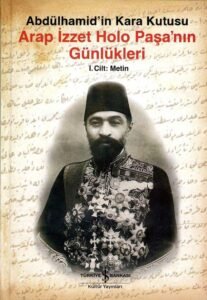
On 8 February 2010, Ahmed Samih Mumtaz entered a bank in the Swiss city of Lausanne, carrying an authorisation that allowed him to open a safe deposit box that had remained sealed for decades. After hours spent opening it, five old notebooks emerged, having been kept in strict secrecy by a family of Ottoman origin. Written by hand, these notebooks contained the testimony of one of Sultan Abdul Hamid II’s closest associates, a man deeply familiar with the inner workings of government in the final years of the nineteenth century and the early twentieth century.
The author of these notebooks was Ahmed Izzet Pasha al-Abid, a Damascene figure known in Turkish documents as “Arab Izzet Pasha”. He rose to an exceptional position at Yildiz Palace, becoming the Sultan’s second secretary, one of his closest advisers, and one of the men entrusted with sensitive political and diplomatic files.
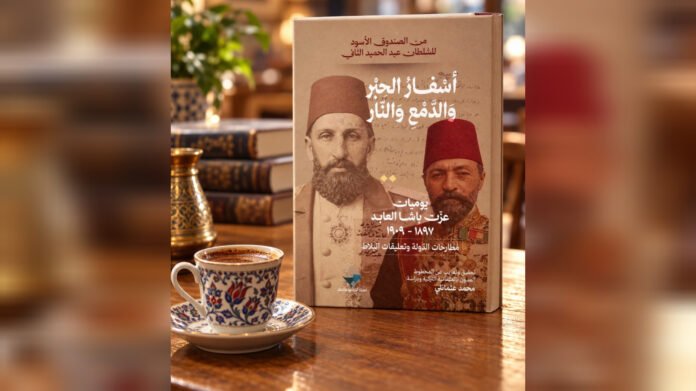
The recent publication of an Arabic translation of his diaries in a substantial 1,037-page volume, edited and translated by researcher Mohammed Osmanli, has renewed interest in this figure, who occupies a notable place in modern Syrian and Ottoman history. His papers open a window onto the world of government from within, through the perspective of a man who spent many years close to the Sultan and witnessed the transformations that preceded the collapse of his political system.
The story of these diaries dates back to the years al-Abid spent at Yildiz Palace, where he recorded his observations, conversations with the Sultan, and reflections on government decisions in five notebooks, alongside details of negotiations and communications in which he took part. He instructed that the notebooks be preserved and their publication postponed for one hundred years. Following his death in 1924, they passed to his daughter, Lamaan Hanım, who deposited them in a bank vault in Switzerland.
For decades, these papers survived in the family’s memory as a mysterious tale of missing notebooks, until one of his descendants, Ahmed Samih Mumtaz, managed to find them after a search lasting more than thirty years. Their discovery marked the beginning of a second journey. Ibrahim Koreli undertook the task of transcribing the Ottoman Turkish text into the Latin alphabet, before the diaries were published in 2019 by Türkiye İş Bankası Publications in two volumes: the first containing the text and the second reproducing images of the original manuscript.
The publication attracted considerable attention in Turkish cultural and historical circles, and the Turkish press produced numerous analytical articles about the diaries, which friends helped us access. Particular attention was given to al-Abid’s accounts of his conversations with the Sultan and to political and diplomatic initiatives that remained, in some cases, at the stage of proposals and discussions.
One striking example cited in analyses of the diaries concerns a proposal attributed to the Sultan during the Boer War in South Africa. According to the account, the proposal involved a population exchange whereby Armenians would be transferred from Anatolia to Africa and Boers brought to Ottoman territories. The war in question was fought by Britain between 1899 and 1902 against the two republics established in South Africa by settlers of Dutch descent known as Boers.
This account, which requires comparison with contemporary diplomatic sources, reveals the kinds of ideas circulating within the ruling circles of the period and the extent of the anxiety that the Armenian question provoked within the Ottoman authorities.
Elsewhere, al-Abid appears keen to record how he had previously objected to certain imperial decisions that ultimately produced negative consequences, presenting himself as an adviser who had warned of the repercussions of particular policies. This observation brings us to one of the fundamental challenges involved in reading the memoirs of statesmen: the relationship between historical testimony and the author’s desire to defend his own role before future generations.
Political memoirs are generally written from within a personal experience shaped by interests, calculations, loyalties and rivalries. In al-Abid’s case, the issue becomes even more complex because of the position he occupied within the state, followed by the transformations that affected his life after the proclamation of the Second Constitutional Era in 1908 and the rise of the Committee of Union and Progress.
This is why the diaries should be approached as a historical testimony requiring critical examination and comparison with Ottoman archival documents, the memoirs of other statesmen, and foreign diplomatic correspondence. Al-Abid’s proximity to the Sultan gave him exceptional insight into events inside the palace, while his personal experience inevitably shaped the perspective from which he interpreted those events and assigned responsibility for them.
This aspect becomes even more significant when considering the contradictory image that surrounded his personality. While Abdul Hamid II regarded him as one of his most trusted and capable men, his opponents accused him of excessive interference in state affairs, abuse of influence, and the accumulation of substantial wealth. Turkish studies of his life reveal the extent of the controversy surrounding his political rise and the prominent position he attained within the administrative apparatus, clandestine communications networks, and circles of influence surrounding the palace.
Yet the aspect that deserves particular attention in the Arab world is this man’s Damascene background. Ahmed Izzet al-Abid was born into a prominent Damascene family with considerable social and economic standing. He progressed through administrative, judicial and journalistic positions before moving to Istanbul and rising within the central state apparatus. He was knowledgeable in Arabic, Turkish and French, with a strong understanding of law, administration and finance.
From his position at the palace, he took part in handling matters relating to public debt, the state budget and relations with European powers. He also contributed to projects undertaken during Abdul Hamid’s reign, most notably the Hejaz Railway and the telegraph lines that connected extensive parts of the empire.
His life offers an opportunity to examine the role played by Arab elites in administering the Ottoman Empire during its final decades. Damascus, Aleppo, Beirut, Baghdad and other Arab cities were part of the broader environment from which generations of administrators, judges, military officers and diplomats emerged, some of whom went on to occupy influential positions within the central institutions of the state.
These elites operated within a complex network of affiliations and loyalties, combining local and family ties, an Arab cultural identity, and participation in the Ottoman political system. Al-Abid’s experience illustrates this complexity clearly. He spent years serving Sultan Abdul Hamid before finding himself in exile following the rise of the Committee of Union and Progress. His name was later associated with contacts and Arab opposition movements directed against the Unionists.
The historical irony is that one of the Ottoman Sultan’s closest associates was the father of Muhammad Ali al-Abid, who became President of the Syrian Republic in 1932. Between the father’s career at Yildiz Palace and the son’s political journey in Damascus lie profound transformations, as the region moved from an imperial system towards the modern political entities that emerged after the First World War.
This relationship between the two generations may give Izzet Pasha’s diaries a significance extending beyond the history of Sultan Abdul Hamid himself. They also illuminate the formation and political and intellectual evolution of Syrian elites, as well as the enduring connections between former Ottoman administrators and the institutions of government that emerged after the empire’s collapse.
The diaries also raise questions about the history of Damascus during that period. How did its prominent figures view the centre of power in Istanbul? What limits constrained their influence over decisions affecting their native provinces? And how did networks of kinship, wealth, education and government service enable figures such as al-Abid to rise to the highest levels of power?
In this context, the Arabic translation carries added significance. The final years of Ottoman rule have been the subject of numerous historical studies, many of which were shaped by the political and nationalist debates that followed the empire’s collapse. Personal memoirs offer an opportunity to examine the details of everyday political life, revealing the human relationships, calculations of interest, fears and hesitations that accompany major decisions.
In an article published in 2019 by the Turkish news website Gazete Duvar, Turkish journalist Soner Sert examined the story of the notebooks’ discovery. He recalled the account given by Ahmed Samih Mumtaz, the grandson, who emphasised the importance of making these papers available to researchers and allowing the Ottoman archives, over time, to shed light on the Pasha’s mistakes, actions and degree of responsibility for the events in which he participated. This appeal is particularly significant because it came from a member of the family that preserved the manuscript and helped bring it to publication.
With the diaries now available in Arabic, this task has become more accessible to Syrian and Arab researchers, particularly because studying al-Abid requires bringing together Ottoman archives, Arabic sources, documents belonging to Damascene families, and the memoirs and testimonies left by his contemporaries.
The story of the manuscript itself raises a broader question concerning the fate of historical memory in the region. Many papers belonging to statesmen, intellectuals, merchants and military figures who lived during the late Ottoman period became scattered among private libraries, foreign archives and family collections, while a substantial portion remained unknown or inaccessible to the public.
The publication of Izzet Pasha’s diaries in Arabic therefore creates a new opportunity to rediscover a Damascene figure who held the secrets of Sultan Abdul Hamid II and lived at close quarters with a historical turning point that marked the beginning of the disintegration of an entire political world.
It is striking that a man who knew the details of the Sultan’s court and had access to the secrets of relations between the state and its internal and external forces chose to postpone the release of his papers until another era. Perhaps this decision reflected his awareness of the sensitivity of what he had recorded, or perhaps it expressed a desire for his writings to be read by a generation removed from the conflicts of his own time.
More than a century later, those papers emerged from a Swiss vault and returned to circulation in the language of the city from which their author had come. Their return carries particular symbolic significance for a Damascene man who recorded part of Ottoman history from the heart of its imperial court, leaving his testimony to wait for many decades before finding its way to Arabic readers.
Ultimately, the question raised by these diaries extends beyond the secrets of Abdul Hamid II: how much of Damascus’s and Syria’s history remains preserved in the papers of men who lived far from their homeland, helped shape its events, and then left their testimonies scattered in vaults and archives around the world?