

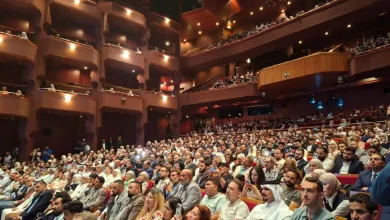
The activities of the Damascus International Arab Poetry Festival have officially begun in the Syrian capital, Damascus. Organized by the Ministry of Culture, the festival brings together 55 poets, writers, and lecturers from 16 Arab countries. The opening ceremony, attended by prominent official, cultural, and artistic figures, featured speeches highlighting the importance of reviving Syria’s cultural movement before the first poetry evenings commenced.
Minister of Culture Mohammad Yassin Saleh announced the completion of the Al-Burda Al-Shamiya Award for Prophetic Praise Poetry, now available through the Ministry’s electronic platform. He also unveiled the Damascus Sword Award for Arabic poetry and announced the establishment of the Nabati Poetry Committee to celebrate both Bedouin and urban literary heritage.
The Ministry’s initiatives extended beyond honorary awards to include the launch of the „Diwan of Syrian Poets“ digital platform, designed as a living archive documenting the history and works of Syrian poets. In addition, the Ministry is cooperating with the Ministry of Agriculture to revive the cultural symbolism of the authentic Syrian horse. The opening ceremony featured a presentation titled „Damascus and Poetry,“ the song „The Syrian Poem,“ a children’s performance, and a tribute segment dedicated to departed intellectuals.
Poetry Returns from Damascus
Speaking to Al-Modon, Minister Saleh said that the participation of more than 15 Arab countries reflects Damascus‘ return to its historical cultural role.
> „We are delighted that Damascus is hosting an international Arab poetry festival and that poetry is once again beginning from Damascus. We seek to restore the cultural, intellectual, and civilizational status of the capital in a manner worthy of Syria, its people, and its heritage.“
Explaining why poetry was chosen as the festival’s focus, Saleh said that poetry „can weave garments worthy of the Arabic language from the threads of language itself,“ adding that the Ministry seeks to create initiatives worthy of Syria and its people.
He confirmed that this is the festival’s inaugural edition and that future editions will follow. According to Saleh, the festival forms part of broader efforts to restore the status of the Arabic language, poetry, and intellectual life, emphasizing that „this is not merely about poetry, but about a moral system.“
He also noted that honoring Dr. Khaldoun Al-Sham’a after fifty years in exile carries a profound ethical significance, symbolizing Syria’s reunion with its intellectual figures. Honoring distinguished Arab poets likewise reflects the cultural standing Damascus deserves within the Arab world.
The festival hosts poets and intellectuals from Iraq, Palestine, Jordan, Saudi Arabia, Qatar, Kuwait, Oman, Yemen, Sudan, and several other Arab countries.
For his part, Mousa Sweidan, one of the Ministry of Culture officials, told Al-Modon that the festival represents the culture of the „new Syria“ and embodies the free voice that poets were previously unable to express. He stressed that poets today can express their opinions freely.
Many participating Arab poets shared similar views, describing the festival as an important step toward restoring Damascus‘ leading cultural role in the Arab world.
Participants: Damascus Regains Its Cultural Presence
Sudanese poet Ibtihal Treiter said this was her first visit to Damascus, but certainly not her last. She emphasized that her presence carries a message to everyone familiar with the city’s ancient history.
> „Roots never die—they grow again. Damascus will always remain strong.“
Treiter admitted she had expected to witness far harsher conditions before arriving but was surprised by the hope she saw among Syrians. She described airports filled with returning Syrians eager to help rebuild their country, saying these scenes gave her great optimism.
Jordanian poet and writer Ayman Al-Atoum said Syria means a great deal to him and that Damascus occupies a special place in his heart.
> „I am a son of this land, and my roots extend into this blessed country.“
He explained that his participation stems from his desire to meet fellow Arab poets, strengthen literary ties, and contribute to evaluating authentic Arab poetic experiences.
Media activist Tamer Turkmani described the festival as an exceptional cultural event and the first of its kind in decades in terms of the freedom it offers poets. He noted that some participants had previously faced persecution or threats because of their views, adding that the festival reflects a new cultural openness and offers intellectuals broader opportunities to express themselves.
Syrian actress Abeer Shams Al-Din also praised Damascus for hosting an event of such significance, particularly with the participation of poets from across the Arab world. She noted that poetry, like all forms of art, evolves alongside society and emphasized the importance of embracing this evolution. She expressed her happiness at seeing such events return to Syria, describing Damascus as a historic cradle of civilizations and cultures whose people have always been pioneers of literary and cultural life.
Festival Program
Running from 2–7 August, the festival’s events take place at the Damascus Opera House and the Drama Theatre, offering a program that goes beyond traditional poetry readings, including:
Diverse poetry evenings featuring both classical Arabic and Nabati poetry by leading poets from Iraq, Saudi Arabia, Yemen, Kuwait, Jordan, Libya, and Syria.
Intellectual seminars discussing topics such as investing in young creative talent, reviewing major literary experiences—including that of poet Souad Al-Sabah—and hosting live podcast recordings.
Art and book exhibitions, book-signing events, and musical performances concluding with a concert by Bashar Zarqan.
Cultural tours linking literature with place through visits to the historic sites of Old Damascus, Bosra, Saidnaya, and Maaloula.