




Dimasheq— News — Damascus
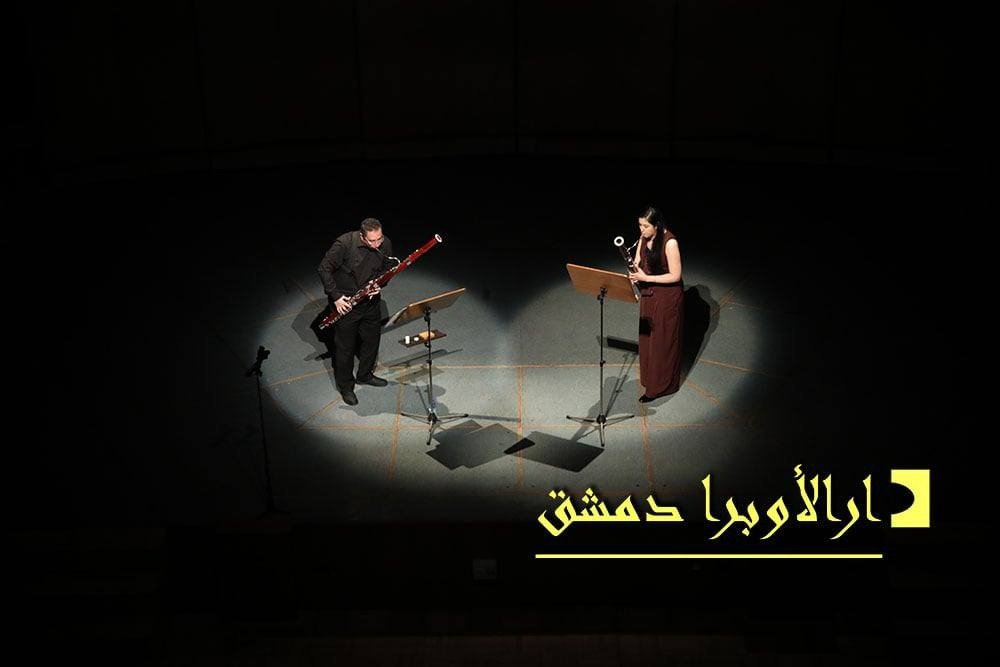
Dialogue, harmony, and an exchange of roles shaped a classical musical evening by bassoon duo Tony Al Amir and Nara Khanmeh, presenting this wind instrument in a new style without accompaniment, while leading a complete musical program dedicated entirely to the duo. The concert took place on Tuesday evening, May 19, 2026, at the Drama Theatre of the Damascus Opera House.
The evening’s program stood out for the diversity of its musical eras and emotions, ranging from romance to sorrow, joy, and humor, while moving through both fast and slow rhythms and techniques. It featured works by the French composers Étienne Ozi, Henri Tomasi, Eugène Bozza, and François Devienne, in addition to a sonata by the German composer Georg Philipp Telemann. The evening concluded with pieces by the Italian composer Gioachino Rossini, famous for the opera The Barber of Seville, alongside selected vocal compositions.
Tony Al Amir described the concert as a new experience for both the performers and the audience, noting that the bassoon carrying the melody alone is entirely different from its presence alongside another accompanying instrument, especially since both bassoons in this performance shared melodies of equal importance. He explained that the diversity of the program allowed the instrument’s technical abilities to be showcased and presented in different styles.
He also pointed out that the duo performance highlights the dynamic interaction between the two musicians in situations where one performer’s feeling may suddenly change, causing them to speed up or slow down, while the partner must maintain harmony and adapt to every change — something that is certainly not easy.
Nara Khanmeh considered the experience extremely challenging because of the responsibility of carrying the full melody, in addition to the constant focus required throughout the performance without the possibility of stopping or fully controlling breathing during the playing, which creates a major challenge.
The bassoonist also noted that one of the most beautiful and distinctive aspects of the evening was that the two instruments sounded different despite being the same size and type. She explained that this difference comes from each performer’s unique way of delivering the musical phrase and expressing the melody, especially since both are wind instruments that rely heavily on physical ability. This clearly revealed the independent personality of each musician while maintaining complete harmony with the other.
Nara Khanmeh also expressed her happiness at performing alongside her teacher, who taught her the fundamentals of the instrument from the very beginning until professionalism. In turn, Tony Al Amir spoke proudly of his student, who now performs with him as an equally important musical partner, encouraging anyone learning the bassoon not to lose hope or consider the instrument strange or difficult, as it has a unique sound and attracts a distinctive audience.