


Damascus News Platform – Quoted from Al-Quds Al-Arabi
By Subhi Hadidi
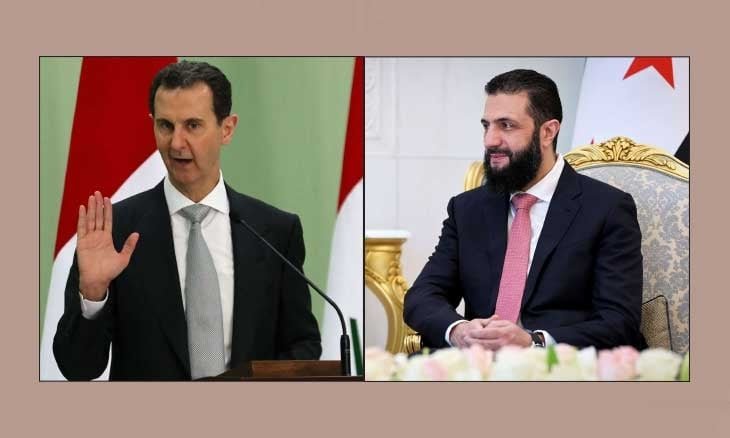
In the Zionist media of various orientations and currents in general — and in the right-wing, far-right, religious, or nationalist press in particular — the new Syria, the current transitional authorities, and transitional president Ahmed al-Sharaa personally do not enjoy the same degree of approval and mutual understanding that the Assad family received over 54 years of the so-called “Corrective Movement” regime.
Naturally, the levels of acceptance, accommodation, understanding, and cooperation were not always equal. They shifted after the 1973 war, when the regime’s army in the occupied Golan effectively became a guardian of the occupation; later after Bashar al-Assad inherited power and was forced to withdraw from Lebanon while adjusting the rhythm of partnership with Hezbollah; then after the popular uprising of spring 2011; and finally following the repercussions of October 7, 2023, across the region, including Iran, Lebanon/Hezbollah, and Assad’s Syria.
Yet it is hardly accurate to claim that these variations stemmed from objective or contextual necessities more than from a reduction in Israeli — and therefore Zionist — satisfaction with the “Corrective Movement” regime. That changed dramatically on December 8, 2024, when the Assadist structures collapsed one after another, amid the shock of Israeli intelligence agencies and the embarrassment of Zionists — who had remained satisfied with both father and son until then — in confronting the sweeping transformations, let alone understanding, analyzing, and adapting their strategies and tactics to them.
During the first months following the outbreak of the Syrian uprising in spring 2011, once it became clear that the regime had resorted to maximum violence and the most brutal methods to suppress peaceful popular protests, Bashar al-Assad chose British journalist Andrew Gilligan — known for his unwavering bias toward the Israeli occupation state — to conduct the first direct interview with a Western journalist. Consequently, Assad selected The Sunday Telegraph, alongside its parent paper The Daily Telegraph, both regarded as platforms dedicated to the blind defense of Israel and global Zionism.
It did not take long before Assad also chose Barbara Walters, the Jewish-American media personality, granting her the first televised interview with a major Western channel.
Both interviews gained their particular prominence and wide circulation because of two factors: the political and media influence of the outlets conducting them, and the dramatic material Assad provided to his interviewers. In the interview with Gilligan, Assad spoke about “burning the region” if his regime were harmed; with Walters, he denied responsibility for the killings carried out by his security apparatus.
The outcome of both interviews was similar in many respects, most notably the promotion of the regime’s narrative about “armed gangs” and “infiltrators,” alongside polishing Assad’s image and reproducing him as a “modern,” “open-minded” Middle Eastern politician who had “studied in the West,” “spoke English fluently,” and was “married to a woman raised in the West.”
They also reinforced a field narrative portraying the Syrian capital as “safe,” “peaceful,” and “free of demonstrations.” Walters even stated that she had wandered around Damascus without a bodyguard and “had never felt as safe in her life” as she did while walking alone through the city’s streets.
For those wondering — or wishing to remember — the reasons behind Zionist satisfaction with the Assad family, it may be useful to revisit the many elements and explicit circumstances that sustained this strange “love story” between a country like Syria, supposedly in an official state of war with the Zionist entity, even though most chapters of that war amounted to noise without action.
The central element was that Israel consistently viewed the “Corrective Movement” regime as an ideal model for maintaining the state of “no war” prevailing in the occupied Golan Heights since 1973. The most important extension of this decisive factor was that it went far beyond military considerations to include economic security, continued investment, settlement expansion, and broader geopolitical interests.
Logically, therefore, any alternative regime — especially one fundamentally opposed to the “Corrective Movement” — would constitute a setback to this harmony between Israel and the Assad family.
Thus, there is a vast difference between Zionist approval of the Assads over 54 years — and perhaps even before that — and Zionist hostility toward Ahmed al-Sharaa.
Perhaps the clearest example of Zionist approval of Assad, contrasted with hostility toward the current transitional authorities, remains — at least in the eyes of this writer — American journalist Daniel Pipes: Jewish, Likud-aligned, hostile toward Arabs and Muslims, and a fabricator of racist imaginary scenarios.
More important than these traits, however, is his skill in avoiding the crude foolishness of figures like Walters or Gilligan, while going directly to the heart of the matter: that the Assad family’s presence in power — with all its authoritarianism, corruption, and war crimes — guaranteed that Syria would not descend into “civil war” or “Sunni-Alawite conflict,” as he described it.
On November 10, 2024, only hours after Assad’s flight and the beginning of the regime’s collapse, Pipes appeared in a radio interview predicting that Syria had just entered a devastating war among Sunnis, Alawites, Druze, Kurds, and Christians all at once. At the same time, he warned the West that Turkish President Recep Tayyip Erdoğan now had “the opportunity to establish an extremist government in Syria,” something he “had not fully managed to achieve in Turkey because of its century-old institutions.”
So what changed in his thinking after weeks, months, or even a year and a half following the collapse of Assad’s regime? Or even after the massacres on the Syrian coast in March 2025, or the massacres in Sweida in July of the same year — events which, despite their gravity, did not evolve into a “civil war”?
Nothing changed.
Even after broad segments of the so-called “reasonable” Zionist thinkers realized that the end of the love affair between Israel and the Assad family had not been replaced by fantasies of civil war or the fragmentation of Syria into Alawite, Druze, or Kurdish mini-states, Pipes and many like him refused to reconsider.
This refusal is not merely stubbornness or an inability to admit analytical failure. It also reflects a chronic Orientalist tendency that prefers preconceived stereotypes over actual political and social realities — realities that have repeatedly proven far more capable of guiding rational analysis.
In any case, figures like Pipes are probably no more rational than Zionists such as Itamar Ben-Gvir at the top of Israel’s ruling coalition — not to mention Benjamin Netanyahu himself, who waited only a few hours after the end of the “Corrective Movement” before launching strikes across Syrian territory against dozens of military sites that Israel had refrained from targeting during Bashar al-Assad’s rule.
Part of the irony in this Zionist hostility toward Syria’s new transitional authorities also lies in the fact that even Israel’s worst interventionist programs aimed at engineering catastrophic scenarios in Syria — such as backing Hikmat al-Hijri and the earlier incident of raising the Star of David in the streets of Sweida — have not only failed spectacularly, but have also accumulated humanitarian, political, and moral consequences for the program’s own collaborators.
Thus, there is indeed a vast difference between Zionist approval of the Assad family over 54 years — perhaps even longer — and Zionist hostility toward Ahmed al-Sharaa during a period that has not yet exceeded a year and a half.
At least for now.
For the coming days are full of possibilities… and may yet give birth to every imaginable surprise.
Syrian writer and researcher based in Paris.