

Dimasheq, citing Al Jazeera
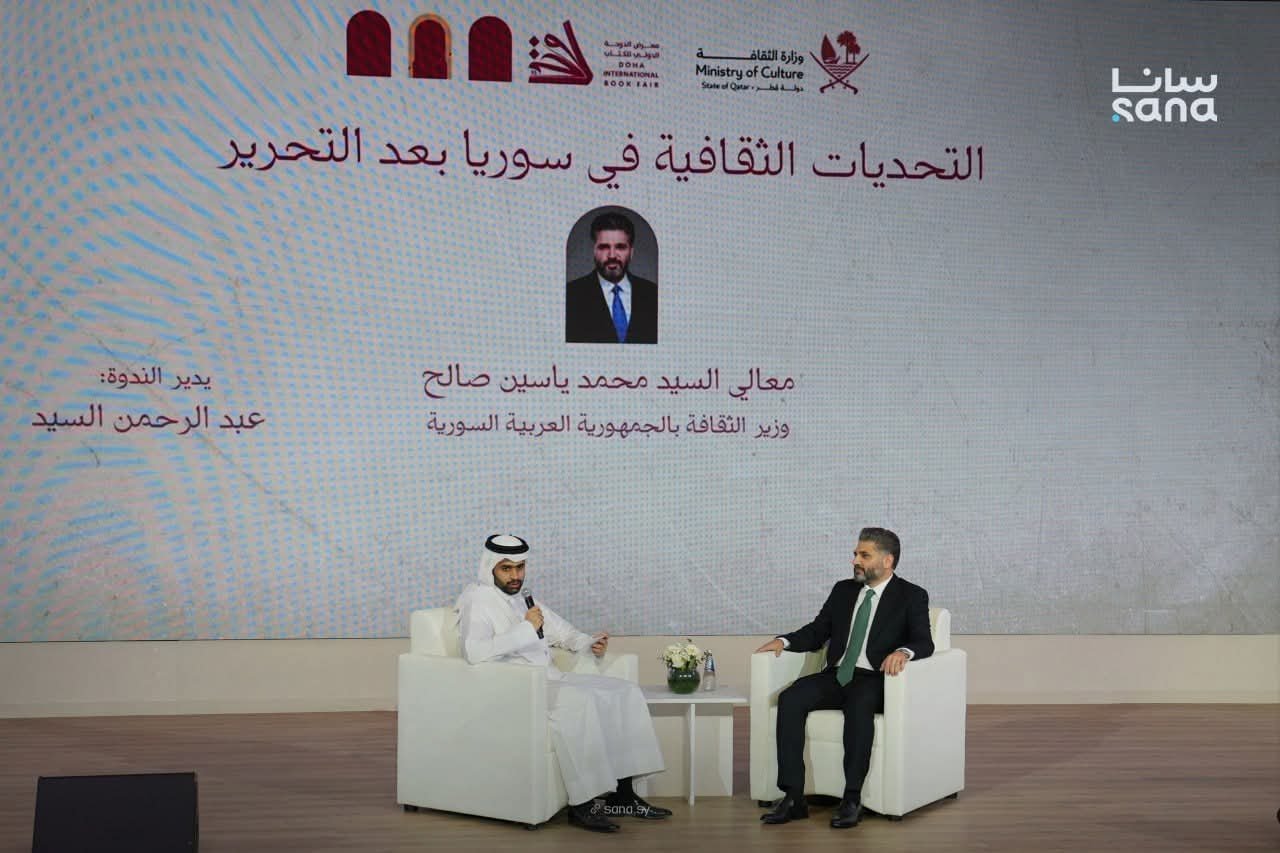
Doha – In the seminar hall of the Doha International Book Fair, Syrian Minister of Culture Mohammad Yassin Saleh sat on Wednesday before a Qatari and Arab audience, alongside Qatari Minister of Culture Sheikh Abdulrahman bin Hamad Al Thani, and declared a sentence that no Syrian had dared to say publicly in any hall for half a century: “There will no longer be any banned books in Syria, and the state will not impose a censor on creators or writers.”
The session, titled “Cultural Challenges in Syria After Liberation,” resembled more a political and cultural declaration of intent than a contemplative seminar. The audience listened to a Syrian minister speaking about his country in the language of a “future present,” not merely a painful past. And when the language of a cultural official shifts from merely “protecting memory” to “drawing a roadmap for the future,” then something has indeed begun to move deep within the Syrian scene.
The Legacy of Five Decades of Repression
To understand the scale of transformation carried by this discourse, it is necessary to look slightly backward. Syria’s cultural sector, both official and private, experienced decades of stagnation and decline due to corruption, favoritism, and poor administration. But the heaviest burden lay in the dominance of the oppressive censorship apparatus over artistic, intellectual, and literary works under the rule of father and son Assad (Hafez and Bashar al-Assad), which lasted around 53 years before collapsing with Bashar al-Assad’s flight to Russia on December 8, 2024, following the opposition’s takeover of most of the country.
From the 1970s until the fall of the regime, books in Syria lived between the hammer of censorship and the anvil of fear. Publishing became a field governed by political guardianship, publishing houses were subjected to strict censorship, and authors were placed under the scissors of censors and security agencies, casting dark shadows over the entire cultural landscape.
For five decades, Syrian intellectuals faced various forms of silencing and repression, ranging from professional and media marginalization of opponents and neutrals, to banning publications and pursuing writers through security apparatuses, all the way to exile and imprisonment merely for expressing opinions or publishing material disliked by the authorities. One recent example was the folk poet Hussein Haidar, who was arrested in August 2023 after criticizing the country’s conditions through poems published on his social media pages.
The Return of “Al-Halbouni Street”
In stark contrast to that recent past, Minister Saleh emphasized that Syria’s participation in this year’s fair was broad and active. The “Syrian General Organization for Books” attended with its publications, alongside the Syrian Embassy in Doha, while representatives of Damascus’s historic “Al-Halbouni Street” — considered the backbone of publishing and bookselling in the Syrian capital — were prominently present.
The presence of Al-Halbouni in Doha is itself a dense visual metaphor. For a Damascene book street to reopen its shelves at a Gulf exhibition after years in which many of its publishers were either in exile or under the blade of censorship was described by Saleh as “restoring the Syrian intellectual to his rightful place and restoring meanings to their true origins.”
The minister also recalled the latest edition of the Damascus International Book Fair, stressing that it was the largest in its history and brought “everyone back to their previously banned books.” During that edition, in which Qatar was the guest of honor, the book “Jasmine Breezes… From the Roses of Damascus That Never Withered” was launched, documenting the Syrian revolution through testimonies and vivid human and historical records.
A “Unifying” Culture or a “Unified” Culture?
In diagnosing Syria’s current cultural condition, the minister revived the concept of a “unifying culture,” pointing out that Syria’s social fabric, extending across thousands of years, granted culture its human dimension. He described the greatest challenge today as making culture part of the country’s broader “recovery” after years of distortion campaigns.
Despite these reassurances and the minister’s invitation for Syrians abroad to return, the distance between a truly “unifying culture” based on genuine plurality and an “official discourse” that might absorb diversity under a single umbrella remains extremely delicate. It is a distance that Syrian intellectuals inside the country will experience firsthand, while Syrian intellectuals in exile will observe cautiously over the coming years.
“The Cultural Bus”
The presentation also included a practical aspect through the announcement of field projects, most notably the “Cultural Bus,” which travels between Syrian villages and regions lacking cultural centers in order to provide activities and discover talents.
What is striking about the Syrian “Cultural Bus” project is how closely it intersects with a similar initiative launched this year by the Doha Book Fair administration, which dedicated a book bus touring 12 schools in Doha. This spontaneous convergence between the two capitals is built on one simple idea: “If the reader does not come to the book, then the book should go to the reader.” Perhaps this small detail, more than any official speech, is the true common ground upon which Qatari-Syrian cultural cooperation stands today.
At the conclusion of the session, the Syrian minister summarized his vision with a notable phrase, saying that “the essence of culture lies in the completion of noble morals,” stressing that culture at this stage is a matter of “national security,” not merely an elite concern.
Such statements, when coming from a minister in a newly formed government, may be interpreted in two ways: either as a genuine promise of change or as a political slogan. The difference between the two readings will ultimately be determined by what appears — or does not appear — on the shelves of bookstores in Aleppo, Homs, and Deir ez-Zor in the coming months.