


Mohammed Khalif Al-Thunayan — Source: Turas.net
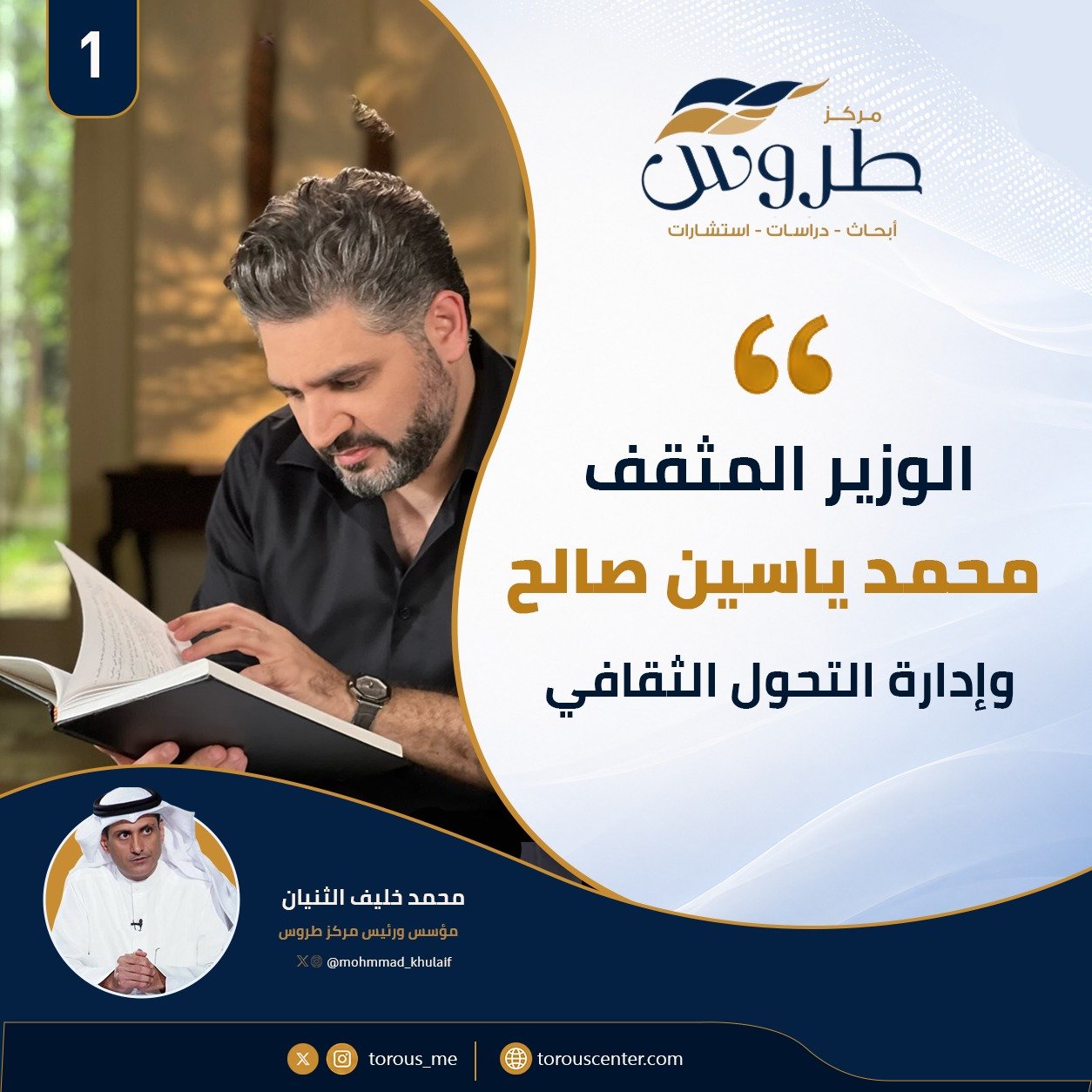
While attending the Doha International Book Fair, I participated in a seminar organized by Qatar’s Ministry of Culture entitled “Cultural Challenges in Syria After Liberation,” presented by His Excellency the Minister of Culture of the Syrian Arab Republic, Mr. Mohammed Yassin Saleh.
What caught my attention during the seminar was that the discussion was not centered on books or reading as traditional cultural activities. Instead, it addressed a deeper concept related to the cultural security of societies and the role of culture in building individuals and shaping the awareness upon which nations rise. As philosopher Will Kymlicka stated: “The right to culture is one of the fundamental human rights, and no freedoms can exist without culture. Human beings are cultural creatures who cannot live without a profound sense of belonging and connection to the culture to which they belong.”
The Minister discussed culture as an integrated system that shapes human behavior, values, and patterns of thinking. This perspective closely aligns with the vision of thinker Malek Bennabi, who viewed culture as the environment within which both individuals and societies are formed.
This vision reveals that the success of cultural institutions depends on leadership that combines culture and management, understands societal transformations, and is capable of transforming culture from a cognitive activity into a project for shaping social awareness.
Cultural institutions are no longer merely concerned with publishing or organizing events. They have become part of a broader system of awareness-building, cultural security, and soft power. This role requires leadership that combines intellectual depth with managerial competence and possesses the ability to transform ideas into programs, projects, and sustainable societal impact.
Perhaps one of the most significant challenges faced by many Arab cultural institutions over past decades has been treating culture as a seasonal activity—such as cutting the ribbon at a book fair opening—or as a routine administrative task, rather than as a project for human development and awareness-building. As a result, some institutions succeeded in organizing events but were less successful in creating lasting cultural impact or fostering influential intellectual movements within society.
This highlights the importance of leaders who combine cultural insight with managerial expertise and who understand societal transformations. The success of a cultural institution should not be measured solely by the number of events it hosts or books it publishes, but by its ability to shape awareness and transform culture into a source of soft power and societal influence.
Based on the ideas presented during the seminar, it appeared that Syria’s new cultural vision places human beings at the center of development and transformation, viewing cultural development as parallel to state-building and the restoration of societal effectiveness. This vision reflects an understanding of culture as a project for shaping awareness and rebuilding individuals, rather than merely a cognitive activity or an isolated institutional function. This perspective was clearly evident in the presentation of Syria’s young and cultured Minister of Culture, Mohammed Yassin Saleh.
Within less than two years, Syria has begun to reclaim the cultural presence for which it has historically been known, through a vision that places human development and awareness at the heart of its national project and treats culture as one of the key drivers of progress and social reconstruction during a period of transformation. One of the most notable cultural initiatives reflecting this new Syria was the slogan of the Damascus International Book Fair: “A History We Write… A History We Read,” symbolizing the creation of a new chapter in Syria’s history.
In the “Transformation Management” project that we are developing at the Torous Center, it becomes evident that institutional success is not determined solely by the quality of an idea, but by the ability to translate vision into reality and effectively manage the social and cultural transformations that societies experience.
This idea brings to mind the model of Dr. Ghazi Al-Gosaibi, who successfully combined culture and management, thought and practice, serving as an example of an intellectual capable of leading institutions and an administrator who never lost his intellectual depth.
In times of major transformation, the need for a “cultured minister” becomes even greater, because such a leader understands that building awareness is no less important than building institutions, and that culture is not a sector separate from the state, but rather one of the most important tools for its progress and stability.