




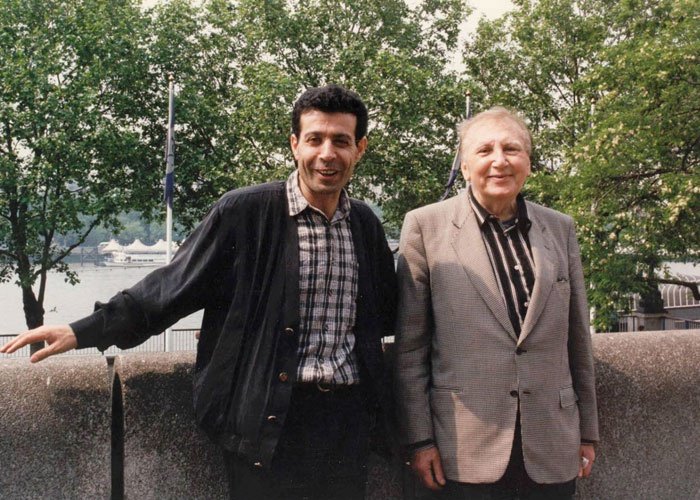
The day was unusually sunny and warm for springtime here, and fortunately there was no trace of the gray climate that characterizes the city. We sat in a café near a theater where actors were rehearsing in full view of the customers. Joining us was an Armenian friend with a remarkable sense of humor named Hmbar Narkizian. Hmbar had once been the celebrated photographer of An-Nahar newspaper before fate afflicted him with the city of sorrows, London, where he became one of its struggling residents.
Nizar Qabbani was exceptionally cheerful that day. None of us imagined that this gathering would be our last, or that the words Nizar spoke during that meeting would become his final testimony.
I will not describe those words; I will leave them to the readers. Yet in that conversation, Nizar Qabbani expressed much of what he wished to leave behind as a final statement on poetry, freedom, exile, and homeland.
This interview was first published in Al-Mashhad Al-Siyasi magazine in late May 1997, and later in the only issue of Al-Qasida magazine published in the summer of 1999. Reprinting it here is, in essence, a revival of the final words of one of the greatest Arab poets of the twentieth century.
—
◄ Ten years ago, you told me that poets were pioneers and the most worthy of leading revolutions. How has your vision of the poet changed in light of the developments and events that have taken place since then?
Nizar Qabbani:
Ten years ago, my childish dreams were larger than myself. I imagined poetry as an invincible power capable of breathing upon things and transforming them into mountains of pearls and rubies.
But after ten years of disappointments, setbacks, and defeats, the dream shattered into a million pieces. The poet no longer sits at the right hand of the caliph as he did during the Umayyad and Abbasid eras; now he sits beneath the caliph’s shoe.
In the glorious past, the poet was simultaneously Minister of Culture, Minister of Education, Minister of Defense, and Minister of Information — the voice of the tribe expressed through poetry.
Today’s poet is unemployed, wandering from one café to another, from one tavern to another, from one exile to another, from one asylum to another.
The greatness of poetry is tied to the greatness of the state. When the banners of the state rise, so do the banners of poetry. Therefore, I do not dream of having great poetry as long as our Arab condition remains tar and misery.
And if the leaders of revolutionary organizations themselves have turned 180 degrees on their heels, what can the Arab poet possibly do when all he possesses is an old Ottoman rifle and twenty-eight bullets — the letters of the alphabet? And the alphabet is insufficient even to kill a chicken.
Sadly, I must say that half of Arab poets have become mercenaries or Janissaries, fighting on the side of authority against their own people while collecting salaries from the sultan’s treasury.
That is why I apologize for my old dreams of “militarizing” poetry. The ruling authorities in the Arab world have stripped poets of their medals, torn the stars from their shoulders, and cut out their tongues.
—
My Finest Poems
◄ Can your writing be divided into major phases marked by specific works such as Childhood of a Breast, The Brunette Told Me, Margins on the Notebook of Defeat, or Abu Jahl Buys Fleet Street?
Nizar Qabbani:
The “suicidal stations” in my poetry are, in my view, the following poems:
1. Bread, Hashish and Moon
2. Margins on the Notebook of Defeat
3. Elegy for جمال عبد الناصر Gamal Abdel Nasser
4. When Will They Announce the Death of the Arabs?
5. The Runners
6. My Friend, I Am Weary of My Arabism
7. Finally, the poem I Am with Terrorism
As for My Finest Poems, it is nothing more than a tourist guide listing hotels, restaurants, theaters, and cafés.
People themselves were the reason behind publishing this collection. During poetry events they would tell me: “Professor, we are confused among your fifty poetry collections. Choose for us. Please compile a book according to your own taste, since our budget allows us to buy only one collection.”
And so I gathered the most popular and widely loved poems from my work into a single book titled My Finest Poems.
But today, my poetic city has changed enormously. It now contains highways, hotels, gardens, airports, jumbo jets, Concordes, and satellite channels. Therefore, a new “useful guide to the poetry of Nizar Qabbani” must inevitably be published.
—
The Critic and the Poem
◄ Why is the relationship between Arab poets and critics so tense?
Nizar Qabbani:
The relationship is not merely tense — it is chaotic and hostile, like a clash between blades or swarms of wasps.
In my opinion, the reason lies in the closeness of the professions themselves and in the innate jealousy critics feel toward poetry, as though the poem were their rival wife.
Poetry is fundamentally a civilizational act; therefore, it must be approached with civilization by the critic. I am one of the poets whose blood has been violated hundreds of times. Yet every time, I wiped away my blood, placed a bandage on my wound, sat at my desk, and wrote a new poem.
Let me confess something: critics never benefited me in any way. They offered me no linguistic, rhythmic, rhetorical, or aesthetic service. So I turned my back on them, carved my own path with my fingernails, and decided to learn from the masses how poetry should be written.
—
◄ What is your conception of the critic’s role?
Nizar Qabbani:
I agree with you that the narcissism of our critics is the wall separating them from the texts they critique. I have read dozens of articles by Arab critics from Egypt and the Maghreb attempting to illuminate modernity in poetry, yet I could not understand the hieroglyphic language in which they wrote.
In reality, they were trying to illuminate themselves, not the poem, while completely obscuring the text under discussion.
There are no true discoveries in criticism today, nor discoverers. Instead, there is a visible distortion of the achievements of modern poetry.
A critic must possess at least a minimum degree of affection and sympathy for the text he reads. No critic can approach poetry armed with weapons of mass destruction and the instincts of African beasts.
Until the arrival of a civilized critic who approaches texts with the manners of a gentleman rather than a highway robber, mountains of salt will remain between poets and critics.
—
A Trivial Price
◄ Is silence the ideal answer in this dark Arab moment, or is speaking the truth a noble necessity regardless of the consequences?
Nizar Qabbani:
Creators scream, each in his own way: the poet through poetry, the painter through colors, the sculptor through stone, the musician through strings.
I cannot imagine a creator struck mute. Nature itself never stops speaking: the wind speaks, thunder speaks, waves speak, earthquakes speak, hurricanes scream nervously, and the animal world never ceases its cooing, neighing, barking, meowing, or roaring.
How then can we ask the Arab writer to swallow his tongue and become a wall — or a mountain of ice?
The price paid by the writer is a trivial one. Creators were born to plant bombs beneath this aging Ottoman train carrying us from the first age of ignorance to the second.
As for writers who hide beneath blankets waiting for the snowstorm to pass, they will remain isolated from the concerns of their societies like polar bears.
—
No Poet Threatens Me
◄ There is an obsession among younger generations in Arab culture with “killing the father.” What is your view on this?
Nizar Qabbani:
Frankly, all these interpretations are police-like, even if Freud himself proposed them.
Why do you imagine that generations must kill one another in order for younger or future generations to live?
No one can kill المتنبي Al-Mutanabbi, أبو تمام Abu Tammam, أبو نواس Abu Nuwas, or أبو فراس الحمداني Abu Firas al-Hamdani. The swords of the modernists are far too short to reach Al-Mutanabbi’s neck.
Let me use myself as an example. I have stood on the platform of poetry for fifty years, yet I do not feel threatened by any modernist poet capable of undermining my poetic authority.
After half a century of writing poetry, I feel my republic still flies its banners high, and my audience spans three generations — from the 1940s to the 1990s.
Why has no seventeen-year-old boy or fifteen-year-old girl managed to kill me yet? Because they were poetically raised by my hand, whereas the poets of modernity have not even managed to raise a chicken, a sparrow, or a rabbit.
—
The Face of Mahmoud Darwish
◄ Who are your poetic fathers, and which modern Arab poets are closest to you?
Nizar Qabbani:
All the poets of the world — Arabs, French, English, and Spanish alike — are my fathers. I read them all… and forgot them all. For to write magnificent poetry, one must erase one’s memory.
Since 1944, the year The Brunette Told Me was published, I decided to have my own language, fingerprints, and style, just like fashion designers such as Valentino Garavani, Pierre Cardin, and Yves Saint Laurent.
I wanted to become a poet with a registered trademark. I do not like ready-made clothes, nor ready-made poems.
Among all modern Arab poets, I see only the face of Mahmoud Darwish.
—
Beirut and Damascus
◄ What did Beirut add to you beyond what Damascus had already given you?
Nizar Qabbani:
Beirut is irreplaceable to me. If I could clone the Beirut of the 1950s, I would never hesitate regardless of the cost.
Beirut gave me a dose of freedom that intoxicated me — and I remain intoxicated while sitting in my London home.
It gave me everything a bird needs to fly, everything a ship needs to sail, everything a fish needs to swim, everything fingers need to become a piano.
As for Damascus, it taught me the first alphabet of beauty. Our beautiful Damascene house in the district of “Midhanat al-Shahm” played a tremendous role in shaping my taste and educating my eyes.
—
The World Is a Beast
◄ How does the poet describe this age of globalization?
Nizar Qabbani:
Everything happening in today’s world is a conspiracy against poetry.
Science has become so arrogant that it now behaves like a god — manipulating genes, genetic engineering, and the laws of nature to the point where reproduction no longer requires a man and a woman.
This means love poetry will become useless, romantic appointments meaningless, poetry collections pointless, and moonlit evenings a waste of time.
Science will kill everything — and then kill itself.
The computer is a beast. Satellite channels are beasts. Modern music is a beast. Modern fashion is a beast. Fast food is a beast. Modern painting is a beast.
Soon there will not remain a single chair for poetry in the café of globalization.
—
My Childhood Is an Antibiotic
◄ What still survives within you from the youthful self that grew up in Damascus?
Nizar Qabbani:
Everything within me belongs there — to childhood, innocence, the jasmine arbor, my mother’s prayer rug, my father’s coffee in Damascene mornings, the swallows, and the blue fountain.
This is the provision I have carried on my shoulders for fifty years, protecting me from hunger, thirst, and cultural nakedness.
My childhood is the antibiotic with which I protect myself from the new American dinosaurs seeking to devour the world.
—
Poetry and People
◄ How do you shape your poetic decisions between love poetry and political engagement?
Nizar Qabbani:
I do not decide, plan, or program my poetic decisions. Every day a sword pierces my side, and I scream in pain. Every day the humiliation of the Arab nation deepens, and I resort to weeping.
The era of Childhood of a Breast, The Brunette Told Me, and I Bear Witness That There Is No Woman but You has passed.
I cannot dance upon the corpse of a nation approaching extinction. I cannot be a plastic poet running on batteries.
Today I discover that “art for art’s sake,” in a time of cholera, is high treason. Poetry that does not engage with the concerns, tears, and existential struggles of people belongs in the garbage bin.
—
Beauty and Death
◄ Why does the politician envy the poet?
Nizar Qabbani:
Beauty has always been a motive for murder. The poet’s beauty and popular charisma make him, like the Prophet Joseph, a target of jealousy even among his own brothers.
And since the politician is inherently ugly, he must kill everything beautiful around him in order to preserve his throne.
—
No Negotiation with Death
◄ You seem to support peace but reject the “peace process.” Why?
Nizar Qabbani:
If signing my own death certificate means that I belong to the old age, then I am very old indeed.
I oppose any pragmatism that assassinates me, confiscates my history, language, and culture, and erases me from the map of the world.
My position is not moral, personal, selective, utopian, or poetic. It is existential. Quite simply: to be or not to be.
Our issue with Israel is not about philosophy, theory, psychology, songs, or poetry. It concerns our life or death. And there are no negotiations with death.
—
No How and No When
◄ How do you build a poem?
Nizar Qabbani:
In poetry, there is no “how,” “when,” or “why.” It is impossible to capture a poem while it is weaving its silk shirt.
If poetry were a craft, then the artisans of Khan El-Khalili would be princes of poetry. And if it were revelation, then magicians, fortune-tellers, and dancing mystics would be the greatest poets.
Poetry is an internal earthquake striking us when we least expect it.
And when we emerge from beneath the rubble, we find the poem beside us in the ambulance.
The poet is always the last to know the gender of the newborn: is it a boy, a girl, a rose, or a dove?
The poem is that beautiful child that arrives after five thousand years of pregnancy.
In cooperation and in agreement with Al-Jadeed Magazine.