

Mundhir Al-Masri, Guest on the Program “A Testimony for History” – Syria TV
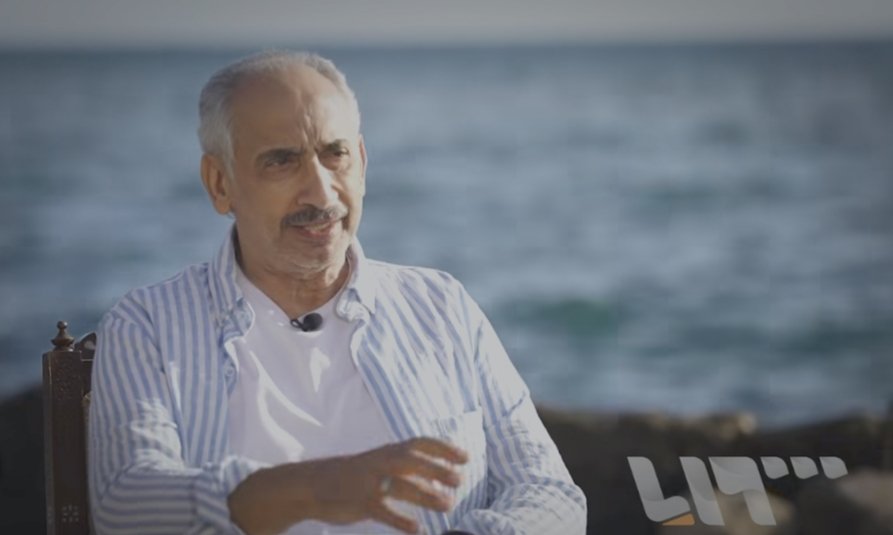
From the shores of the Mediterranean, where he said the sunset is part of the details of his daily life, Syrian poet and painter Mundhir Al-Masri appeared as a guest on the program “A Testimony for History,” presented by journalist and novelist Ibrahim Al-Jubein on Syria TV. He reflected on his poetic, intellectual, and political journey, offering a comprehensive reading of the Syrian poetry experience and its transformations, his relationship with the 1970s generation, and extending to the Syrian revolution, his stances on it, and his vision for the country’s future.
Modernizing the Syrian Poem in the 1970s
Al-Masri noted that the 1970s witnessed radical transformations in the structure of Syrian poetry, with a significant number of poets moving from the taf‘ila (metrical) poem to free verse.
He explained that the Syrian taf‘ila poem had a distinct character and stood out from its counterparts in Iraq and Palestine. He added that it was closer to direct life experience and carried “fresh blood” within the structure of poetry.
He also pointed out that free verse later began to assert its presence strongly, to the point that several taf‘ila poets themselves transitioned to writing it.
“Al-Maghut is Lethal… and His Influence is Toxic”
Al-Masri extensively discussed the experience of poet Muhammad Al-Maghut, considering him one of the foremost founders of free verse poetry in the Arab world. He said: “No one passes through the field called Al-Maghut without feeling its deep imprint.”
He clarified that Al-Maghut’s influence was not merely linguistic but a full, intense poetic presence, adding: “Al-Maghut is lethal, like every great poet, and his impact on those who came after him was profound and toxic.”
Al-Masri also noted that he personally tried early on to free himself from this influence in search of a “simple poem” that would not replicate Al-Maghut’s style or language.
“The Journey of Longing”… Syrian Poets Sharing Poetry
Among the Most Bold and Influential Poets of His Generation
Al-Masri stated that poet Ibrahim Al-Jaradi was one of the boldest poets of his generation in embracing formal modernity in poetry, pushing experimentation to its limits.
However, he clarified that his personal focus leaned more towards simplicity and clarity in poetic texts rather than formal experimentation.
Al-Masri mentioned that Jubran Ibrahim Jabra was among the names that influenced his poetic journey, particularly his poem “Letter to Tawfiq Sayigh,” which he considered a significant work in his career.
According to Al-Masri, the deepest influence, however, came from poet Tawfiq Sayigh, whose work he described as “a different poetic shock.”
He also cited his influence by Ansi Al-Haj, Shawqi Abi Shakra, Nazih Abu Afesh, and Riyad Al-Saleh Al-Hussein.
Riyad Al-Saleh Al-Hussein… Absolute Freedom in Poetry
Al-Masri elaborated on Riyad Al-Saleh Al-Hussein, considering him one of the most prominent modern Syrian poets, emphasizing that he embodied the concept of “absolute freedom” in poetic writing.
He pointed out that Riyad’s disability was not central to his human or poetic experience; rather, he treated poetry as a space of complete freedom.
Beginnings and Relationship with Poetry
Al-Masri said that he was not interested in poetry during his school years and never memorized classical verse, describing his early engagement with poetry as entering it “as an enemy.”
He noted that his first poems were published in the magazine Al-Mawqif Al-Adabi during his military service, after Zakaria Tamer modified the title of one of his poems.
Frontline Experience and Painting
Al-Masri mentioned that he served as a signal officer during the October War, spending years on the frontlines between reading and painting.
He described this period as “magical” for him, contributing significantly to shaping his poetic and artistic experience.
From the Library to Politics and the 1987 Arrest
Al-Masri stated that opening the Fikr wa Fan library in Latakia in 1984 marked a turning point, as the library became a meeting point for intellectuals and dissenters.
He added that his political involvement arose through this cultural space, which evolved into an open forum for discussion.
Al-Masri also recounted being arrested during a security campaign in 1987, only to be released after four days through the mediation of an officer connected to his family.
He noted that others arrested with him spent many years in prison.
Al-Masri emphasized that he chose to remain in Syria despite many friends leaving, saying: “I started feeling wounded in this city… I want to stay here.”
He clarified that his connection with Latakia and the sea became part of his personal identity.
Al-Masri described poet Mahmoud Darwish as “the most magnificent image of the Arab poet,” noting that while he does not belong directly to Darwish’s poetic school, he deeply respects his poetic and human experience.
The Syrian Revolution and the Article “If Only It Hadn’t Happened”
Al-Masri explained that his article “If Only It Hadn’t Happened” was written during a period of deep psychological and human collapse imposed by years of war and destruction. Writing the article felt like a near-suicidal act, as he felt he was putting all his moral and intellectual capital at stake.
He confirmed that the article was in no way a call to return to the Assad era or a defense of the regime’s survival. Rather, it was a candid expression of despair and shock at the scale of the tragedy Syria had endured over the past years. He emphasized that the idea of the regime’s survival “was never even on the table” for him.
Listing as a Terrorist
Al-Masri revealed that in 2021 he was listed on the “terrorism list” on charges he considered baseless, explaining that the file against him included accusations such as “inciting riots” and “financing terrorism,” none of which were supported by real evidence.
He said the moment was extremely harsh, leaving him with only two options: either flee and leave everything behind or surrender to the regime. Ultimately, he chose to surrender to the “Terrorism Court” in Damascus.
The Fall of Assad and Syria’s Future
Al-Masri considered the fall of the Assad regime a “major event” in Syrian history. At the same time, he does not believe the country will quickly transform into “the dream Syria,” as he put it.
He clarified that his current aspirations are not about grand slogans but about building a country “fit for living,” emphasizing that his main demands are freedom, dignity, and justice for all Syrians, without exception.
Regarding Syria’s future, Al-Masri said he still holds a degree of optimism, though this optimism relates less to his personal future than to the future of the Syrian people themselves.
He said: “I am optimistic… but not for myself,” adding about his mental state: “I am bound by hope.”
He confirmed that all he wishes for is for Syrians to live in a normal, safe country after decades of fear and oppression.
The interview concluded with Al-Masri reading a verse by poet Muhammad Sayyida:
“Oh my God, if she is the sea, let me be the shore that holds her in its arms,
Even in her small, withered hand, a blue lake swims with colorful fish.”