




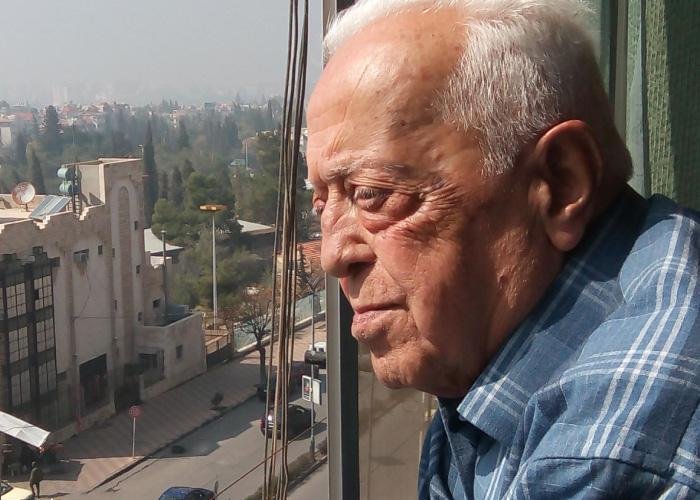
Al-Jadeed: Your recent poems, which will appear in a collection titled “Republic of Fear,” revolve around the homeland and what is happening in it. Do you consider writing outside this framework a form of betrayal, as many believe, or has the poet’s gaze become unable to see anything else?
Shawqi Baghadadi: Let us move away from the word “betrayal” in this question. Whatever the poet writes, he is free to choose his subject. He is only required to ensure that his poem is truly beautiful. But what is a poet supposed to do when he finds his country burning entirely—like what is happening now to a homeland once called “Syria,” which has begun to fragment into “cantons”? In such a case, if he is truly a poet and not merely a word arranger, he must either cry out, groan in pain, or fall silent if pressure is tightened upon him.
This is what I have found myself immersed in. Nothing governs our lives today except fear—fear of any fate threatening the country. And as it seems, there is no fate except dictatorship or civil war. So what subject could I possibly feel driven to express, whether in poetry or prose?
Take, for example, our love for nature or for a beautiful woman. There was once a massive mulberry tree that shaded part of a friend’s garden in the Qassaa district, near Jobar. That magnificent tree, from whose branches we used to eat the sweetest mulberries, I once found—during a rare visit to the area—had been struck at its trunk by bombs. Its green leaves and honey-brown fruit had vanished. Should I write about the tree, or about the house that was half destroyed? And that girl who once enchanted me with her beauty and writing—should I flirt with her in verse, or mourn her brother who died in detention?
This is our problem now as poets: we must die as our countries die. Otherwise, who are we in this “Republic of Fear”?
—
The Departure of Poets
Al-Jadeed: Your fellow poets are departing one after another. Do you bid them farewell as friends, or are you bidding farewell to an era of poetry that will not return?
Shawqi Baghadadi: Not all of them were friends, of course. And have real friends even remained in this brutal age?
The truth is that the age of poetry has passed, and nothing will remain of it except school memories.
This realization struck me years ago, when Arab poetry became a playground for rhetorical tricks, linguistic games, and journalistic chatter. This happened especially when, in a conversation over a quarter century ago with a French publisher, he told me about the state of poetry in his country:
French publishing houses no longer publish poetry. And if they do, they only publish Hugo, Lamartine, Musset, and their likes in thousands of copies each year. As for new poetry, it is rarely risked, and at most three new collections are published per year by emerging poets who must first prove themselves in prestigious journals, in limited print runs of no more than two or three thousand copies—and even those are not fully sold without great effort.
Al-Jadeed: When did this happen? And why?
Shawqi Baghadadi: The story is painful, long, and complex. I will summarize it by saying that there was once a time for poetry—when human beings were possessed by it everywhere, in every time and place, whether they looked at the sky or the earth, the stars or fresh grass, or passing strangers. It was a time when no art was more important than poetry and music in opening the closed windows of the soul and beauty.
I do not want to be too pessimistic. I speak as a human first, and a poet second. And in agreement with those poet friends who have passed away, modern civilization—with its inventions of communication and entertainment—has created an environment for new arts more attractive than linguistic creation. Poetry may still find small spiritual openings, where people preserve it, just as humanity now struggles to save the planet from desertification and rising temperatures, and to invent a just civilization that does not conflict with poetry or the poetic environment.
Should I write about the tree, or about the house half destroyed? And that girl I once admired—should I praise her beauty, or mourn her brother who died in detention?
—
The Poet’s Keffiyeh
Al-Jadeed: You once told me you kept a keffiyeh given to you by Samih al-Qasim. What does it mean to you? And do you have memories with departed friends such as Al-Sayyab, Al-Qasim, and Suleiman Al-Eissa?
Shawqi Baghadadi: I did indeed keep that keffiyeh for a long time, until Samih al-Qasim—may he rest in peace—visited Damascus and surprised us with a poem of praise that surpassed even Al-Mutanabbi’s praise of Kafur. So I gave up the keffiyeh. My memory of Al-Qasim remains, despite my personal affection for him as a poet and a man of clean national history, though that memory was somewhat marred in a way unworthy of his reputation.
As for Al-Sayyab, I never had the chance to know him personally, so my admiration for him and his poetry remained free of complications. As for Suleiman Al-Eissa, we were always close colleagues. However, his wife, Dr. Malak Abyad—may God prolong her life—refused my participation in his memorial service after I was informed through Dr. Mahmoud Al-Sayyid that the committee had approved my participation. A misunderstanding seems to have occurred between the organizing committee and Dr. Al-Sayyid. Thus, the loyal wife of the deceased somewhat disrupted what had been a pure relationship with the late poet, who had been a poet of Arab nationalism and Arab children throughout his life.
I still remember what I wrote in his elegy:
I had saddled my horse for departure / long ago—what then remains of me?
Eighty years I have crossed, and Zuhair / remains behind me—who sees him sees me
Is it because violence has become habit / in the madness of news and deprivation?
Or because hatred has risen upon a throne / of ashes, flames, and smoke?
Or because vision is not what we see / and time itself is no longer my time?
A drop of love still repels the heat / with a touch of tenderness
Yet sands overwhelm the oases / until no well remains in the garden
Is this the barrenness of sand, or man / a beast in the face of humanity?
So blessed is he who passed, O Abu Ma‘n / you were the forerunner in sorrow
You were an eagle when you struck the tyrant / shaking the order of oppression
You became a child when the elders hid / behind false noise and celebration
—
Behind Damascus
Al-Jadeed: Among your collections, “Searching for Damascus” was the most painful. Did you expect what would happen here, as a leftist who once visited Damascus prisons? And are you still searching for Damascus today?
Shawqi Baghadadi: I never expected what has happened—and is happening—to Damascus, even though I have always been a leftist who visited its most luxurious prisons, and there were many of them!
As for my search for Damascus, I think I must stop it, because nothing remains of Damascus except the Umayyad Mosque and the presidential palace perched on a hill overlooking the city for fifty years—and seemingly forever.
What a terrifying and astonishing difference between the feelings of someone watching brutal bombardment on a small screen and someone whose heart and ears are pierced by explosions, footsteps, and the fear that overwhelms the citizen.
—
That Journey
Al-Jadeed: In the 1960s, you travelled across Europe by car. What did that journey give you artistically and humanly? Do you consider your life longer than that journey?
Shawqi Baghadadi: My life is certainly longer than that journey—not only in time, but in richness of form and meaning. It would require volumes of anecdotes and experiences that I may one day admit in memoirs I still hesitate to write.
But let us speak only of that journey—what a journey it was! It gave me so much artistically and humanly. For example, it gave me one of the deepest poems I ever wrote, titled “Escape from the Curse”:
(All hidden cellars / and all secret rooms
All rocky depths / and forgotten holes
All abandoned huts / in the far wilderness
All these small things, full of life
fluttered with the bird of the heart like fairy tales
and the gates opened
and secrets of doors were revealed
and the love of the ancients
turned into physical desire
and they absorbed with hands and mouths
all spiritual pleasures…)
Should I continue? Very well:
(What is on the great table—I am full
What lies beyond other cities—I am entangled
Yet I now feel hunger again
As if I ate only to hunger
I search like a madman
thinking poetry crossed dimensions with me
but I now see things differently
worse or better—I do not know
the world is not like poetry
we draw rivers and mountains
yet the view is never the same
Why try to understand more
if the scene never repeats itself?
Tomorrow I shall pass the dark side of the moon
as if I am exiled in the universe…)
This is the poem. No—it will not end. Even today I see it as a model of poetry: drawn from lived reality and elevated into a universal dimension.
—
A Few Remaining Lines of the Interview
Al-Jadeed: You did not leave Damascus like many others, nor did it leave you. What has staying here given you—as a human and as a poet?
Shawqi Baghadadi: It has given me much. As a human being, I have faced an unprecedented ordeal of destruction and terror, living day and night under fear and pain. As a poet, it made me more capable of capturing the appropriate poetic expression for harsh experience.
—
The Poet’s Heart
Al-Jadeed: Between your first collection “More Than One Heart” and your last “Republic of Fear,” where is Shawqi Baghadadi’s heart?
Shawqi Baghadadi: A beautiful and dangerous question! Once, my heart was on the earth with people. Now it is with the universe, with the Creator of the universe, asking: what have you done with my heart? Why does it still beat even though I have passed eighty? O my God, take your trust back, or relieve me—or save the heart of my homeland before we lose it forever.
—
Moral Decline
Al-Jadeed: You wrote for children in several collections. Why did you stop in this cultural decline?
Shawqi Baghadadi: It is true—this is cultural decline, even moral and human decline. It is a decline from the child himself, as if any attempt to address children has become impossible after all attempts to address adults have failed.
What child would read poetry while running behind his parents through the anxious roads of Europe, frightened by the flood of refugees?
—
It Is Absurd
Al-Jadeed: Where do you find poetry now, after so many voices have crowded it?
Shawqi Baghadadi: Where do I find poetry? What a question! I have no answer, except something similar to what the poet Ibrahim Tuqan once said humorously.
Modern civilization, with its communication tools, has created a climate for new arts more attractive than linguistic creation.
As for me, I try to be more polite, though I secretly agree with Tuqan’s irony:
“Poetry comes to me most when I am in the toilet, in the realm of permitted and forbidden, under the rhythm of peace missiles!”
—
The Story of Al-Mutanabbi
Al-Jadeed: Does Al-Mutanabbi still sit on the throne of your memory?
Shawqi Baghadadi: Yes, his place has not changed. He is the only poet who convinced me that a true poet cannot sincerely praise an unworthy ruler.
—
I Am Not Satisfied
Al-Jadeed: Are you satisfied with your poetic experience? Any regrets?
Shawqi Baghadadi: I am not satisfied at all—not with my poetry, nor with my life as a whole as a schoolteacher. I wish I had been a businessman in satellites, so I could have taken one and lived on it forever, away from all ideologies and sectarian philosophies.
—
What Tamerlane Did Not Do
Al-Jadeed: After everything that has happened, what are your hopes?
Shawqi Baghadadi: Oh… what hopes can remain after all this devastation—after calamities even Tamerlane himself, who stayed in Damascus only forty days, did not commit?
Now nothing remains of the two Ghoutas except two trees, a few paralyzed farmers, five elderly women, and nine children. Do not laugh at these numbers—they may even be more. But the destruction continues, even after ceasefire.
In cooperation and in agreement with Al-Jadeed Magazine.